
Research concept
People experience a variety of complex emotions when looking at liminal spaces.
That’s the reason I’m assuming it could be a complete video game experience.
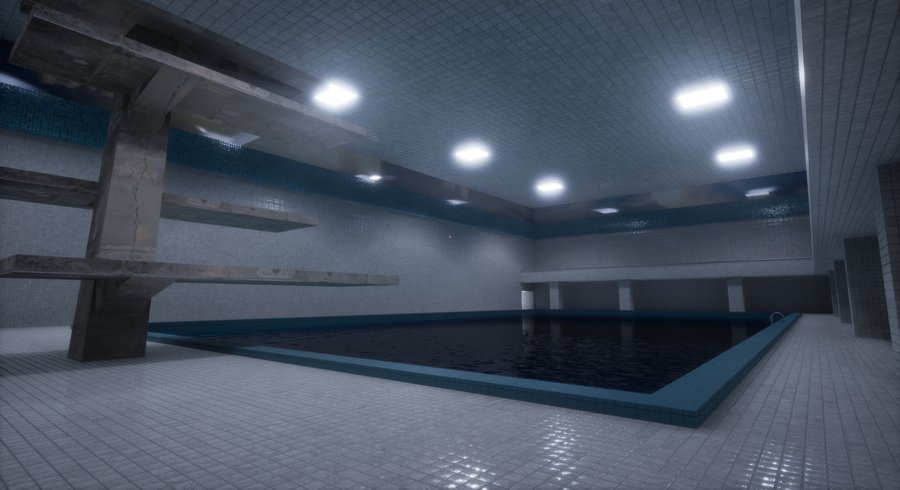
One of the poolrooms from «DREAM LOGIC» (2022)
Before we begin, we need to figure out the definition of liminal space we’ll be using. There are a lot of them. The majority are technical, focusing on how liminal spaces are transitive between either two locations or states of mind.
For the purpose of this research, we will be using the next definition, as it focuses on the feeling rather than the technical qualities:
«A liminal space picture is a picture that features human—made or manipulated structures or objects, that does not contain any people and that emits a strong feeling of familiarity but at the same time a feeling of uncanniness and discomfort.»
— Scrabbl
Please note that this definition was given to a liminal picture and not a video game atmosphere. That being said, we can still apply it to the latter.
How the liminal space atmosphere translates from a picture to a video game is another way to look at this research.
There are various emotions that are associated with liminal spaces. Some of the most prevalent are:
Otherworldliness Unease Disorientation Uncertainty Nostalgia Loneliness Curiosity Tranquility The Sublime
Just by reading this list, we can see that portraying the liminal space atmosphere in its totality, let alone converting it into a video game, is not an easy task. To begin, why is tranquility on the same list as unease?
As we will see later, liminal spaces are quite a polarizing experience. When some gaze at these sights with anxiety, others feel comforted.
gm_construct from «Garry’s Mod» (2006)
«While my memories of these places aren’t scary, the disconnect I feel between the large, bustling spaces I remember and the vast empty landscapes I see in liminal space photos — deeply unsettling.» — GameSpot.
«…for me and for some other people, they mainly give off a sense of comfort. A sense of comfort so prevalent, I consider looking at these bizarre, abnormal pictures, as a relaxing and calming experience. A sense of comfort, which is the strongest when you are mentally at your lowest. At those moments where you just want to vanish from this reality and dive into another one.» — Scrabbl
«Have you ever wondered why the liminal spaces feel so empty? It’s because you are supposed to feel the void, to escape reality, even if it’s just for a brief moment and explore a world where you and your feelings are completely free.» — Scrabbl
Liminal hotel from «DREAM LOGIC» (2022)
This is going to be an issue on its own when creating a coherent video game experience. When a designer creates a game, the goal is to achieve a specific result. When two different people, playing your game, feel two diametrically opposed emotions, problems will arise.
The other thing we have to talk about on this list is loneliness. The overwhelming majority of video games contain multiple different characters, or at the very least an antagonist to the story. Adding characters to our hypothetical video game will decimate the liminal feeling we are talking about.
«If you would add people or monsters to a liminal space picture, it would totally change its atmosphere and the associate feelings. It would cease to be a liminal space» — Srabbl
It is important to note that we are at the very extreme point where we aren’t just talking about the standard sentient being apposing the main character, but any force opposing the player.
Oldest house from «Control» (2019)
Now we will talk about the criteria for selecting games for this research.
Not everything that has the word «liminal» in its name is a match. Some of the games that are often described as such, are just abstract or surreal. The meaning of liminal has been stretched in some internet communities. One of the examples is «Control», the game filled to the brim with shattered Oldest House hallways and abstract geometry. It might have a certain liminal note to it, but it is still pretty far from a standard liminal space atmosphere.
We are also not going to mention games that are void of any gameplay mechanic aside from walking.
We are looking for a full gaming experience, not just a gallery of liminal spaces.
There will be some compromises, though. If a game is a good example for our research but contains sections or parts that are deviating (an antagonist, for example), we will allow it. The purpose of looking at the case studies below is to find the answer to the question:
Can a liminal space be a complete atmosphere for a video game?
Thus, we are looking at a more granular building block of a video game—its main game loop. In this case, we can always pretend that certain parts of the game are just not there.
«The backrooms» (2019)
For the reader more closely acquainted with liminal spaces, I feel the urge to explain myself for excluding some of the most popular and well—received games, such as «Backrooms expedition», «Inside the backrooms», «The Backrooms 1998» and original «The Backrooms».
The backrooms game subgenre was built on an extended lore and has gameplay that ventures far away from our original definition. Even though the theme of the game is «the backrooms» or «liminal spaces», the game aesthetic is not completely consistent with the liminal space.
Now that we have given a definition to a liminal space, considered the possible problems, and defined the criteria, it’s time to dive deep into some of the example cases, decomposition the experiences players are having playing these games, and answer a question:
How liminal spaces as a package already work in some of these games?
1.Anemoiapolis
City poster from «Anemoiapolis: Chapter 1» (2020)
«And don’t worry about pronouncing Anemoiapolis, the main character can’t do it either.»
— GameSpot
We touched on otherworldliness when describing liminal space emotions. Now, we can see its reflection at the very start of the game. A protagonist falls through the ground to a completely different place — a common trope in literature and film to show how alien the main character is to the place he discovered himself in.
Ceiling hole from «Anemoiapolis: Chapter 1» (2020)
The other detail that we will see more than once in this research is abstract geometry embedded in familiar places. The pool at the very start of the game looks somewhat ordinary…
First poolroom from «Anemoiapolis: Chapter 1» (2020)
… except for the rectangle extrusion in the room wall that looks, to say the least, out of place.
Hollow in the wall surface from «Anemoiapolis: Chapter 1» (2020)
One of the other examples of surreal abstract geometry is in one of the first sections of the game, «Entering Anemoiapolis».
The pools with water guns are placed in a weird way. Such structure is nonsensical; it interferes with our memories of such places and our sense of nostalgia, creating a weird and eerie amalgamation of feelings.
Pastel poolroom from «Anemoiapolis: Chapter 1» (2020)
In the same section, there was something that must have been intended to be beach balls. Coincidentally enough, their texture reminds me of a material icon from «Blender». Intended or not, this adds to the unfinished look that some of the liminal spaces have. Later on, we’ll see more of that.
Beach balls from «Anemoiapolis: Chapter 1» (2020) and material icon from Blender (1994)
I have discovered another interesting property of liminal spaces in the context of video games.
Conventionally, pictures depicting nature landscapes without any human intervention are not considered liminal. However, we can notice liminal qualities in the picture below. Earlier, we talked about how liminal spaces transformed childhood memories in uncanny ways. Due to video game graphic limitations, they can alter our perception of places differently, achieving this liminal feel without changing the contents of the picture.
Like so, video games have the capability to make nonliminal spaces liminal.