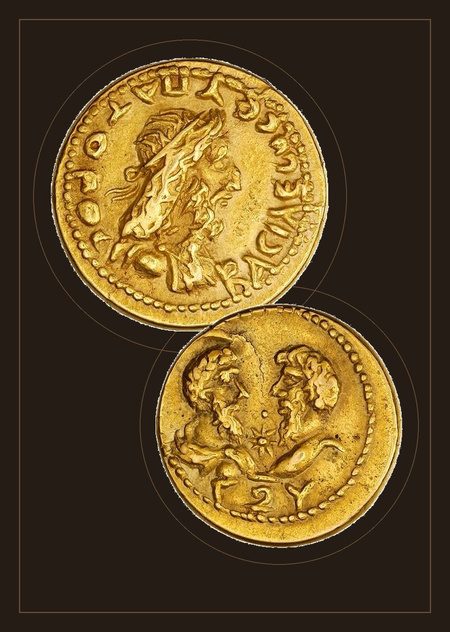
12 Coins of the Ocean, or How the Power of Bosporus Waned
Rationale for Topic Selection
What struck me about the Bosporan coins was that one side featured the local king, while the other displayed a Roman emperor. Yet, the coin itself was issued in the name of the Bosporan king. I became curious about why these two portraits shared one artifact and why this composition persisted even as rulers and coin metals changed. This coin is interesting not just as a medium of exchange, but as an image of power that people could encounter in their daily lives.
Research Subject
Coinage of the Bosporan Kingdom and related ancient North Black Sea coinage. This study covers the period from the 2nd century BCE to the 4th century CE. The primary research regions include eastern Crimea and the Taman Peninsula. For comparison, the work incorporates coins from the Pontic Kingdom and the Roman Empire.
Area of Study
Representations of Power on Coins. I examine who is depicted on the obverse and reverse, how the portraits are styled, where names and titles are placed, and what symbols distinguish a tsar from an emperor. Additionally, I correlate information about the alloy composition with what changes or remains consistent in the coin’s design.
The key research question
How did the image of power change on Bosporan coins, and what elements of this image remained consistent despite changes in rulers and alloy composition?
Research Hypothesis
I hypothesize that after Bosporus became dependent on Rome, the imperial portrait became a stable feature of the Bosporan staters' design. Over time, the alloy composition might have changed more noticeably than the portrait composition itself. However, I do not believe that the mere gold content of a coin can determine how powerful a specific ruler was.
Research Objective
Show how coins represented the Bosporan king and his connection to Rome, and determine which elements of this imagery survived changes in rulers and materials.
Research Objectives
- Compare the portraits and titles on the staters of Mithridates VI and Farnaces II.
- Examine how Asclepius is depicted on the coin that does not feature his portrait.
- Compare the layout and decoration of royal and imperial portraits on Bosporan staters.
- Compare the Bosporan composition with the Roman denarius of Caracalla.
- Trace how the alloy composition changed and which design elements were retained.
- Test the hypothesis using examples that do not fit a direct correlation between metal and ruler power.
- Compare later staters with imitations and determine which image elements were repeated.
Material Selection Principle
The study includes twelve specimens, nine of which are Bosporan coins. A staters of Mithridates VI and a denarius of Caracalla were selected for comparison, while the last position groups a collection of imitations of Bosporan staters. I selected specimens for which images of both sides are available and which have a museum or scholarly description. This allows for the comparison of not only the portraits but also the inscriptions, dating, and material. I included an example in the sample that complicates the initial hypothesis. The staters of Euphrates in the selection are made of gold, while the staters of Sabromatus II are made of electrum. Furthermore, Sabromatus II strengthened the kingdom, and the general design principle of the coin was preserved. Such a comparison helps to distinguish a change in alloy from an assessment of the reign.
Rubrication Principle
The research is structured chronologically. In the first section, I examine the royal portraits and titles of Mithridates VI and Farnaces II. In the second section, I examine the Aspurg coin, on which the king is designated by a monogram. In the third, I compare Bosporan staters with the Roman denarius. In the fourth, I trace changes in the alloy and the stability of the portrait schema. In the fifth, I compare late staters with imitations.
Principles of Source Selection and Analysis
For coin attribution, I use museum catalogs and scholarly publications. I cross-reference them to verify dating, metal composition, inscriptions, and portrait identification. Historical works are necessary to correlate the coin’s design with the circumstances of the reign. If a portrait attribution is disputed, I note this separately.
Research Methodology
First, I examine both sides of each coin and note what is visible on the image itself. Then, I compare the specimens based on the arrangement of portraits, headwear, inscriptions, and composition. I obtain information about the alloy from a catalog rather than determining it by the photo’s color. When comparing details, I take into account the coin’s wear to avoid mistaking poor condition for a simplification of the image.
I. Claim to Grandeur
First, I will compare how Mithridates VI and Farnaces II represented their power on coinage.
Gold statter of Mithridates VI Eupator, 85 BCE. On the left is a portrait of the king, and on the right are a deer and the king’s name inscribed on a wreath of ivy. British Museum, RPK, p158A.1.Pont.
Coin turnaround large
Stater of Mithridates VI. The king’s name and the figure of the panthēr are set within a laurel wreath. British Museum, RPK, p158A.1.Pont.
On the front side of Farnack II, there is also the imperial portrait. On the reverse, Apollo is depicted, and the inscription explicitly denotes a claim to a high rank. Farnack calls himself the «great king of kings.»
Gold statter of Farnack II, 53–52 BCE. Both sides. Münzkabinett, Berlin, 18200229.