CONTENT
CONCEPTBACKGROUND1. THE MAJOR EUROPEAN MUSEUMS WITH AFRICAN COLLECTIONS. 2. THE GREAT KINGDOM OF BENIN. Art and culture 3. NORTH AFRICAN HERITAGE VIEW. The Egyptian Collections in Europe 4. COLLABORATION STRATEGIES OF EUROPEANS AND AFRICANS AND THE QUESTION OF REPATRIATION. 5. CONCLUSION 6. BIBLIOGRAPHY 7. IMAGE SOURCE
CONCEPT
In the aftermath of colonialism in Africa, there existed the scramble and partition of Africa following the Berlin Conference in 1885. The European powers, on agreement, took control over the countries on the continent and whatsoever that existed in general. Besides land grabbing, slavery and overexploited resources, the European powers dismantled the African cultural system by overthrowing and exiling traditional leaders like kings and chiefs and broke monarchies and families by enslaving and displacing many of them. However, besides all that, the remains of the African heritage, like artefacts, functional objects, fabrics, and decorative and monumental statues, are still retained in European museums and exhibited as national assets of the countries that stole them. According to the landmark 2018 report commissioned by the French government, 90% to 95% of the sub-Saharan African material heritage is housed outside the continent» [Sarr & Savoy, 2018]. Metropolitan Museums of Archaeology and Anthropology, the British Museum and the Royal Museum for Central Africa in Belgium and more others hold thousands of them in their collections. This research will explore the acquisition of the ancient artefacts from Africa by the Europeans without their consent but rather after, through violent ways, by furiously grabbing them. For example, the British expedition of Benin, though some were collected in rightful ways like commissions, gifts and donations like John Roscoe, where Apollo Kaggwa the Katikkiro (The prime minister) of Buganda donated to him some artefacts and barter trade, especially at the coast. It also looks at how the works of art were allocated to different collections in museums like the British Museum collections. The study as well focuses on the three African regions, the Northern and sub-Saharan African regions in East and West Africa, with a case study of three countries, with their kingdoms like the Benin Kingdom in Nigeria, the Buganda Kingdom in Uganda and Egyptian heritage. The study will have a clear description of the cultural attachments and heritage of the artefacts from these countries.
The main objective of this study is to explore how the European museums have preserved and exhibited the African artefacts and collections which are allocated depending on the countries of origin and the materials used, besides the ethnic background and heritages. The histories and heritage of the African past communities and cultures are understood by the contemporary African people through the research made by the curators and other researchers commissioned by the European museums. In this section the case study will be focused on two museums in Europe, that is to say, the British Museum and the Metropolitan Museum of Anthropology and Archaeology. Since they contain most of the East and West African collections, they are the great references of this research, and so most of the resources will be obtained from these museums.The research has a great focus on the question of repatriation, where we observe the future plans of the museums and whether they will fulfil the demands of the African countries to fully give back the stolen artefacts to the people of Africa on a permanent deal to restore the cultural identity and continuity, and besides, the major motive of reclaiming dignity and addressing the colonial unjust perspectives that are held by the Western Powers. Despite the current independence of these states, why should 90% to 95% of the estimated cultural heritage still reside outside the continent? Well-established and capable of housing them in their land of origin.The research also contains a concluding study of the strategies and collaborations of both Continental Europe and Africa to display the African heritage, in particular within the context of whether some should be returned and others should be retained in Europe. Focusing on the fact that if the artefacts are returning to Africa, are there any strategies to house and maintain them as they were done by the Europeans, and the strategies to work hand in hand to exhibit them within Europe and beyond? We paid attention to the Ife exhibition in 2010 at the British Museum, which helped in cultural exchange and strengthened the relationship between Britain and Nigeria, particularly the Ife people. In this very section we will slightly look at the decision and strategy by France to decolonize the museums. After passing the law, easing the process by Emmanuel Macron.
BACKGROUND
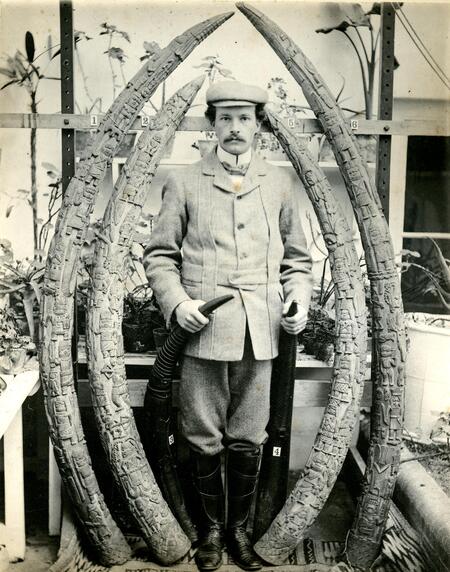
European acquisition of African artefactsThe British Expedition of BeninThe African art collected by the Europeans came as a result of colonialism, besides the trading that existed at the Coast of Africa, where there was barter trade between the Africans and Arab traders who gave out their goods in exchange for the artefacts. In the interior the explorers and missionaries commissioned the African industrialists to create for them some souvenirs, and curios were also collected along with them. However, after the signing of the 1885 Berlin Conference, the partition of Africa by the colonial powers gave them even more power and liberty to take whatever they wanted from the people of Africa. As part of the British Scramble for Africa, in 1897 Sir Harry Rawson led a troop of 1,200 men into Benin and captured Benin City, and the Oba (king of the Edo people of Benin) was forced into exile. The British troops stole the artefacts as loot; among these included the plaques, bursts, artefacts carved from ivory and other cast objects, including weapons and animal sculptures cast from brass, though they are commonly referred to as «Benin bronzes». These were seen in a famous photograph taken in 1897 when the British soldiers were captured, laying them down at the court of Benin City. Years later, the artefacts were found on display at the British Museum, where they are still exhibited to date.
British Soldiers in 1897 with looted Artefacts after the expedition in Benin
The role of the Christian missionaries and explorers in Uganda, towards the European acquisition of artefacts.

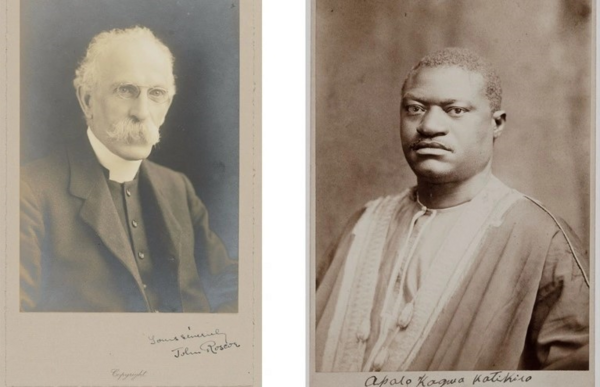
Reverend John Roscoe, Anglican missionary with the Church Mission Society in Uganda, 1894-1909. Sir Apolo Kaggwa, (Prime Minister) of the of the Kingdom of Buganda. Photograph by Elliott & Fry.
The Cambridge Museum of Archaeology and Anthropology holds a number of collections of artefacts and photographs of the past histories of many African countries. Many of these were collected by early missionaries and explorers who were tasked by Britain to go to Africa and lay a foundation for colonialism through exploration and theological impersonation; among these are Rev. John Roscoe, who was an Anglican missionary in East Africa. He had an upper hand in collecting works from Uganda, where he spent 25 years and learnt about their culture. Sir Harry Hamilton Johnstone, Frank Rogers, John Gilbert Rubie, Ernest Balfour Haddon and Arthur Brian Fisher were also among the Europeans known for collecting African relics during the pre-colonial and colonial periods in Africa. «Collections have reached the museum in many different ways. Some artefacts, in common with those in similar museums, were acquired in the aftermath of violence, as loot, or in other ways that would not be considered legitimate or appropriate today.» [mma.cam.ac.uk].Most of the artefacts from Uganda were attained by the Cambridge Museum of Archaeology and Anthropology through the Christian missionaries and explorers who came to the East African Coast in the late 18th and early 19th centuries. Rev. John Roscoe, an Anglican missionary, collected a series of artefacts from the kingdoms and native societies of Buganda, Ankole, Toro, Bunyoro, Acholi and the Bagesu, among others. However, the biggest number of artefacts were donated to him by Apolo Kaggwa, the Katikiro (Prime Minister) of the Kingdom of Buganda.«But several were donated to the Museum by Apolo Kaggwa (sometimes spelt Apollo Kagwa), the Katikiro (Prime Minister) of the Kingdom of Buganda. Other donors include British colonial officials Sir Harry Hamilton Johnston, Ernest Balfour Haddon, Frank Rogers, and John Gilbert Rubie, and Anglican missionary Arthur Bryan Fisher» [source: maa.cam.ac.uk]. And he clearly made an outstanding study through writing about the culture, beliefs and practices of the societies in Uganda; these are found in his books «The Baganda — an account of their native customs and beliefs», «The northern Bantu», «Tribes of Uganda Protectorate» and «The Banyoro Kitara», an account of many other relics that were collected by Ernest Balfour Haddon.
The great kingdom of Benin Art and culture on display in Europe
A display of Benin Bronzes at the British Museum Geni — Photo by user: geni: Benin Plaques.source[www.britishmuseum.org]
The Great Benin Empire belonged to the Edo people who currently live in the Edo State in present-day Nigeria. The Benin kingdom is well renowned for their figurative and artistic style of casting metal as a traditional skill. Most of the casted artefacts were commissioned by the royal family and were only for that purpose. The kingdom had a unique feature of a centralised political system, great creativity and outstanding craftsmanship, where their traditions included metal crafting techniques for decorative, cultural and blacksmithing of weapons they used in war like arrows and spears. Besides resisting the enemy, this was perhaps seen in the Scuffle when the British invaded them in 1897. After the scuffle, artefacts from Benin were all looted and taken following the overthrow of the Oba (Edo King of Benin).
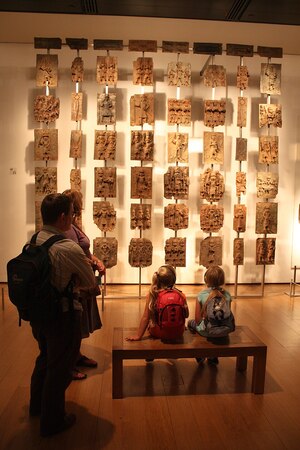
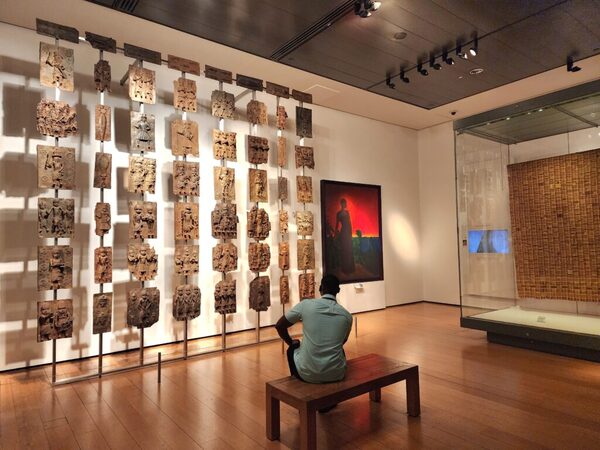
A display of Benin Bronzes at the British Museum Benin Plaques.source[www.britishmuseum.org]
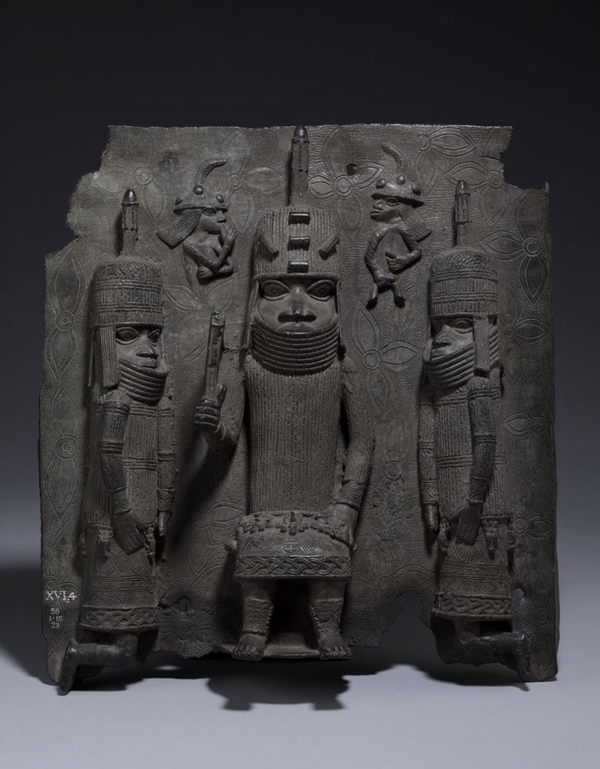
The Benin bronzes Include a series of plaques mostly high relief sculptures, which were created by the Edo people in the Benin Empire specifically to decorate the the Royal Palace. These artefacts were locally known as Ama in the Edo Language. They were created with compositions depicting the historical, cultural and present events to tell stories and mark important cultural ceremonies at the court and most of the main figures were from the court of the Oba (King Of the Edo people of Benin). The figures depicting the Oba were normally bolder and dominant besides placing them in the centre a technique used by many ancient artists to show the supremacy of a particular figure.
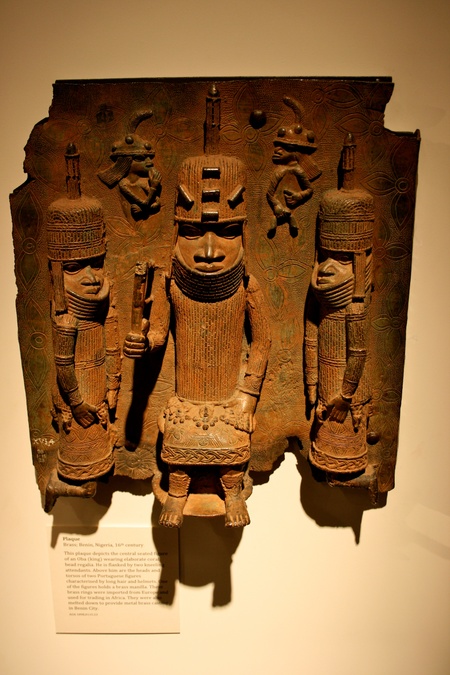
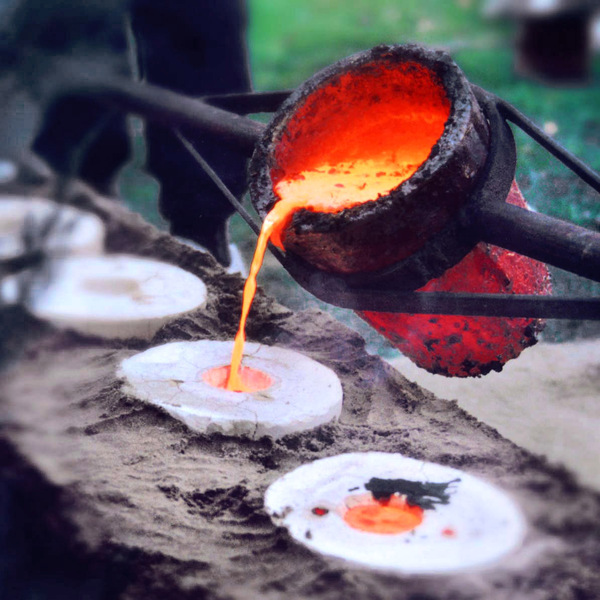
Image 1- 16th-century brass plaque, depicting an oba, two kneeling attendants, British Museum. Image 2 Bronze casting using the lost wax method. The molten metal is poured into the mould.
The people traditionally had a skill of metal casting, and it’s through this that they observed the subject. According to the museum curators of the British Museum, they used 'the’ciré Purdue' (lost wax) technique to cast molten brass, though in some cases they cast bronze. The Europeans who went to Benin and Ife, both in Nigeria, were wondering how these people could have a very successful process of bronze casting, with sophisticated designs and intricate details.The European museums, through their expert curators, extend research and describe the artefacts by paying attention to the details, including the materials used in the process of creation.
Plaques Title Series: Benin Plaques.source[www.britishmuseum.org]/collection/object/E_Af1898-0115-23?
The Benin people included the invasion by European soldiers in their artwork. The plagues in this image clearly demonstrate the craftsmanship of the ancient African people, who were able to depict figures wearing various styles of dress. The two European soldiers were dressed with different weapons, like a gun in the first plaque and a bow and arrow-like weapon held by the European soldier in the third plaque. The European style of dressing is shown clearly different from that of the Oba and the two attendants kneeling down. Besides, you can clearly see the facial details in all the images, showing three different people with the African and the European facial complements.
Free standing sculptures.from Benin societies.source[www.britishmuseum.org]
They also created the free-standing sculptures rather than just the relief sculptures, though the forms are sometimes smaller but with round pedestals, mostly metallic and wooden. The gallery also contains a variety and attaches each to every society. Though others lacked a pedestal, they were created with wide feet so that they may stand firmly.
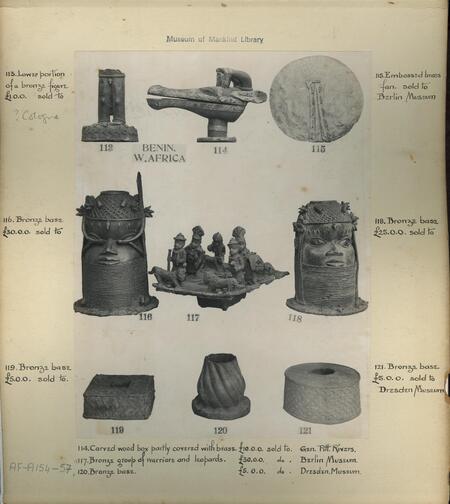
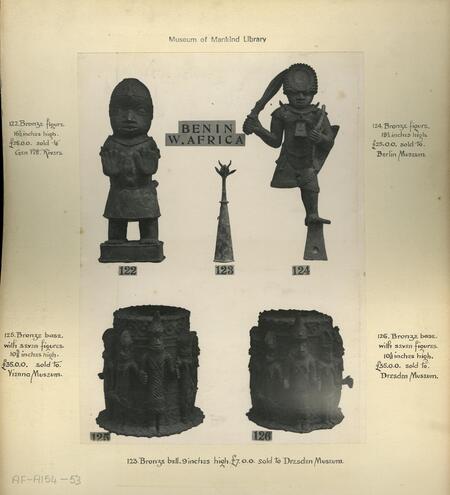
Photograph (black and white); mounted on card, part of a bound album. View of nine objects: lower section of brass figure; antelope head box & lid; brass fan; two brass commemorative heads; upper section of brass altar group; three brass bases/supports.
'This album contains photographs of objects from the Kingdom of Benin, Nigeria, sold by the London-based dealer, William Downing Webster. Many of the photographs are annotated with information relating to the vendor (s), and some include purchase prices. It is likely that the photographic series was compiled by Webster in the early 1900s. '[www.britishmuseum.org]The museum exhibit not only has artefacts but also photographs that represent the history of these artefacts, and some have clear descriptions of the artefacts and how they were attained in the period; some include the prices of sellers and the period when they were bought. These photographs help to protect the details of the artefacts and trace back the ownership and help those who claim artefacts to be restituted to understand who stole the artefacts at first and how they ended up in the hands of the museum.
Benin functional sculptures
Cast bronze figure or aquamanile of a leopard with small hinged lid in its head, and spots shown as plain circles on clotted background.
Leopard_aquamanile, _Nigeria, _Benin_Kingdom, _17th_century_AD, brass-_Ethnological_Museum, Berlin
Most of the artefacts that were created by the African people were for functional purposes. They just decorated them to have good-looking, functional vases, cast in brass or bronze, with proportions and details of these animals. A great example is the Aquamanile ceremonial metal water vessel. These are typically shaped like wild animals like leopards and others like rams. Without knowing the functional part of it, you may think they are just standalone sculptures. Water was poured into a hollow body using the lid on top of the head, and the water is later dispensed through the mouth and sometimes in the nostrils.
Pottery in bisque ware and terracotta.African art room