Растительные мотивы в итальянской живописи XIV века: композиционные и художественно-выразительные функции
Topics
- Concept
- Botanical Motifs as Part of the Depicted World
- Botanical Motifs in Spatial Organization
- Botanical Motifs as a Means of Artistic Expression
- Conclusion
- Bibliography
- Image Sources
Concept
Plants are frequently featured in works of painting. Artists depict trees, flowers, bushes, grass, and other elements of nature. Sometimes they become part of a landscape; sometimes they help complement images of people and buildings; and sometimes they capture the viewer’s attention entirely. Plants may occupy a small area in a painting yet play a crucial role in its overall perception.
In this study, I aim to examine how artists depicted flora in 14th-century Italian painting and the function of these motifs. My interest extends beyond merely identifying the plants in the paintings; I am focused on how they influence the image as a whole. For example, trees can serve to establish the surrounding landscape, divide the picture space, or highlight specific elements of the composition. Individual flowers might draw the viewer’s eye, complement the characters, or carry symbolic weight.
This topic is compelling because plants are often perceived as mere decorative additions to the main narrative. However, a closer examination reveals that artists employ them in diverse ways. Some plants become integrated into a sweeping landscape, others help structure the space, and a third group plays a crucial role in characterizing individual figures. Consequently, even the smallest details can impact how a viewer interprets the artwork.
My research’s central question is: what role do botanical motifs play in 14th-century Italian painting? I hypothesize that plants were not merely used by artists to depict nature or to decorate a painting. Through them, artists could create an ambient space, connect different parts of the composition, draw attention to specific details, and enrich the image’s meaning.
For my research, I divided the study into three chapters. The first is titled «Botanical Motifs as Part of the Depicted World.» In this chapter, I examine how artists portrayed nature and utilized plants to create the surrounding environment. I focus on trees, shrubs, fields, and other elements that help establish the setting where the action takes place, as well as their interaction with people and buildings.
Chapter Two: «Botanical Motifs in Spatial Organization.» In this chapter, I examine how plants help build the composition of a painting. Trees and shrubs can divide the image into separate sections, create foreground and background, highlight groups of characters, and guide the viewer’s eye. I also draw attention to how vegetation interacts with mountains, roads, and architecture.
Chapter Three: «Botanical Motifs as a Means of Artistic Expression.» This chapter examines individual flowers and other botanical elements that hold special significance within a work. For instance, flowers can constitute a vital part of the composition, draw the viewer’s attention, or supplement character imagery. Using lilies and roses as examples, I aim to demonstrate how a single, small element can influence the perception of the entire painting.
The primary material for this study consists of works of 14th-century Italian painting. Among these are frescoes and altarpieces by Giotto, Ambrogio Lorenzetti, Buffalmacco, Simone Martini, and other artists. For this project, I use images of these works to examine how plants are represented, where they are placed, and what role they play in the overall composition.Therefore, through this research, I aim to demonstrate that plants in 14th-century Italian painting are not merely background elements or ornamentation. Instead, they aid artists in depicting the surrounding world, constructing the picture’s space, and enriching its content. Analyzing diverse works will reveal the wide array of ways botanical motifs can be utilized and how profoundly they influence the viewer’s perception of the image.
Botanical motifs as part of the depicted world
In this section, I want to demonstrate how 14th-century artists incorporated plants into the depicted space—how they created a natural environment, delineated the setting, and connected the figures to their surroundings.
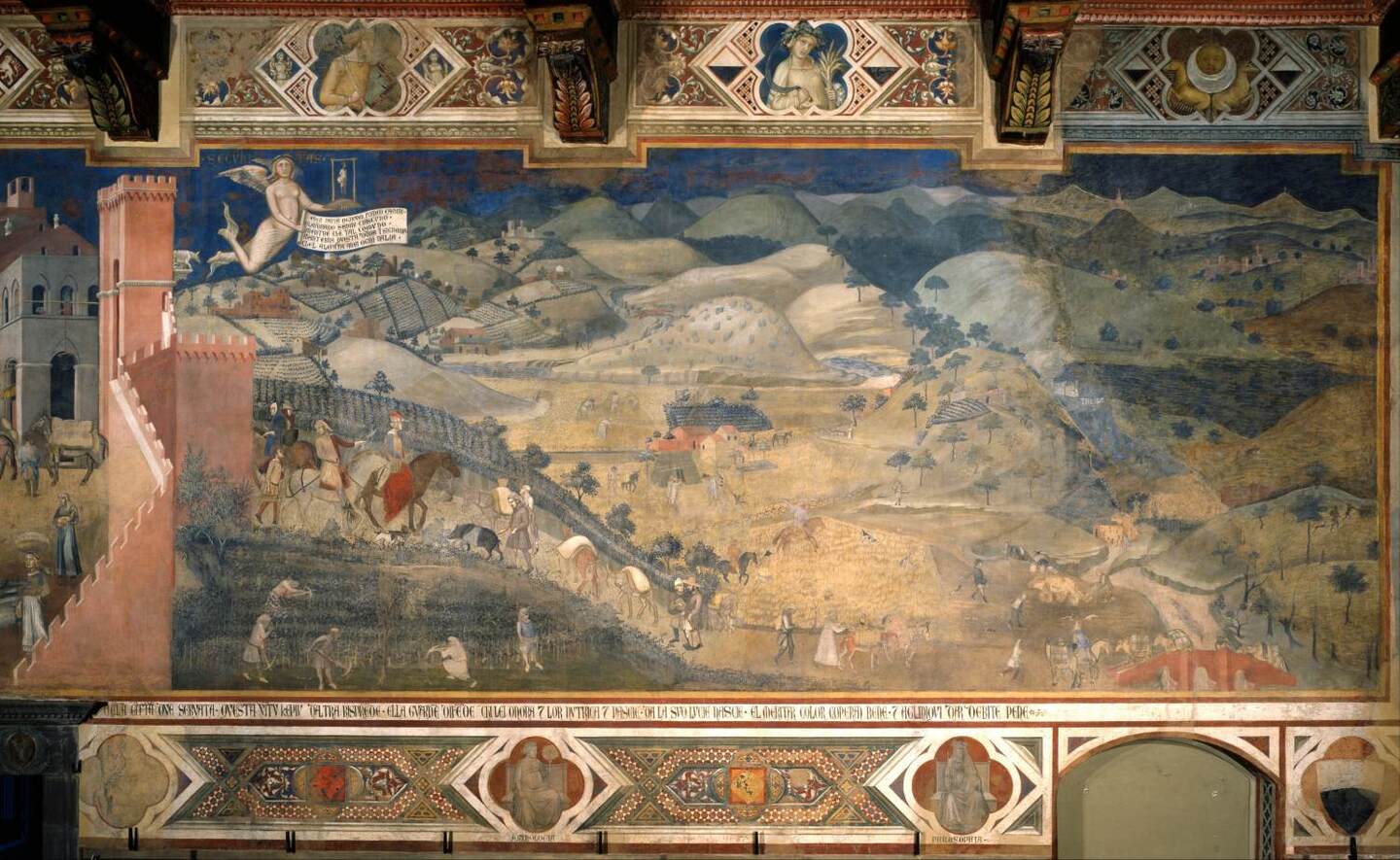
Ambrogio Lorenzetti, «The Aftermath of Good Governance in the Countryside,» 1338–1340.
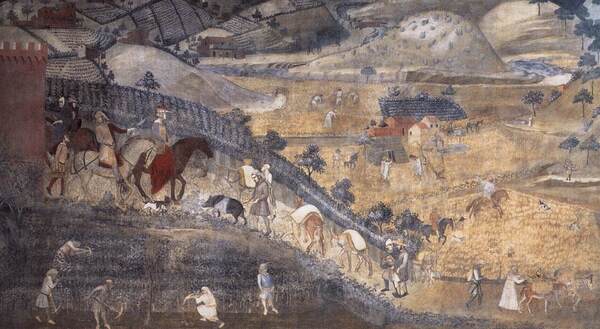
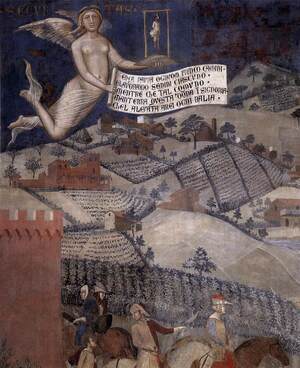
Ambrogio Lorenzetti, «Consequences of Good Government in the Countryside» (detail), 1338–1340.
In this fresco, vegetation becomes an integral part of the rural landscape. Trees, vineyards, and cultivated fields form a cohesive panorama where people’s daily lives unfold. Nature here is depicted as inhabited and tamed by humankind.
Pietro Lorenzetti, «Hermits at the Fountain of Elijah» (also known as «Fountain of the Prophet Elijah»), 1328–1329.
In this work, the natural environment becomes the setting for the main action. A stony landscape, a spring, and the surrounding patches of land form the space where the hermits are situated. Unlike the rural landscapes depicted by Ambrogio Lorenzetti, here nature is not tied to daily labor or agricultural activity. Instead, it functions as an independent component of the world, creating the impression that the hermits are sheltered from the outside world.
Anolo Gaddi, «Acquisition and Testing of Three Crosses, ” 1385–1387.
Behind the main action of the fresco, an expansive landscape unfolds. It features mountains, a river, trees, and rural structures. The natural environment forms a separate spatial plane that extends the imagery beyond the foreground where the main characters are situated. Because of this, the landscape is perceived not merely as a symbolic marker of location, but as an independent component of the depicted world. The landscape continues beyond the figures, and the trees are evenly integrated into the overall spatial structure.
Pietro Lorenzetti, «The Entry of Christ into Jerusalem, ” circa 1320.
The composition features palm trees and other foliage surrounding the city and the event participants. The vegetation helps convey the character of the location, connecting the architectural backdrop with the action taking place. Here, the plants are an integral part of the depicted world, rather than merely ornamentation.
Botanical Motifs in Space Organization
If the first section demonstrated the natural environment created by plants, this section will examine precisely how they assist the artist in building composition and organizing the picture space.
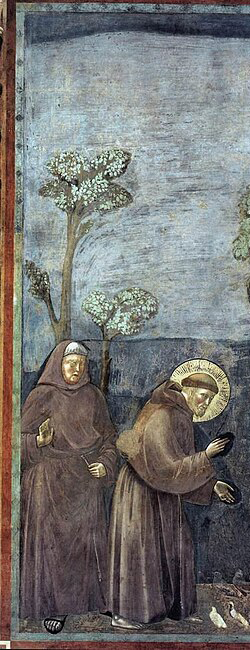
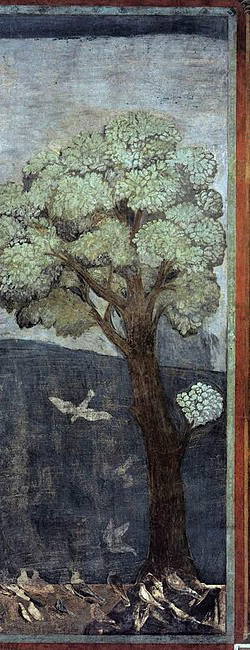
Giotto, «The Sermon to the Birds, ” c. 1290–1292
A large tree dominates a significant portion of the composition, establishing itself as one of the primary spatial anchors in the image. Its trunk and canopy stand out against the landscape, and the tree’s placement balances the group of figures. The branches and foliage create a vertical accent that organizes the space surrounding the central action. As a result, this natural element does not merely signify the setting; it actively participates in the composition’s structure. In relation to the figures, the tree rises majestically. Furthermore, the trees help distribute the visual weight between the right and left sides of the composition.
Giotto di Bondone, «Noli me tangere, ” c. 1303–1305.
In this composition, the hilly terrain and the trees situated upon it establish a diagonal direction that helps organize the space of the scene. The contour line of the slope connects the figures to the upper portion of the image, while the vegetation denotes distinct areas of the natural environment. Consequently, the landscape transcends the role of a neutral backdrop, becoming an active element in the compositional structure.
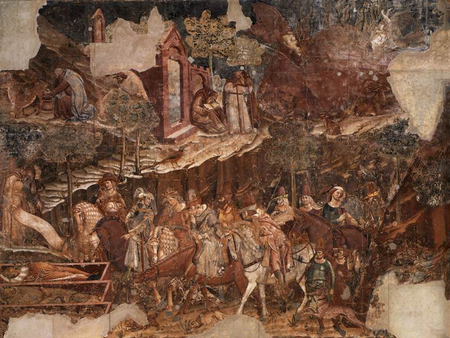
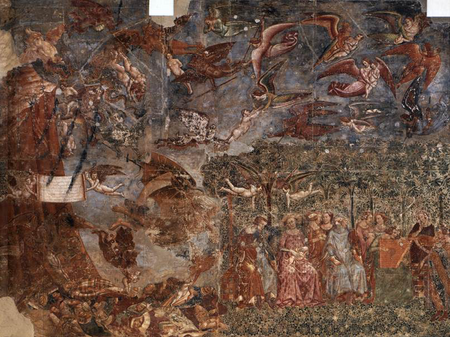
Buffalmacco, «Triumph of Death,» 1335–1340
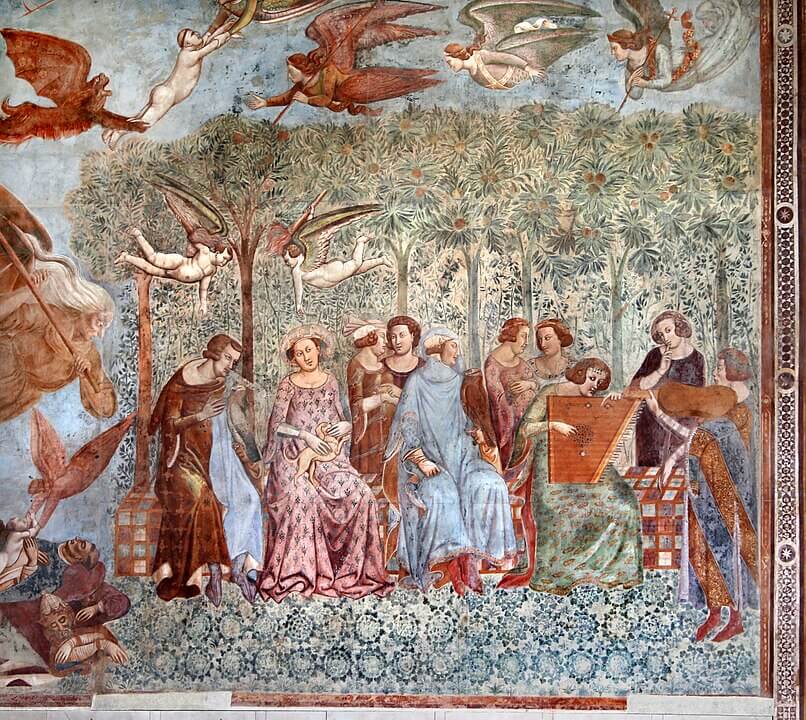
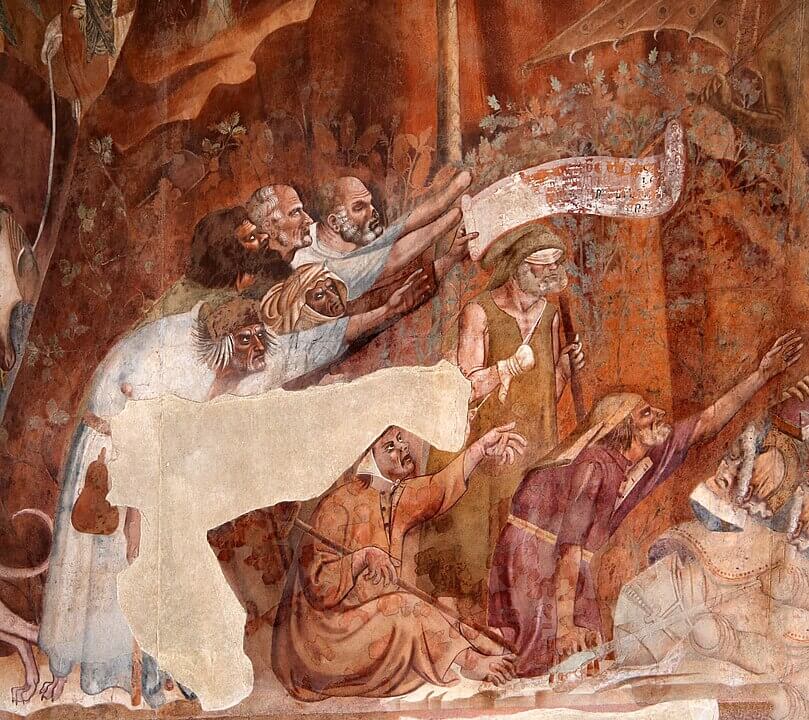
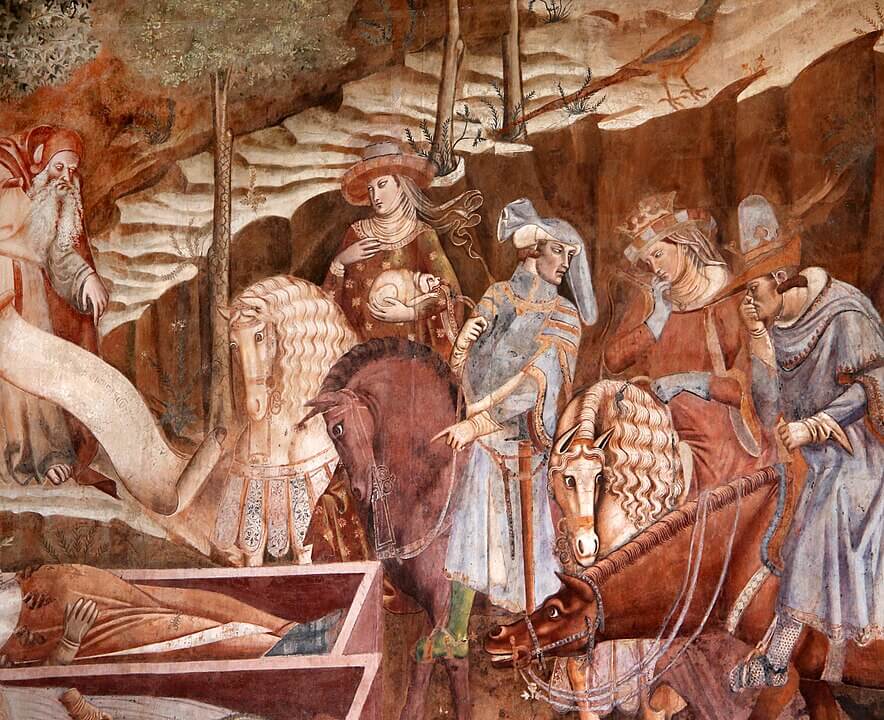
Buffalmacco, «Triumph of Death» (detail), 1335–1340.