Concept
Rationale for Topic Selection
The acanthus leaf is one of the most recognizable botanical motifs, appearing in Greek art in the 5th century BCE, and decorating Roman friezes, Byzantine capitals, book miniatures, and Romanesque cathedrals for over 1500 years.While the motif remained constant, the leaves evolved dramatically across different eras. The Greek acanthus is strict and symmetrical; the Roman version is lush and voluminous; the Byzantine one resembles lacework of light and shadow; and in the Gothic period, it was entirely replaced by oak and maple leaves, forms familiar to everyone.According to a legend recorded by the Roman architect Vitruvius, the Athenian sculptor Callimachus saw an acanthus growing around a basket on the grave of a young Kore, and he used this image to create a column capital. However, in the late 19th century, art historian Alois Riegl proposed a different origin story: the acanthus leaf grew not from a garden, but from the ornament of a Greek palmette, which itself traces back to the Egyptian lotus.Who was correct? Did masters copy the leaf from nature, or did they pass down a finished pattern from generation to generation?This topic remains relevant today, as the acanthus is still found everywhere: on facades, in stucco work, on wallpaper, and in textiles. It is especially important for a designer to understand how a visual template lives and why it has been copied for centuries—and what compels it to change. This is why I wanted to trace the entire journey of the leaf, from its initial appearance up to the Gothic period.
The key question I ask myself is: Did the masters render the acanthus from life, or did they replicate a pre-existing ornamental formula?
I suspect Rigg’s hypothesis is closer to the truth. Because Kant’s entire history existed primarily as a formula, which each era developed using its own methods, and masters turned to living plants only once—during the Gothic period, and even then, not for long.
Material Selection Principle
The chronological scope of the study ranges from archaic palmettes of the 6th century BCE to Gothic carving from the first half of the 14th century. For each era, the most well-known monuments featuring a clearly visible leaf were selected. Primarily, these were capitals and friezes, as the acanthus is fundamentally an architectural motif. The study also incorporated examples from mosaics, metalwork, and illuminated manuscripts to illustrate how the leaf transitions across different materials, from stone to others.
The Principle of Rubrication
The research is divided into chapters that allow for a step-by-step tracing of the leaf’s evolution. Chapter one examines the birth of the Corinthian capital in Greece. Chapter two analyzes the Roman acanthus. Chapter three reveals how the leaf transforms into a pattern in Byzantium and the Islamic world. Chapter four is dedicated to the Early Middle Ages and Romanesque, while chapter five addresses Gothic style and the return to the organic leaf. For each example, I approach the study with the same set of questions: how closely the leaf resembles a plant, how it is constructed, and where it is situated.
Principle of Source Selection
The key parameters for selecting information sources were their authority and the depth of their coverage on the topic. I utilized Vitruvius’s treatise as a primary source, A. Riegl’s work «Questions of Style,» and an article by N. A. Ivanov on his views, in addition to encyclopedic articles to acquire foundational knowledge. To analyze Gothic carving, I used the books by S. Gardner and N. Pevzner, and monument dating was cross-referenced with museum catalogs and educational project materials. This allowed me to examine the topic from multiple perspectives and rely on verified data.
Chapter 1. The Birth of the Leaf. 6th–4th centuries BCE
To understand the origin of the acanthus, one must first examine the plant itself and the ornamentation that existed in Greece prior to it. The acanthus is a Mediterranean plant, and its stylized leaves were widely employed in Greek art starting in the 5th century BCE, primarily on the capitals of Corinthian columns.
This is where the dispute between Vitruvius and Rigel begins. According to Rigel, the Egyptian lotus was transformed into the palmette as early as Mycenaean Greece. Afterward, artisans needed half a palmette to fill in the corners, and it was this palmette that gained volume in the Corinthian capital, evolving into the acanthus leaf. Rigel rejected a natural origin. Let’s look at some examples:
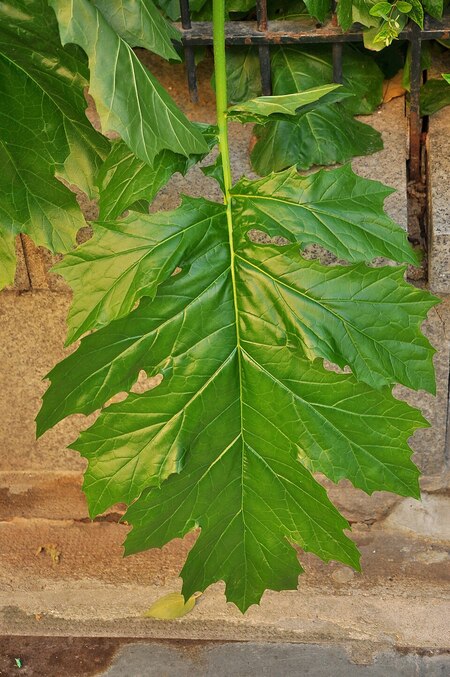
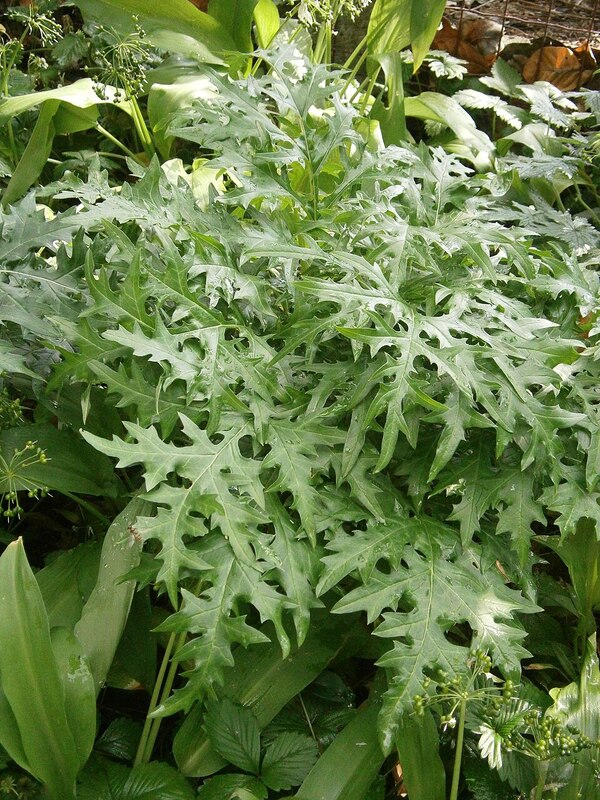
«Soft Acanthus, ” Contemporary Photography // „Prickly Acanthus, ” Contemporary Photography
Let’s start with the plant. The leaf of the soft acanthus (on the left) is wide, with rounded lobes, while the leaf of the prickly acanthus (on the right) is cut deeper and terminates in spines. The stone leaves will resemble one type or the other, but almost never perfectly replicate the living leaf.
«Finial of a Tomb Stele, ” c. 525–500 BCE // „Acroterion of the Tomb of Timotheus and Nikon, ” c. 350–325 BCE
Before us is the apex of an archaic tombstone: a pair of volutes and a pair of palmettes—a large one and a small one positioned between the volutes; the pattern is carved with fine lines and accented with color. Only red traces of paint remain from the small palmette. We note that the acanthus is absent here; instead, there is only a fan of petals growing from spirals.
A similar relationship between motifs is visible outside the architecture. On this tombstone, the palmette stems rise from the bed of acanthus leaves in spiral twists. When compared to the archaic finial (Fig. 4), it becomes clear that the scheme of palmette and spirals remains the same, while the acanthus has grown at its base. This aligns well with Righe’s idea that the leaf originated within the ornament rather than being copied directly from a plant.
C. R. Cockerell, «Capital of the free-standing column, frieze, and other elements of the Temple of Apollo Epicurius in Phigalia, ” 1860 — Plate XV, fragment (capital — c. 420 BCE).
The oldest known Corinthian capital topped a freestanding column at the southern end of the cella. Curiously, the original is lost to us—it was sketched soon after the temple’s discovery, and then it was lost. Therefore, the beginning of the Corinthian capital’s history is known only through drawings, such as those in C.R. Cockerell’s book. Note the structure of the capital: a palmette and two spirals are in the center, while the acanthus leaves occupy only a lower band. The leaf here also serves as a base for the palmette.
«Corinthian capital of the Tholos in Epidauros, ” mid-4th century BCE.
However, in the capital, the acanthus does not remain at the base for long. Several decades later, the torus capital in Epidaurus, attributed to the architect Polycleitus the Younger, already bears features of the Corinthian order: two rows of acanthus leaves, stems with small volutes, and an abacus with slightly concave sides, which may be decorated in the center with a flower. Compare this with the capital from Bass (Fig. 7); there, the acanthus was merely a narrow band beneath a palmette, whereas here it envelops the entire lower section of the capital, and in the center, instead of a palmette, there is only a small flower on the abacus. Furthermore, the leaf is still structured as an ornament: the lobes are symmetrical and repeated with the precision of a stencil. A living acanthus leaf is never so perfectly regular.
«Horegic Monument of Lysikratos in Athens,» circa 335 BCE — upper section
The fact that the acanthus leaf transformed into a finished form easily translatable from one place to another is confirmed by the Lysicrates monument. Its half-columns are the first surviving example of the Corinthian order on the exterior of a building, whereas in Bassae and Epidauros, Corinthian columns were placed inside. We should also note the roof finial: it is also assembled from acanthus leaves. Thus, the acanthus, which appeared in funerary ornamentation and became fixed in the capital, becomes an independent motif that can be placed in any part of the structure.
Conclusion
Thus, the Greek acanthus appears within an already formed ornament. Vitruvius’s legend speaks to nature, but the monuments show something different: in the oldest capital, the basal leaf serves as a pedestal for the palmette, then fills the entire capital, and by the end of the 4th century BCE, it becomes a ready-made formula that can be applied to other parts of the building. These monuments do not show the transformation of the palmette into a leaf, nor do they show any evidence of tracing from nature.
Chapter 2. The Scroll of Abundance
During the Hellenistic period, the Corinthian order spread, and in Imperial Rome, it became one of the most favored styles due to its opulence and solemnity. The acanthus leaves spread beyond the capital; they were carved onto consoles, friezes, and cornices, and also used in metalwork and jewelry. The central question of this chapter is whether Roman extravagance brings the acanthus leaf closer to a living plant. We will see how the leaf grows to cover an entire wall of the Altar of Peace, and then return to the capital to see if its design has changed since Greek times.
«Augustus’s Altar of Peace» in Rome, 13–9 BCE — vegetative frieze of the fence, fragment