Concept
Celeste Bursier-Muzeno is a French artist and sound artist who works at the intersection of music, space, and visual art. The foundation of his artistic practice is the exploration of chance as an independent compositional method. Unlike the traditional approach to music creation, he establishes conditions within which sound forms autonomously under the influence of the surrounding environment, object movement, physical processes, and the viewer’s presence. Celeste Bursier-Muzeno does not predetermine every note; instead, he builds a system where music emerges in real-time and is never repeated.
He proposes that we perceive the surrounding space as a potential musical composition that exists outside of traditional musical instruments and academic rules.
The artist’s works exist as evolving sound environments that integrate acoustic and visual experiences. In his installations, sound emerges from chance encounters, vibrations, mechanical movements, or animal behavior. Everyday noise ceases to be perceived as mere background and assumes the status of artistic material. Céleste Bursie-Mujeno draws the viewer’s attention to the hidden musicality of the surrounding world, prompting us to perceive the environment as a living compositional system.
«I create musical forms based on self-regulating systems. In these systems, I completely relinquish control over the sequence of incoming sounds, but the final result is incredibly important to me.»
One of the key aspects of his practice is the rejection of complete authorial control; chance ceases to be a side effect and becomes a fundamental principle of sound creation. This unpredictability shapes the uniqueness of each viewer’s acoustic experience, positioning the viewer not only as an observer but also as a participant in the act of listening, as any movement within the space can alter the sound of the installations.
This approach is linked to the development of experimental music and generative art, fields where the autonomy of the artistic process plays a crucial role. In his works, chance serves as a method for investigating the perception of space and everyday acoustics. The installations of Celeste Bursier-Muzin become an immersive experience wherein the viewer begins to perceive familiar environmental sounds in a different way.
«My work is a way to contemplate complexity in real time. For me, this complexity is everywhere around us—it is life itself.»
My hypothesis in this visual study is that Celeste Bursie-Muzeno’s sound installations demonstrate autonomous randomness, where sound emerges without the author’s direct control, transforming the movement of the environment and everyday noise into a mutable musical system. Unpredictability becomes a key element of perception, and the viewer is an active participant in the process. The artist shifts the traditional perception of music by turning everyday sounds and environmental behavior into an independent composition. The goal of this visual study is to explore how the artist utilizes randomness, environmental movement, and object interaction to form sound installations from which «music» arises.
The structure of my visual research is based on a sequential analysis of the key sound installations by Celeste Bursie-Muzeno, where chance becomes the primary artistic compositional method. I will examine specific installations by the artist, delving into how she generates sound through environmental movement, object interaction, and unpredictable processes.
Celeste Bourssier-Muzeno, Kleinfen, 2015
1. «From the Ear to the Listener»
Celeste Bursie-Mujeno, «From Here to Hearing, ” 2010
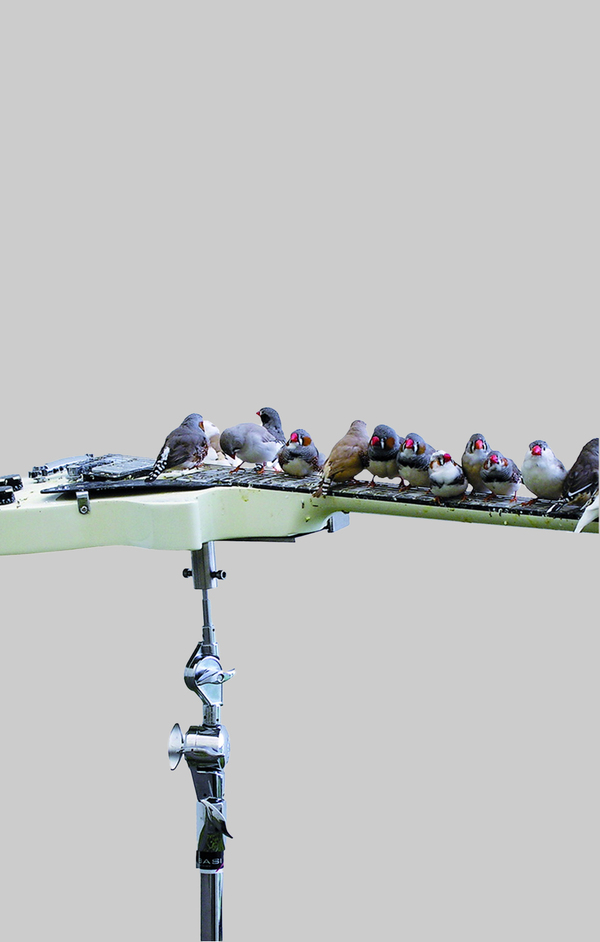
One of Céleste Bursie-Muzeno’s earliest and most recognized works is the sound installation, «From Here to Hearing,» where the artist fully articulates her methodology for working with randomness and the autonomy of sound. The installation is a space containing electric guitars connected to amplifiers, and freely moving birds—zebra amadines.
Celeste Bourssie-Muzeno, «From Here to the Ear, ” 2010
Birds alight on the strings, brushing them with their feet and bodies, which generates random sounds that coalesce into a continuous, evolving composition. The artist predetermines only the structure of the system—the placement of objects, the tuning of the instruments, and the parameters of the space—but the actual sequence of sound falls entirely outside of his control. The music forms in real time as a result of the behavior of living creatures and the environment’s interaction. He creates a response that is constantly forming in real time amidst instability, where the artwork simultaneously functions as an unnotated concert and an installation.
General view of the installation «From Here to Hearing (V.21), ” 2016–2017
Chance becomes the core principle of the composition’s sound. Sound emerges as a result of natural movement within the space, and the viewer becomes part of the acoustic environment because any movement they make affects the birds' behavior, and thereby, the sound of the piece itself.
It is also important to note that the installation exists in several variations and is adapted for different exhibition spaces. In one version, it is a large enclosure featuring numerous electric guitars and birds, whereas in another, it becomes more minimalist, focusing on individual instruments and the interaction between the birds and the strings. Despite the change in environmental scale, the core operating principle remains constant: sound emerges randomly through the autonomous behavior of living creatures. For Bursche-Muzeno, the installation is not a fixed object but constantly adapts to its new environment while maintaining the system of random sound generation.
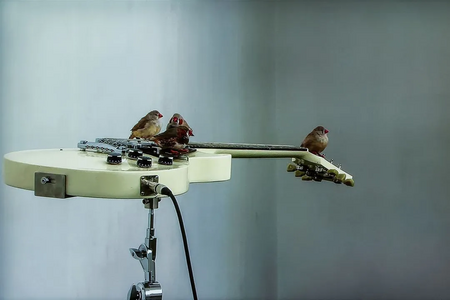

Celeste Bursse-Muzeno and Ariane Michel, «Celeste’s Birds,» 2008, Frac Franche-Comté collection), © Ariane Michel and Celeste Bursse-Muzeno, photo © Olivier Loeve
Celeste Bursier-Mujeno, «From Here to Hearing (vol. 21), ” 2016–2017
The installation «From Here to Hearing» has continued into an audio format in the album «Part One, ” which is connected to the project’s acoustic experiments. The album can be viewed as a form of sound documentation of the installation, which also follows the author’s concept: the music is generated autonomously within the created system and evolves as a continuous process, dependent on chance and environmental behavior.
Celeste Bourgeois-Muzeno, «From Here to Hearing (Vol. 21),» 2016–2017
2. «Harmonic Chaos»
Celeste Bursie-Mujeno, «Harmonic Chaos, ” 2006. Photographer: Jeffrey Price
For the next piece in Céleste Bursse-Mujeno’s practice, I highlight the sound installation «Harmonic Chaos, ” in which a mechanical system interacts with sound waves within a space. The work consists of a system of vacuum cleaners, each attached to a lip harmonic and a sound sensor. When one of the mechanisms is activated, the airflow extracts sound, and the resulting vibration triggers neighboring units, creating a chain reaction of acoustic responses. Gradually, the space fills with chaotic and constantly shifting sounds. This technical simplicity makes the installation convincing: the artist demonstrates that a complex acoustic structure can arise from the most utilitarian and everyday objects.
Celeste Bursier-Mujeno, «Harmonic Chaos, ” 2006
In this work, Boussie-Muzeno demonstrates the crisis of the traditional concept of composition as a predetermined sequence of sounds. Music emerges from the interaction of mechanical processes and random external stimuli.
The selection of objects is also noteworthy. Vacuum cleaners—domestic and functional devices—lose their original role in the installation and are transformed into acoustic agents. Boussie-Muzeno shows that musicality does not belong exclusively to an instrument or a performer; rather, it is potentially latent within any environment and can be activated through a system of interactions.
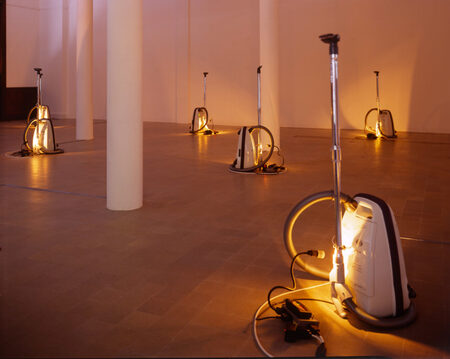
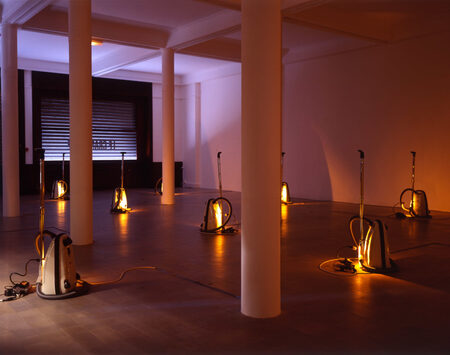
Celeste Bursse-Muzeno, «Harmony of Chaos, ” 2002. Photographer: Stéphane Belange