Contents
1. Problem Statement
2. America’s Big Cars
3. DDB—Advertising Against the Rules
4. Think Small and Lemon—Two Ads That Changed the Game
5. Evolution of Advertising Strategy
6. The Automobile as a Reflection of the Owner
7. Campaign Effectiveness and Limitations
8. Conclusion
Introduction
Advertising usually seeks to present a product in the most favorable light. It highlights advantages, shapes an appealing image, and prompts the buyer to see the product as the embodiment of their own desires.But what happens if the advertiser does the opposite?In 1959, Volkswagen launched an advertising campaign in the United States that did not conceal the Beetle’s small size, unconventional appearance, or modesty. Instead of aligning the German car with the image of luxurious American automobiles, the agency Doyle Dane Bernbach made the differences between them the foundation of the communication.Volkswagen did not try to prove that the small car was equal in every way to the large one. It prompted the buyer to consider whether size, outward flashiness, and a high price truly define a vehicle’s value.
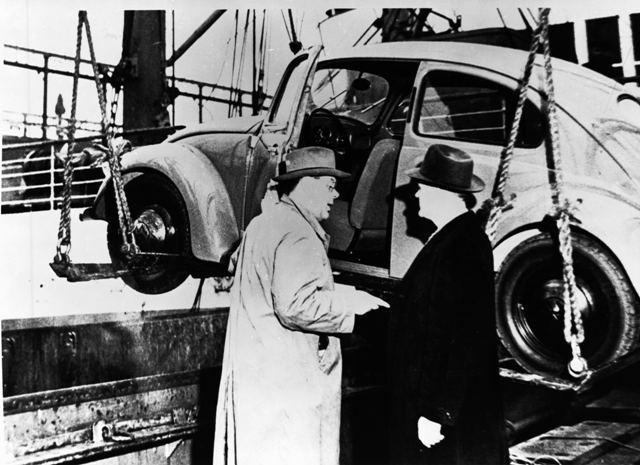
Volkswagen Beetle — the car’s arrival in the US, 1949. Archive photograph.
Research Question Can advertising alter the perception of a flaw without changing the product itself?Hypothesis The persuasiveness of the Volkswagen Beetle’s advertising strategy was linked to reframing characteristics of the car that might otherwise have been perceived as shortcomings. Research Objective To identify the psychological mechanisms through which the Volkswagen Beetle advertising campaign could change the American audience’s attitude toward the car’s features.Object of Study — the American print advertising for the Volkswagen Beetle, created by DDB since 1959.Subject of Study— the methods of reinterpreting consumer perceptions through advertising imagery, headlines, and argumentation.Method — qualitative comparative analysis of advertising materials, utilizing historical sources and scientific research on the psychology of perception and persuasion.
Volkswagen Beetle — vehicles at the Ralph D. Jones dealership, Springfield, USA, 1958. TheSamba Archive
America of Big Cars
In post-war United States, the automobile was more than just a means of transportation. It served as a statement of prosperity, social standing, and belonging to a certain lifestyle. In the advertising of American manufacturers in the late 1950s, the size of the car, engine power, comfort, novelty, and striking appearance held significant importance. Large cars featuring chrome details, dramatic rear fins, and spacious interiors matched the aesthetic of post-war consumer optimism. [2, 3]
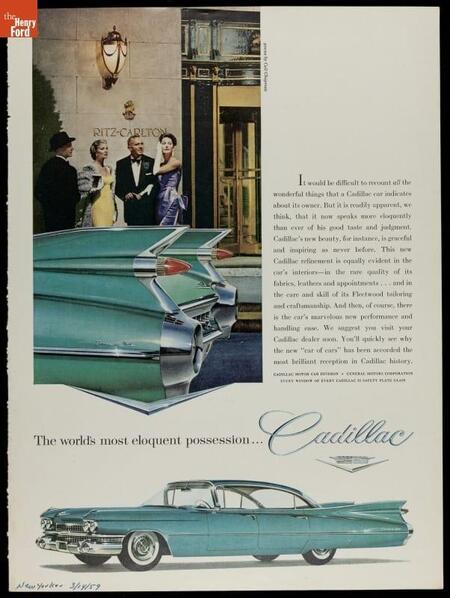
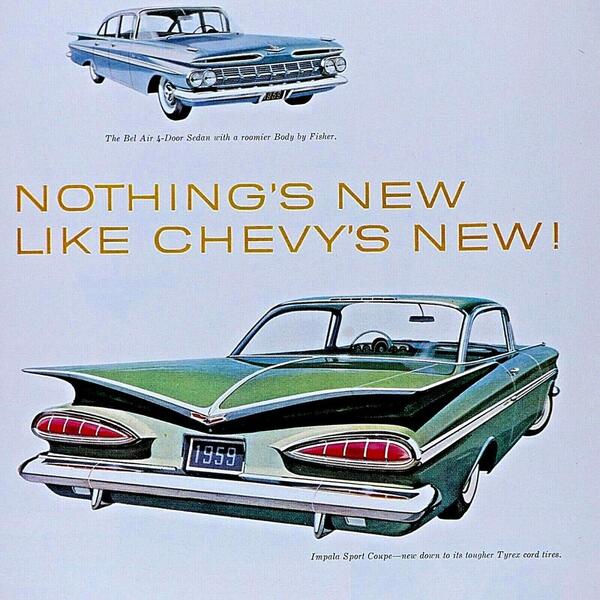
On the left is the 1959 Cadillac, «The One Car That Befits the Occasion!», and on the right is the 1959 Chevrolet, «Nothing’s New Like Chevy’s New!»
In the Cadillac advertisement, the car is presented as a symbol of high social standing. Elegantly dressed people, luxurious architecture, and a formal setting create an association between owning the vehicle and a prestigious lifestyle.
Chevrolet employs a different strategy. The image of the car emphasizes its refreshed silhouette, expressive rear wings, and unique body proportions. The headline draws attention to the model’s novelty.
In the first case, the advertising message is built around social status; in the second, it revolves around renewal as a sign of progress.
For Volkswagen, this created a problem. The Beetle could not credibly compete with similar vehicles in the sphere of luxury, imposing size, and external flashiness. However, smaller cars were already present in the American market.
Renault Dauphine — «Joy of Life! , ” 1959.
One of Volkswagen’s competitors was the French Renault Dauphine. Renault’s advertising utilized vibrant colors, a festive mood, and the image of carefree city living. The French expression Joie de vivre means «the joy of life.» This helped link the small car not just to limited financial means, but to the pleasure of driving.Consequently, DDB’s task was not simply to market a small car, but to create a distinctive perception of it.
Volkswagen Beetle Sedan, 1962. Hulton Archive photograph
The compact, rounded body, rear engine placement, and virtually unchanged design set the Beetle apart from many American automobiles. The brand’s origins, linked to the automotive program of Nazi Germany, could have served as an additional barrier. [3]
Bill Bernbach, co-founder and Creative Director of DDB, in his New York office, 1966. Archival photograph.
In 1959, Volkswagen of America hired the Doyle Dane Bernbach (DDB) agency to strengthen its position in competition with Renault and other American compact cars. [1]
Instead of obscuring the Beetle’s characteristics or mimicking the advertising of prestige vehicles, DDB made those characteristics the foundation of a new positioning. Economy, practicality, and reliability were brought to the forefront. The agency’s task was to make an attractive the car—one that did not fit the common idea of the perfect automobile.
DDB — Advertising Against the Rules
Helmut Krone, art director, and Julian Kenig, copywriter, worked on the key advertisements under the creative direction of Bill Bernbach. The imagery and text were created as a unified message—one where an unexpected presentation captured attention, and the argumentation clarified the car’s advantages. [2,3]
In 1962, DDB employee Robert Levenson explained the agency’s approach in an interview with The New York Times.
Advertising for some American cars attempts to sell an image rather than the product itself.
For Volkswagen, this meant abandoning the idealized image of the car. The advertising spoke to the buyer through relatable arguments, concrete specifications, and self-irony.
Volkswagen — «And If You Run Out of Gas, It’s Easy to Push, ” 1962. DDB Advertising Copy.
The headline translates to, «What if the gas runs out? You can easily push the car.» Instead of promising flawless convenience, the advertisement plays on an inconvenient situation, turning the car’s small weight into an advantage.
Meanwhile, the main body text explains that because of the fuel-efficient consumption, the driver rarely visits gas stations. The joke doesn’t replace the argument; rather, it helps unfold it.
This very principle lies at the foundation of the two most famous ads in the campaign—Think Small and Lemon. Both use the contradiction between the first impression and the subsequent explanation, but they appeal to different aspects of consumer perception.
Think Small and Lemon — two ads that changed the rules
Volkswagen — «Think Small.» A DDB advertising campaign launched in 1959.
In the advertisement, the car occupies only a small part of the page. The vast white space visually isolates it and contradicts the usual advertising goal—to present the product as large and impressive. However, this discrepancy is directly linked to the headline, «Think Small.»
Susan Hekler and Terry Childers (1992) established that surprise and semantic relevance are crucial factors in information retention. Research by Li and Mason (1999) supports this conclusion—unexpected, yet related, information can improve attitudes toward advertising. [4, 5]
In Think Small, this unusual composition doesn’t just attract attention; it visually validates the main argument.
Volkswagen — «Lemon, ” 1960. DDB Advertising Advertisement.
The word lemon in American English can refer to a faulty car. Therefore, the headline reads like an unexpected confession of a defect. However, the Beetle in the photograph shows no visible damage, and this contradiction compels the viewer to seek an explanation.
The main text reveals the reason—the car did not pass factory inspection due to a minor flaw on a chrome part of the glove compartment cover. Thus, the initial negative impression transforms into evidence of rigorous quality control.
This technique can be explained through the two-sided argumentation researched by Martin Eisenberg (2006). Admitting a shortcoming can increase consumer trust in the advertiser, provided it is accompanied by a convincing positive argument [6]. In Lemon, the inspection system itself becomes that argument—Volkswagen doesn’t promise the absence of defects; it demonstrates its ability to find them.