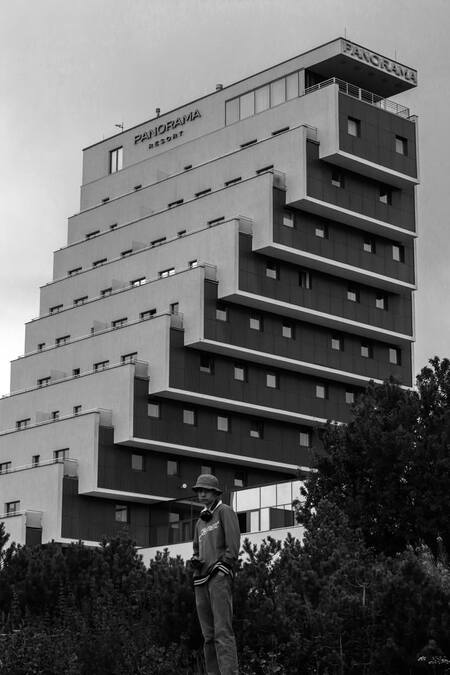
Concept
Art is a reflection of reality. If we expand on this statement, art is a reflection of human needs given what is happening to them. Of course, works are not created by the entire populace; they are backed by an individual or a group of people. But how is it that architecture, sculpture, and mosaics from the time of the USSR conveyed, and still convey, the mood of the entire nation? One can trace the Russian person’s relationship with the culture of the Soviet era through me as an individual, no matter how immodest it may seem. Let’s take as symbols of the art of that time the mosaics at the entrance to a swimming pool (or another public place familiar to a Russian) and the «panel building"—items familiar to everyone.
In childhood, I was afraid of «panel buildings.» I was also scared of the panoramic window I looked out of after swimming while waiting for my parents. Then—teenage years and quarantine. The fear remains, but for some reason, I want to overcome it. During the pandemic, I wasn’t alone in thinking this—musical groups dominated, characterized by a brutalist aesthetic.
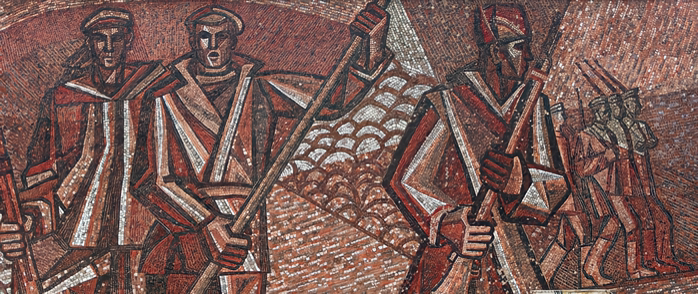
Facade of the «Oktyabr» Cinema, Moscow, Russia, by A. Vasnetsov, N. Andronov, and V. Elkonin, 1967.
My fear evolved into a love—a specific kind of love. It held elements of unity with my peers, and elements of connection with the older generation. A generation that lived in the same city and loved that city, but differently. There was also something in it about the elusiveness of feeling and nostalgia—a longing for a better, purer, more honest past. From this love, without exaggeration, I still feel a desire to explore brutalism.
The decision to prioritize album covers by musical artists inspired by the Soviet era became logical. This is because these covers represent the intersection of «then» and «now» in how people relate to brutalism.
Brutalism seems relevant both then and now due to the specificities of the Russian mentality. Regardless of what happens to a person, mentality invariably influences their interaction with surrounding reality. Human psychological mechanisms also seem important in this aspect.
When selecting textual sources, preference was given to scientific articles indexed in RINC and the RINC core collection. I consulted works dedicated directly to the Brutalism movement as well as articles from fields that seemed seemingly unrelated to my chosen topic. This allowed for a more comprehensive and multifaceted analysis. The information was chosen based on the principles of credibility and relevance to my subject.
So, what has caused people to regard Brutalism with such reverence, then and now? How does this manifest in other areas of art?
The research is structured around these very questions: Part 1 Political events and the economic situation Mentality: nostalgia Mentality: inability to be free «Truth and nothing but the truth» Cyclical nature Part 2 Silent at Home Where is the Phantom? Other performers: Soft Blade Rewind Film Conclusions
Part 1 Political Events and Economic Conditions
Brutalism is literally born from the ashes: the recently concluded Second World War forced the rapid and massive construction of both residential and administrative buildings to restore life to war-ravaged cities. From these circumstances, one can easily gauge the state of society. The horror of war, loss, and poverty settle into the new buildings along with their inhabitants.
Trellick Tower, London, UK, Arno Goldfinger, 1972
Various periods are hypothesized to have influenced the psychological state of modern people. For older generations, the events of the nineties were staggering. Furthermore, the 2020 quarantine was a shock. Regardless of the specific event, the state of people was influenced by uncertainty, the fear of the unknown, the fear of death, self-isolation, and, for some, the loss of loved ones. It was during the quarantine that the peak popularity of music referencing the Soviet era occurred. The key symbol became the «panel building"—a multi-apartment block also known as a «Khrushchevka.» Therefore, the reliance on the image of concrete structures can be considered recurring.
Durrington Tower, London, UK, Colin Lucas, Philip Botomley, 1967
Mindset: Nostalgia
Humans generally tend toward nostalgia. This tendency is often developed even more strongly in Russians: in his article, A.N. Bespalov, he draws attention to the sensitivity of the Russian soul: «The Russian person is extremely sentimental; they can empathize with someone else’s misfortune or sorrow in a short time, offering help and support in difficult situations. The phrase 'a conversation of souls' exists only in our language.»
Z. Bauman argues that the yearning for guiding values stems from the dismantling of the perception of absolute control over the future, because constancy and stability imply predictability in processes.
The psyche is structured in such a way that all negative experiences fade from memory, while positive ones are magnified to the extreme. Romanticizing everything «Soviet» (buildings, in this case, serve as a direct symbol of the era) is a trend observed in people aged approximately 20 to 35. For older individuals in this demographic, the USSR represents childhood, so the Soviet Union is associated with happiness. Younger people, on the other hand, did not live through the existence of the Soviet Union. Often, their impressions are based either on the accounts of older generations or on films. Interestingly, watching these films only fuels nostalgia for that period: due to censorship, many films reinforce the idea of a happy life in the communist era. A.L. Muravyev confirms this notion: «…work was often evaluated not based on the author’s ideas and intentions, but on pre-constructed ideological constructs.»
Mindset: the inability to be free
Another characteristic of the Russian people is the ingrained habit of always living under someone else’s authority. In the article by A. N. Bespalova, this is described as: «Power is a phenomenon that is given from above, and one must submit to it.» It can thus be assumed that the need for control, which became embedded alongside other needs, first prompted people to construct imposing, monumental buildings, and subsequently, they almost instinctively began to deify them.
«People like us need to believe in something or someone.»
Ryugyen Hotel, Pyongyang, DPRK, Zaha Hadid, 1987: a formidable, commanding structure
Furthermore, the ambiguous attitude toward the frightening within the Russian psyche may be linked to the prohibition of Orthodoxy in the USSR. Yet, the need to believe—a characteristic ingrained in a folk tradition that adhered to specific, limited beliefs throughout its existence—cannot be eradicated. Therefore, it can be hypothesized that Brutalist structures became a kind of modern idol for the Soviet person.
Album cover for «Looking in Your Eyes,» by the band «Where is the Phantom? ,» 2019: «the idol of the Soviet person»
«Truth and nothing but the truth»
The word «brutalism» is often associated with the name Marcus Junius Brutus. In modern Russian, the word «brutal» is rarely perceived positively, but for Brutus’s contemporaries, sternness and coarseness were equated with truthfulness. Meticulousness and delicacy, conversely, were associated with hypocrisy. The image of the «noble savage» and one of its most essential characteristics, brutality, remained relevant even during the Age of Enlightenment. Regarding the arrival of «art brut» in architecture, K. Lidin states: «Modernists perceived reinforced concrete as ‘the universal material of the future’; its rough surfaces embodied, for them, the severe truth of the emerging realm of reason, devoid of foolish sentimentality.»
«Perhaps this is why photographers—specialists in shooting architectural subjects—love brutalism so much. As the most documentary of the fine arts, photography naturally gravitates toward the truthful and unembellished language of brutalism.»
The need for honesty among young people romanticizing the Soviet Union stems from the modern human lifestyle. Social media projects an image of a happy, productive individual. The Internet has the capacity to answer any emerging question. But is the depiction of a person presented online realistic, or is it merely how people wish to appear? Is the information in articles reliable, or is it presented by someone who lacks education in the field they are discussing? Pessimistic answers to these questions make honesty extremely valuable to young people—even the honesty of raw concrete.
Cyclicality