
How communication theory works in the field of design
Human communication is never limited to words. Design, art, and digital products communicate through symbols, colors, structures, textures, interactions, and stories. Communication Theory helps us understand how meaning is created, how people interpret it, and why certain visual or interactive decisions resonate while others fail.
In design, communication works as a constant exchange of meaning: the designer encodes an idea into form, color, or movement, and the viewer decodes it through personal experience, cultural norms, and context. As the course materials explain, communication is a relational process shaped by feedback, expectations, and interpretation. This means that no design exists on its own — it exists only in interaction with the audience. Semiotics teaches us to see design as a system of signs. A warm color becomes a symbol of safety, an icon becomes a shortcut to meaning, and a layout becomes a map of attention. Socio-cultural approaches remind us that perception is never universal: every viewer brings cultural habits and background knowledge into the act of interpretation. Phenomenological perspectives emphasize experience — the moment when a person «feels» the meaning, not just understands it intellectually.
Communication Theory therefore transforms design from decoration into a meaning-making practice. It becomes a tool for building trust, guiding behavior, shaping expectations, and expressing values. This is especially important in contemporary art and digital products, where interaction itself becomes a message and the audience becomes an active co-creator of meaning. In the context of Little Friends — a brand built around care, ecology, and smart technologies — communication theory allows us to create a visual and interactive world where technology feels warm, data feels human, and a pet’s well-being becomes a shared value. The brand becomes not only a product, but a communication ecosystem where every element — color, icon, interface movement, even the «voice» of notifications — carries meaning.
Presentation for a general audience
Dogs cannot explain how they feel — but we can help them be heard. Little Friends is a system created for those who see their dog not as «just a pet, ” but as a beloved family member whose health and happiness truly matter. Our brand combines three elements: organic dog food, a smart feeding bowl, and an intuitive mobile app that helps owners understand the real needs of their pets.
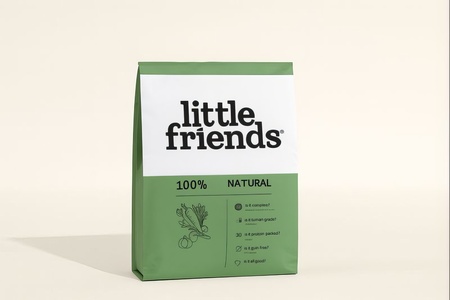
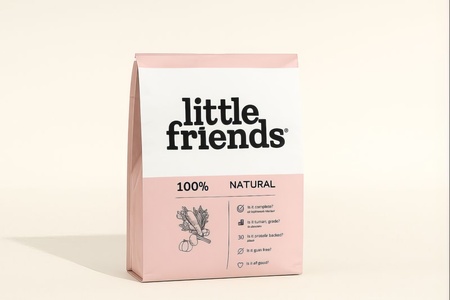
Natural ingredients, careful recipes, and personalized formulas for different breeds ensure that each dog receives exactly what their body requires.


But nutrition is only the beginning. The smart bowl learns your dog’s habits. It tracks how fast they eat, how much they consume, which flavors they love, and when their appetite changes. After each meal, the bowl sends data to the app, helping you understand your dog’s status in real time.
Is your dog satisfied? Do they eat too quickly? Do they need a different portion size? Has their mood or appetite changed?
The Little Friends app turns these invisible signals into clear insights. It creates a personal nutrition profile, offers recommendations, and helps you maintain daily routines that support long-term health. For a general audience, Little Friends is not just a product. It is a companion and a guide, a system that simplifies care and strengthens the emotional connection between people and their animals.


The visual identity — warm yellows, natural earthy tones, soft neutrals — communicates gentleness, trust, and ecology, making the brand feel friendly and alive. Little Friends helps you give your dog the love they cannot ask for — but deeply feel.
Brand presentation for a professional audience
Little Friends is an integrated nutritional ecosystem designed at the intersection of ecology, data analytics, and IoT technology. Our goal is to bring measurable quality and transparency into the everyday feeding practices of dog owners. The system consists of three core components:
- Organic food line — formulated with veterinary input — tailored to breed, age, and dietary sensitivities — produced with certified sustainable methods
- IoT smart feeding bowl — equipped with weight sensors and behavioral tracking — collects high-precision data on eating patterns — detects anomalies early (loss of appetite, overeating, stress behavior)
- Data-driven application — visualizes consumption and behavioral trends — generates personalized feeding recommendations — supports long-term monitoring for veterinarians and partners — integrates with retail systems for automatic replenishment
The brand identity is built around calm, stable neutrals combined with warm accents from the organic palette. The visual system is designed to communicate accuracy, reliability, and ecological responsibility — qualities essential for collaboration with veterinary clinics, pet-care retailers, and scientific partners.
Professional audiences are offered not only a product, but a platform for evidence-based pet care. By using the smart bowl’s analytics, veterinarians gain access to previously unavailable behavioral and dietary data, improving diagnostic accuracy and treatment adherence. Retail and corporate partners benefit from a flexible ecosystem that increases customer loyalty and facilitates responsible feeding habits.
Little Friends stands as a bridge between technology and animal well-being — a precise, scalable, and ecologically grounded solution for the contemporary pet-care industry.
Communication theory as basis for the presentations
The entire structure of the Little Friends brand is built on Communication Theory, which serves as the foundation for both the emotional and professional presentations. Semiotics guided the development of the visual identity. Colors and forms act as signs that communicate safety, naturalness, and technological precision. Warm yellows evoke vitality, while muted neutrals express trust and stability.