CONCEPT
When discussing graphic design, people typically first recall posters, books and magazines, advertising materials, packaging, identity systems, navigation, digital interfaces, and so on. Far less often, attention is drawn to textile works, and even less frequently are tapestries considered within the context of visual communication. Nevertheless, historically, they served a distinctly communicative function. Principles that were later developed in graphic narrative can be discovered in their organization. I plan to systematize and analyze these in this study. I must make an important caveat: in the strict sense, the tapestry is not an object of graphic design; it is a piece of decorative and applied art. However, from a broader perspective of the history of visual communication, it can be viewed as a precursor to graphic narrative. Even medieval tapestries already contain techniques that would later become fundamental to book illustration, comics, and contemporary graphic narratives. We are talking about the sequence of images, the repetition of a character across different scenes, the combination of text and image, visual hierarchy, and the division of the surface into semantic zones. These parameters will form the basis for analyzing every work in the study.
A tapestry possesses several characteristics that uniquely distinguish it from other visual mediums and directly influence image perception. Since the work is formed by the interweaving of threads, the material structure of the fabric plays a vital role, drawing the viewer into a deep, spatial examination of the scenes and details. Furthermore, the weaving process itself implies duration, which fosters a particular engagement with time and material labor when perceiving the image. In my research, I aim to trace the evolution of visual narrative techniques using textile works from various historical periods—from early woven images and medieval hangings to contemporary pieces. Moreover, to more accurately situate textile narrative within the history of visual culture, I plan to incorporate comparative material drawn directly from the history of graphic design. The primary criterion for material selection is the narrative quality of the works. I believe it is important to examine pieces where the image implies a history, as this allows for tracing how figures connect and how a sequence of events is constructed.
The material will be organized primarily according to a historical-chronological principle. I plan to identify several periods where the functions of textile works and narrative construction methods change notably, and then compare the selected pieces against each other. Comparative material from the history of graphic design will help complement this sequence. As textual sources, I intend to use art historical literature, scholarly articles, museum catalogs, and research on the history of visual communication and narratology. These resources will help me understand the historical context, the purpose of the works, the specificities of their creation, and their symbolic content. Furthermore, the primary focus will be on independent visual analysis, where I will examine composition, scale, texture, and color.
Key research question: How is narrative organized through visual means in historical and contemporary posters, and how do these means relate to their artistic and communicative functions?
My hypothesis is that, despite variations in material, intended use, and historical context, textile works utilize a set of persistent principles that can also be found in other forms, including contemporary visual communication. Of course, the ways these principles are applied change over time. While historical tapestries often feature collectively significant images and narratives, contemporary works place an increasingly important role on the author’s interpretation of reality—though the traditional properties of the medium itself do not disappear.
I. Early Woven Images: From Singular Figure to Composition
Before approaching tapestries as an independent form of visual narrative, it is important to examine earlier examples of pictorial textiles. In Coptic fabrics from late antique Egypt, figurative motifs could serve a decorative, symbolic, or representative function. Even in early examples, it is noticeable that the image on the textile is organized according to specific compositional principles: individual figures stand out against the background ornament, group together, or are distributed across various sections of the canvas. For this section, two pieces from the 4th–5th centuries have been selected to demonstrate different ways of organizing figurative imagery: a medallion depicting the god of the Nile and a «Curtain with a Flutist.»
Medallion depicting the god of the Nile
A polychrome medallion depicting the god Nile is a fragment of Coptic textile intended for clothing embellishment. The composition centers on a single half-figure: the gray-haired god is shown with aquatic plants on his head and a cornucopia in his hands. These attributes identify the character and connect his image to fertility and abundance. The medallion’s composition is built around the static presentation of the central figure. The image is constrained by the insert’s shape and does not imply action, as the character is presented in a stable pose. Thus, meaning is created quietly, through the combination of visual elements.
Curtain with flautist
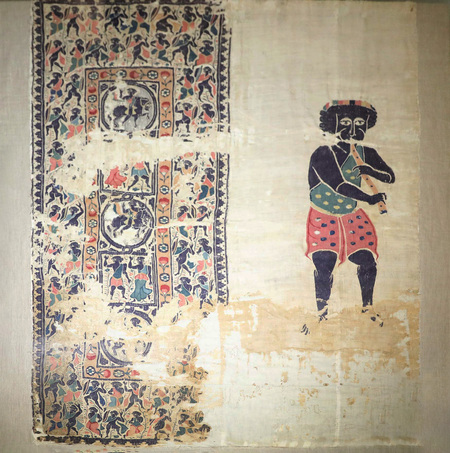
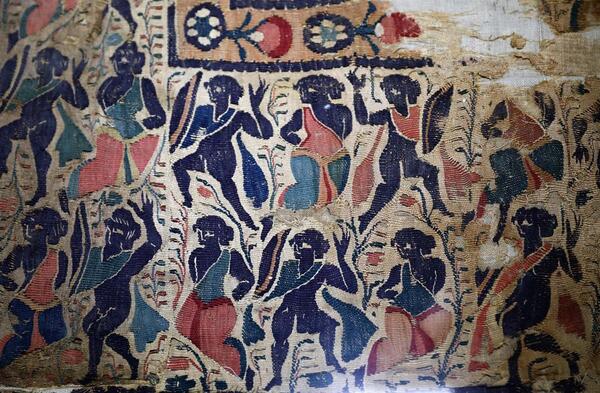
Another principle of image organization is presented in «The Flutist’s Curtain.» Here, the composition is not focused around a single character. The flutist occupies the right side of the image, while the left side features vertical groups of warriors and dancers. Because of this arrangement, the viewer’s gaze moves between distinct sections of the canvas, gradually assembling the image into a unified whole.
None of this allows us to assert that we are looking at a sequential narrative. The image rather unites various figures and motifs within a broader composition. It can be viewed as an example of a more complex organization of visual material, where meaning arises from the interaction of individual elements.
The very format of the work also plays a significant role here. Unlike a small medallion, the curtain is intended to be perceived from a distance and in relation to the surrounding space—which further contributes to a perception unanchored to a single center.
Section Conclusions
We examined two different approaches to organizing figurative imagery in early textiles. One focuses around a single character, whose meaning is conveyed through attributes and a stable pose, or it becomes more complex when multiple groups of figures are distributed across the fabric surface to form a single composition.Neither of these examples yet suggests a full narrative, but they illustrate how the capacity to integrate figures, motifs, and symbols into an extended composition will become a foundational element in the future development of wall coverings.
II. The Middle Ages: Sequence
In the Middle Ages, the element of time emerges in tapestries. As mentioned above, in early textiles, figures were grouped into a single composition—but now, events unfold sequentially in the canvas, and characters reappear from scene to scene.Large textile cycles adorned cathedrals and noble halls, and they were displayed for special occasions. Primarily, they recounted themes of power and faith, representing mythological or literary narratives.This section examines three works that illustrate three different ways of constructing sequence: the Bayeux Tapestry, the «Apocalypse of Angers, ” and the „Hunt of the Unicorn.“
Baye Sheet
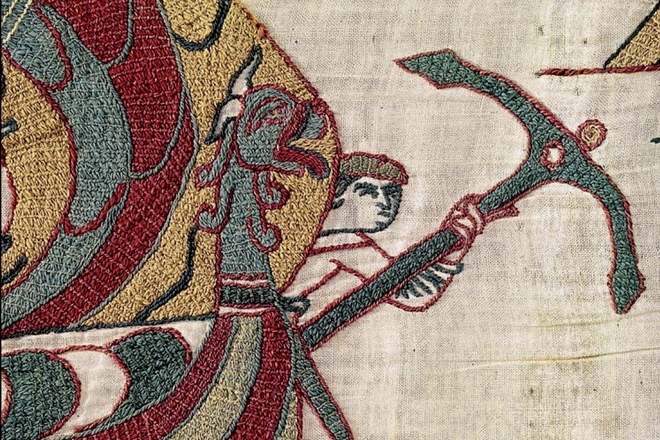
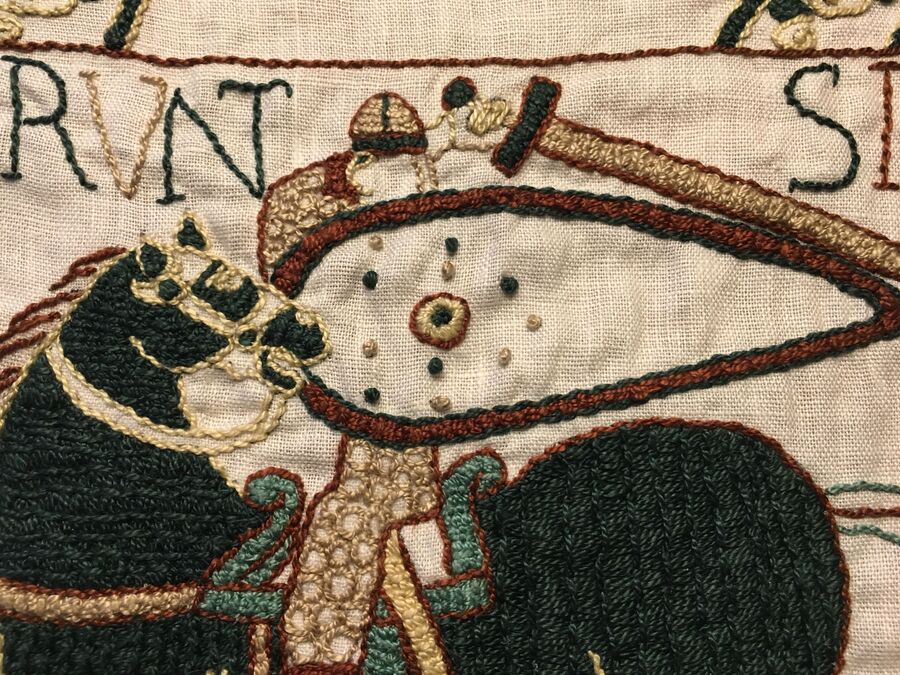
The Bayeux Tapestry is a strip about 68 meters long and approximately 50 centimeters high, detailing the events leading up to the Norman conquest of England in 1066.It is important to note that this is not precisely a tapestry, because, unlike woven tapestries, the imagery here is embroidered with wool threads onto a linen base. Nevertheless, the work is traditionally referred to as a tapestry, and for my research, it is fundamentally important as one of the earliest examples of narrative textile work.
The canvas is read from left to right. Stylized trees and buildings serve as the borders between scenes, allowing one event to flow seamlessly into the next without interruption—something that framed divisions would preclude. The temporal rhythm here is quite varied—travel sequences and dialogue scenes alternate with dense, figure-filled episodes of fleet construction and the Battle of Hastings.The narrative hinges on the recurrence of characters: Harold and William reappear again and again. Latin inscriptions above the scenes help the viewer identify them and briefly explain the action. The text is embedded within the image space—this is reminiscent of captions in a comic book.