Данный проект является учебной работой студента Школы дизайна или исследовательской работой преподавателя Школы дизайна. Данный проект не является коммерческим и служит образовательным целям

I. Introduction

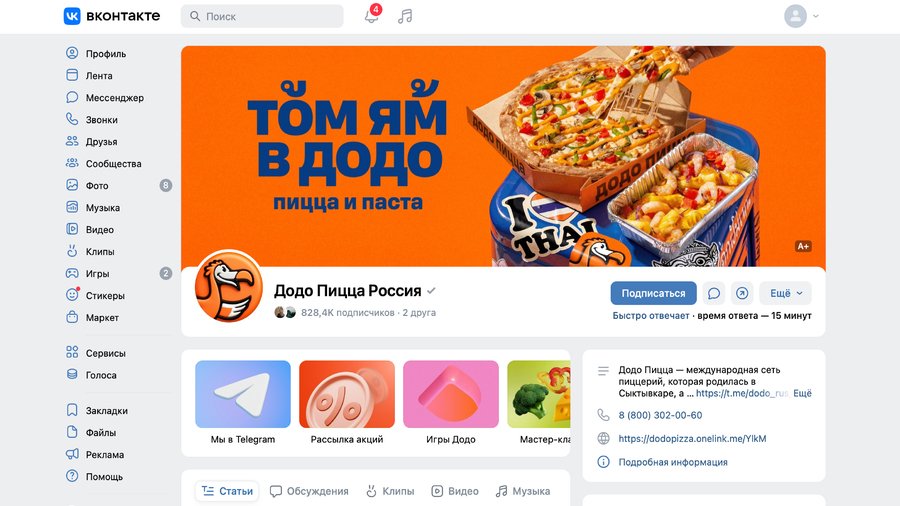
The brand «Dodo Pizza» was chosen for analysis due to its unconventional positioning in the fast-food market. Unlike traditional delivery chains, Dodo Pizza positions itself as a «technology company that makes pizza». The brand’s core idea lies in transparency, process automation, and openness of business metrics. This positioning is reflected across all of the company’s communication channels.

big
Исходный размер 4000x1517

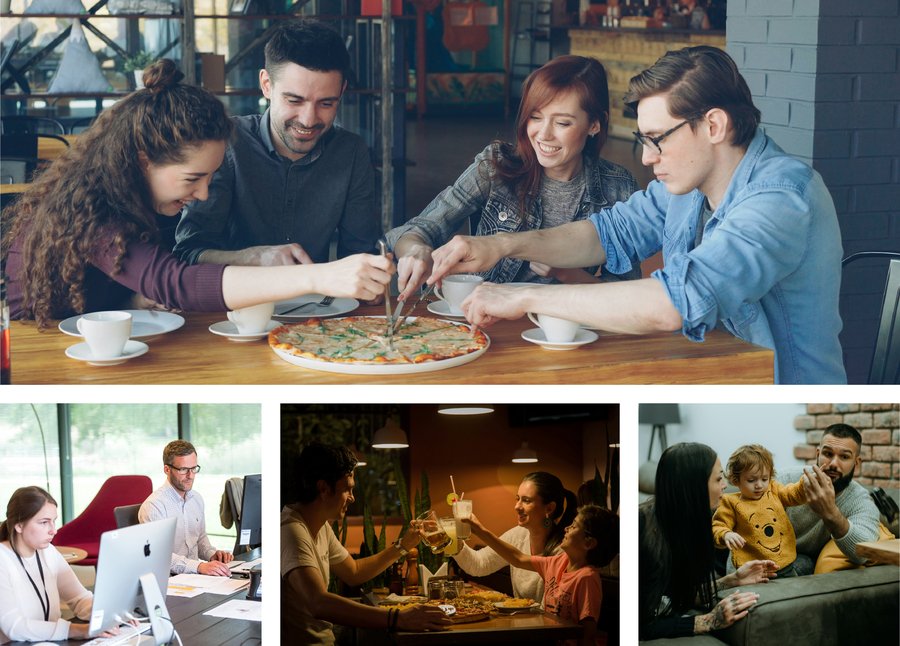
The brand’s target audience is segmented into two main groups. The first group is families with children aged 25–40, for whom delivery speed, consistent quality, and an understandable ordering interface are critically important. The second group consists of young professionals aged 18–30, working in the IT environment, who value humor, memes, and innovation. It is for these two segments that the brand builds its communication strategy, actively using visual imagery and dialogue formats on social media.
big
Исходный размер 4000x2873

II. Communication Channels

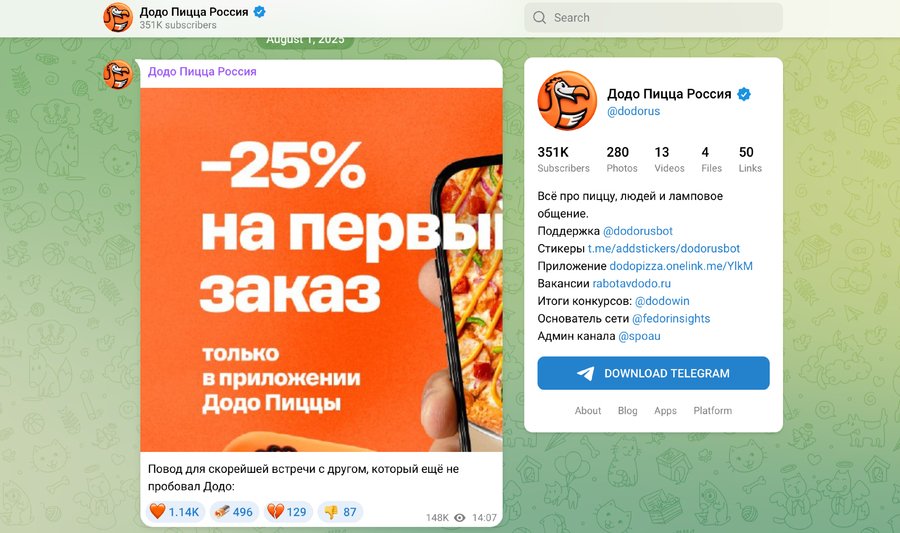
Dodo Pizza is present in several key digital channels. The main channels are Telegram and VK, where company news, internal statistics, memes, as well as detailed posts with business insights from the founder are published. On TikTok (@dodo_pizza), the brand focuses on entertainment content: short viral videos, pranks, challenges involving couriers.
0

The brand’s PR strategies include three key elements. First, a policy of complete transparency: data on revenue and number of orders for each branch is published in real-time on the dodopizza.ru website. Second, the personal PR of the founder, who acts as a public opinion leader in the field of technological entrepreneurship. Third, the active use of user-generated content (UGC), where customers film videos with the brand’s products and receive public recognition on official accounts in return.

III. Theoretical Framework

Two theories studied during the course are applied to analyze the chosen brand’s communication.

The first theory is the Elaboration Likelihood Model (ELM), proposed by Petty and Cacioppo (1986). This theory argues that persuasion can follow two routes: central (requiring conscious processing of arguments) and peripheral (based on heuristics, visual images, and emotions). Regarding visual persuasion in fast food, the hypothesis is that the peripheral route will dominate.

Исходный размер 4000x2250

The second theory is the Uses and Gratifications Theory (UGT), developed by Katz, Blumler, and Gurevitch (1973). This theory shifts the focus from the question «what do media do to people» to the question «what do people do with media». Audience needs can include obtaining information, socialization, entertainment, and personal identification. The analysis will determine which specific needs Dodo Pizza’s content fulfills.

Исходный размер 4000x2250

IV. Analysis

IV.I Application of ELM Theory: Visual Persuasion

The visual imagery used by the brand is almost entirely oriented towards the peripheral route of information processing. As proof, consider a screenshot of a post from the official Pinterest community. The image shows a close-up of a pizza with a stretching cheese strand against a warm orange-red background. The post has no text — it is unimportant here. No rational arguments about ingredients, calories, or delivery times are provided.

Исходный размер 3519x2250
Исходный размер 4000x1517

From an ELM perspective, this post activates peripheral cues: bright colors («aesthetic appeal»). The viewer requires no cognitive effort to make a decision — an emotional impulse leads to the desire «I want that pizza». This is an effective strategy for a low-involvement product.

Исходный размер 4000x2250

IV.II Application of UGT Theory: Social Media and Engagement

The Uses and Gratifications Theory helps explain why the audience actively comments, reposts, and creates content around the brand, even when not making a purchase. Let’s analyze three pieces of visual evidence.

Исходный размер 4000x1517

Need for Socialization

Исходный размер 4000x1042

A screenshot of a poll in the Telegram channel asks: «Which Winx Club fairy are you?». The post generated over 1000 comments; users argue, defend positions, and create inside jokes. The brand acts not as a seller, but as a community moderator, providing a platform for discussion. According to UGT, people use this post not so much for product information but to communicate with peers.

Исходный размер 4000x1517

Here, two needs are fulfilled simultaneously: the informational need (the user learns a fact from the brand’s history) and socialization (they can discuss in the comments why they were wrong or guessed correctly).

Исходный размер 1698x1644

However, the key difference from the first level is that the user’s cognitive effort is directed precisely at the brand. In ELM terms, this is the peripheral route with elements of the central route: the poll format itself does not require deep thinking, but the content of the question makes the user recall or guess facts about the company. This creates a mental connection — the brand is perceived as having a history worth studying.

Исходный размер 1698x1644

This format is the most effective. It fulfills the need for personal significance and autonomy (Self-Determination Theory, related to UGT) — the user feels that their voice has influenced the actual product range. Furthermore, it creates an expectation of future consumption: by voting for a topping, the user has already mentally ’tasted’ it and wants to buy the very product they chose. From an ELM perspective, a powerful peripheral cue of social proof is added in reverse: ’If the majority chose option A, then it must be delicious.’

The critical difference from the second level is that the voting outcome is directly converted into a purchasing action. The user goes to the app not just to ’browse, ’ but to order their pizza. This is the third, deepest level of engagement.

Need for Entertainment

Исходный размер 3519x2250

A screenshot from a YouTube Short demonstrates a viral video. The video shows a situation faced by restaurant pizzamakers due to the open kitchen system — a worker turns around and sees customers whose emotions resemble a popular meme with a cat. The pizza itself is almost absent from the frame, yet the video garnered 30,000 views. Here, the audience’s need is pure entertainment, escapism, and emotional release. The brand successfully «parasitizes» existing meme formats.

Need for Information

Исходный размер 3865x1644

The third example is a screenshot of the brand’s official response to a negative comment (VK screenshot). The employee responds not with a template «we regret», but with a concrete offer: «Write to us in DMs with your order ID — we’ll sort it out in 5 minutes». This fulfills the information need: the customer wants to know their problem has been heard and understood. However, it will be shown later that such live responses are not always the case.

V. Conclusion & Recommendations

V.I Effectiveness Assessment

Dodo Pizza’s strategy generally demonstrates high effectiveness. From an ELM perspective, the brand masterfully uses peripheral cues to quickly generate desire, which is critically important for the fast-food category. From a UGT perspective, the company successfully fulfills the audience’s needs for socialization (through polls and comments) and entertainment (through memes and viral formats).

0

However, several weaknesses can be identified in Dodo Pizza’s social media communication strategy. First, the brand relies predominantly on peripheral-route persuasion, while the central route of the Elaboration Likelihood Model (ELM) is used only to a limited extent. Most content focuses on emotional appeal, entertainment, promotions, and visual engagement, whereas posts providing detailed, fact-based information are relatively uncommon.

For example, Dodo Pizza rarely communicates in depth about nutritional values, ingredient sourcing, sustainability initiatives, food quality standards, or the environmental impact of its packaging. As consumer awareness regarding health, transparency, and sustainability continues to grow, the absence of such rational arguments may represent a missed opportunity to build stronger credibility and trust among more involved and conscious consumers.

Second, from the perspective of dialogic communication theory, Dodo Pizza does not always fully capitalize on opportunities for authentic two-way interaction. Although the company actively responds to comments and customer inquiries, many responses appear standardized and follow predetermined templates. While this approach ensures consistency and efficiency, it may reduce the perception of authenticity and personal engagement.

Consumers increasingly expect brands to communicate in a more human and individualized manner, particularly when addressing complaints or negative feedback.

Исходный размер 4000x2250

Third, despite maintaining a strong presence across multiple digital platforms, some of Dodo Pizza’s communication channels remain largely one-directional. This is particularly visible on platforms such as Telegram, where content is primarily used to distribute announcements, promotions, and product updates. Opportunities for user participation, discussion, co-creation, or community-building activities are relatively limited.

According to dialogic communication principles, encouraging greater audience involvement through polls, user-generated content campaigns, interactive discussions, and feedback initiatives could strengthen customer relationships and foster a stronger sense of brand community.

Исходный размер 4000x2250

V.II Recommendations

  1. Launch a «Bad Review Breakdown» rubric. It is recommended to publish a video format weekly where a live employee (not a chatbot) publicly analyzes one negative review — explaining what went wrong and offering compensation. This would apply the principles of dialogic theory and increase trust. (Though something similar exists on YouTube).

  2. Add content for the central ELM route. Create a series of posts under a conditional hashtag like #DodoEnough (playing on the word «dough»). These would reveal calories, the carbon footprint of packaging, a rating of ingredient suppliers. This information would be processed via the central route by the 30% of the audience who care about ethics and health.

  3. Implement interactive audio formats on Telegram. Instead of text polls, offer voice message circles from employees with unexpected questions («What would you add to a pizza if there were no rules?») and record subscribers’ voice responses. This would deepen socialization and add an element of human presence.

Библиография
Показать полностью
1.

Petty, R. E., & Cacioppo, J. T. (1986). Communication and persuasion: Central and peripheral routes to attitude change. Springer-Verlag.

2.

Katz, E., Blumler, J. G., & Gurevitch, M. (1973). Uses and gratifications research. Public Opinion Quarterly, 37(4), 509–523.

3.

Official Dodo Pizza website. Access mode: https://dodopizza.ru (viewed 10.06.2026). Sections: «About the company,» «News,» «Careers.»

4.

Official Dodo Pizza Telegram channel. Access mode: https://t.me/dodopizza (viewed 10.06.2026).

5.

Official Dodo Pizza TikTok account. Access mode: https://tiktok.com/@dodo_pizza (viewed 10.06.2026).

6.

Official Dodo Pinterest account.

7.

Official Dodo VK account.

Источники изображений
1.

All illustrative materials are screenshots taken by the report author between June 1 and June 10, 2026, from the official brand accounts listed above.

Мы используем файлы cookies для улучшения работы сайта и большего удобства его использования. Более подробную информац...
Показать больше