«You smashed the rose window! The thirteenth century. It had stood for six hundred years…» — Van Helsing, 2004 [1].
Concept
Cologne Cathedral is a Roman Catholic Gothic cathedral, an outstanding monument of German Gothic architecture. The stained glass, which constitutes one of the important elements of its interior decoration, represents complex artistic compositions.
In my work, I investigate the ornamental and geometric elements of stained glass, which are often given less attention than the narrative compositions. Even the earliest stained glass windows of Cologne Cathedral (13th–14th centuries) are astonishing in their scale, detail, and variety of patterns. Using the oldest windows of the cathedral—the «Älteres Bibelfenster» («Old Bible Window»), c. 1260, the «Königsfenster» («King Windows»), c. 1300–1311, and the «Dreikönigenfenster» («Three Kings Window»), c. 1330–1340—I aim to determine the purpose of the stained glass ornaments and how they influence the viewer’s perception of the narrative scenes.
Navigation Menu
- Concept
- Composition
- Contrast
- Line
- Form
- Geometry
- Construction Principles
- Bibliography
- Image Sources
Composition
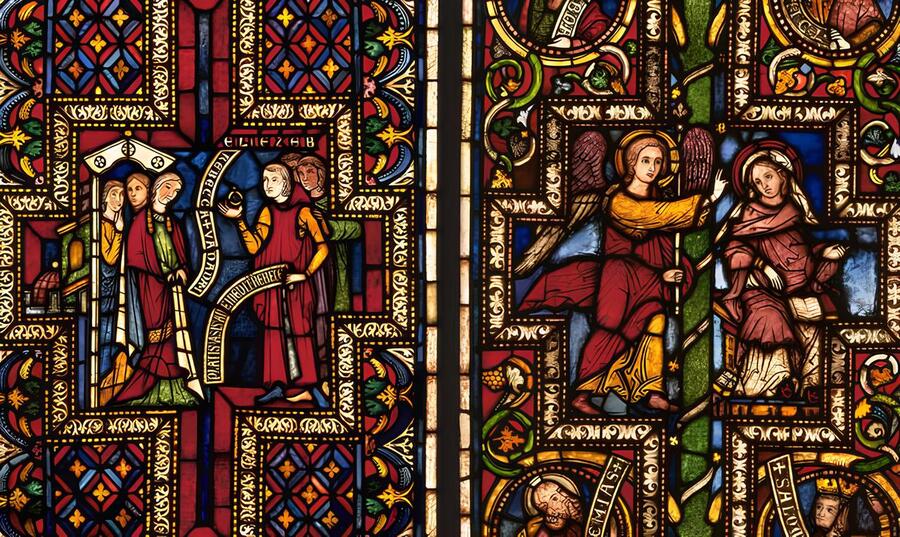
The Annunciation to Mary by Rebecca. The second pair of subjects from the «Älteres Bibelfenster» («Oldest Biblical Window») stained glass, c. 1260.
The composition of one of the stained-glass windows, «Older Bible Window, ” is structured as two vertical sections that tell two related narratives. The left side depicts the Old Testament, and the right side depicts the New Testament. The images are paired so that the viewer can see foreshadowings of events in the Old Testament within what will later occur in the New Testament. Consequently, the decorative elements of the composition align distinctly with their visual theme.
Fragments from the second-to-last pair of scenes from the stained glass window «Elder Biblical Window» («Oldest Biblical Window»). The left, central panel depicts «Betrothal to Rebekah, ” and the right panel depicts „Annunciation to Mary, ” circa 1260.
The solid background and the strict structure of diamonds and crosses on the left half create a sense of rhythm and order, helping the viewer perceive the enormous vertical stained glass as a unified whole. Concurrently, the dense ornamental grid is partially connected to the narrative content. The left side features Old Testament scenes that precede the events of the New Testament. The primary, simple ornament on the left transitions into a more complex, less ordered vegetal ornament on the right. Here, the decorative function of the leaves, scrolls, and stems merges with a symbolic one: they connect the history of the ancient people with the arrival of Christ. The vegetal ornament symbolizes Christ’s origin as a continuous line extending into the past.
Imperishable bud / Christmas. The third pair of subjects from the stained-glass window «Older Biblical Window, ” circa 1260.
Thus, the geometric background on the left side of the stained glass organizes the space and functions as a decorative element, while the botanical pattern on the right side can be viewed as a self-contained biblical symbol.
Maria on the throne / Christ on the throne. Upper scenes of the stained-glass window «Älteres Bibelfenster» («Oldest Biblical Window»), c. 1260.
Contrast
Why do decorative elements help the viewer see the main subject, complement the stained glass without drawing attention to themselves?
The answer is contrast. The perception of an image by the viewer is influenced by the opposition of hues used in the composition. It must be noted that masters were already working with color very skillfully in the 14th century.
Fragments of the lower section of the «Königsfenster» (Royal Windows) stained glass, c. 1300–1311.
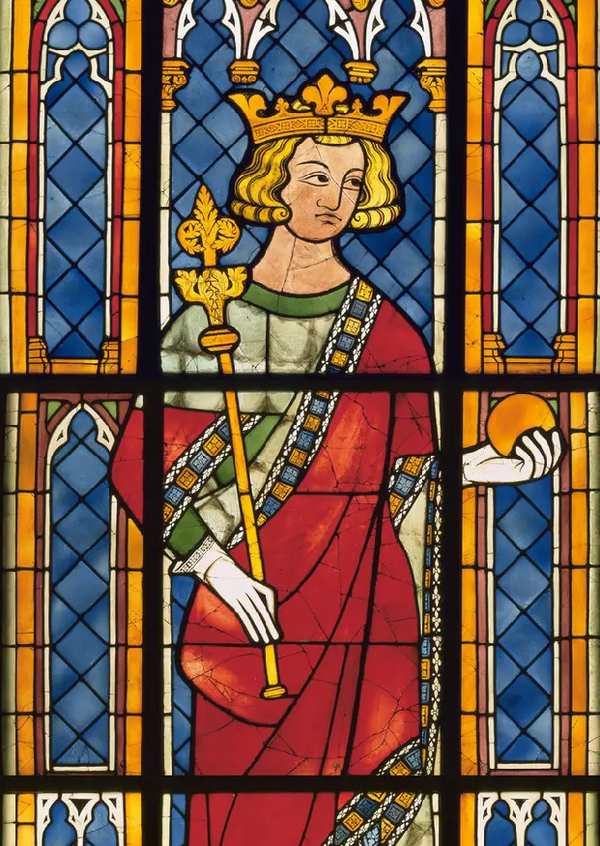
For example, here is another ancient stained-glass window from the cathedral—the «Königsfenster» («Royal Windows»). We immediately notice the images of kings at the center of each window’s composition. Their figures are highlighted by the contrast in color: the rulers' garments contrast with the background ornamentation. The red and blue create distinct color oppositions, so the figures are separated from the rhythmic grid behind them and are perceived as independent silhouettes. It is also worth noting that the backgrounds of the stained glass are much darker in tone than the figures of the rulers, and this is deliberate. If we imagine sunlight streaming through the stained glass from the outside, the figures of the rulers would stand out even more.
Fragment from a lower section of the «Königsfenster» («Royal Windows») stained glass, c. 1300–1311.
Geometric and floral elements of the pattern are present in the fine details of the royal garments. For instance, their belts, garment edges, and footwear are decorated with a fine, intricate ornament: squares, clover flowers, rhombuses, and circles. Furthermore, the ornament on the clothing does not blend into the background—the viewer can clearly distinguish the border between the ruler’s figure and the stained-glass background due to the different sizes of the decorative elements.
The large, generalized background grid contrasts with the fine, detailed ornamentation on the clothing, allowing us to distinguish them clearly.
Fragment of the lower section of the «Königsfenster» (Royal Windows) stained glass, c. 1300–1311.
The principle of contrast is also observable in the arrangement of the stained-glass windows. In the lower third of the «Royal Windows, ” which stand almost 18 meters high, images of both old and young rulers alternate. The blue and red background ornamentation also alternates. This technique influences the viewer’s perception of the stained glass. In this instance, the color palette may not merely be a chromatic decision but a deliberate choice connected to the semantic weight of the image. For example, red is associated with power and sacrifice, while blue signifies the celestial sphere and spirituality. Consequently, if specific rulers are depicted in the stained glass, the colored background may reflect their personal qualities.
Line
Lines, alongside geometric and organic patterns, play a vital role in the composition of a stained-glass window. They structure the design and help highlight the main focal points. The strips that connect the geometric motifs and narrative segments can also be described as decorative elements. Each possesses its own character, distinguishing it from other ornamentation, and moreover, they echo the very image of the cathedral on the glass surface.
Gereon. Fragment of the second-from-top pair of scenes from the stained glass window «Dreikönigenfenster» («Window of the Three Kings»), c. 1330–1340 / West Portal of Cologne Cathedral, 14th–19th centuries.
It is impossible not to notice the parallels between the ornamental elements of the «Dreikönigenfenster» (Three Kings Window) stained glass and the central portal of Cologne Cathedral. They were created around the same time and share obvious similarities. For instance, the vertical white linear ornamental elements in the stained glass composition depict the cathedral’s own columns. The design of the portal arches is identical to that of the left section of the stained glass fragment. In this case, the ornament is not merely a decorative element but a specific pattern sequence that mimics the appearance of the cathedral. Furthermore, the stained glass features gold stripes and other golden elements that emphasize the connection to religious themes. Gold in stained glass and icon painting is most often a symbol of holiness, eternity, and the Kingdom of Heaven; therefore, the gold ornamental elements complement the composition, lending it expressiveness, and are an inseparable part of it, harmoniously coexisting with the elements of the rigorous architecture of Cologne Cathedral.
Sculpture
From left to right, two are fragments of the stained-glass window «Older Bible Window» (Старейшее библейское окно), circa 1260, and three are fragments of the stained-glass window «Three Kings Window» (Окно Трёх Волхвов), circa 1330–1340.