Navigation
Concepts1. Circus (1925)2. Ice Cream (1925)3. Yesterday and Today (1925)4. Baggage 4.1 (1926) 4.2 (1931) 4.2 (1965)5. Moustachioed Stripe 5.1 (1930) 5.2 (1948) Conclusion Bibliography Image Sources
Concept
The creative collaboration between the poet Samuel Marshak and the artist Vladimir Lebedev holds a special place in the history of Soviet children’s literature. Their joint work began in 1925 with «The Circus» and continued for decades, giving rise to «The Baggage, ” „Ice Cream, ” „The Striped Whiskers, ” and others. However, the significance of this duo is not defined by the sheer number of books they created, but by how they changed the very concept of the illustrated children’s book. Illustration ceased to be a mere embellishment of the text and became an equal participant in the narrative, transforming the book into a cohesive work of art governed by a unified structural vision.
The relevance of this research lies in the fact that the books by Marshak and Lebedev from the 1920s represent a rare instance where the visual language of the avant-garde was not simply overlaid onto children’s literature, but successfully reached the mass reader. Lebedev did not simplify the avant-garde for children; instead, he found ways to make it accessible without sacrificing artistic complexity.
The central research question is to examine the key characteristics and transformations in children’s literature under the guidance of S. Marshak and V. Lebedev. This study aims to identify and analyze the techniques Lebedev employed in children’s illustrations of the 1920s and how those same narratives evolved over time under the pressure of various circumstances.
The study’s hypothesis is that the innovation in children’s literature of the 1920s did not reside in isolated stylistic techniques, but rather in establishing a new model for the book—one where illustration and text served as equal co-authors of the narrative, and where the visual language of the avant-garde was systematically applied to children’s literature without being oversimplified for the child.
The research structure is built on the sequential comparison of two planes. The study proposes to examine preceding trends in children’s illustration and new solutions through the lens of the vision of V. Lebedev and S. Marshak. Furthermore, early and late editions of the same works are compared. This approach allows us to document where Lebedev diverged from tradition and trace how established books were transformed.
Material selection for the research centers on several types of sources. The core consists of books and articles about the work of S. Marshak and V. Lebedev, contemporary reviews, and critical responses to specific books, alongside general works that examine the evolution of children’s literature in the 1920s–1930s.
1. Circus (1925)
Sketches for «Circus, ” 1925 V. Lebedev
«The Circus» was the debut work of the creative partnership of S. Marshak and V. Lebedev, and it stands as a rare instance in the history of children’s literature where the illustrations were created before the text was written. This approach altered the production logic and formed a cohesive artistic vision, in which all elements submitted to a single constructive concept and overall composition. Lebedev functioned not as an illustrator of a finished text, but as an equal co-creator, establishing the book’s visual and rhythmic framework.
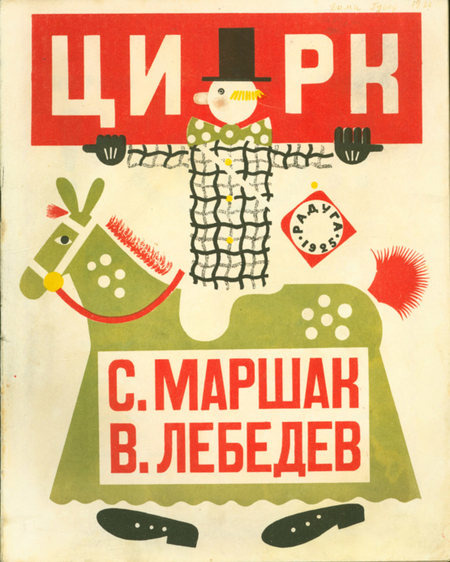
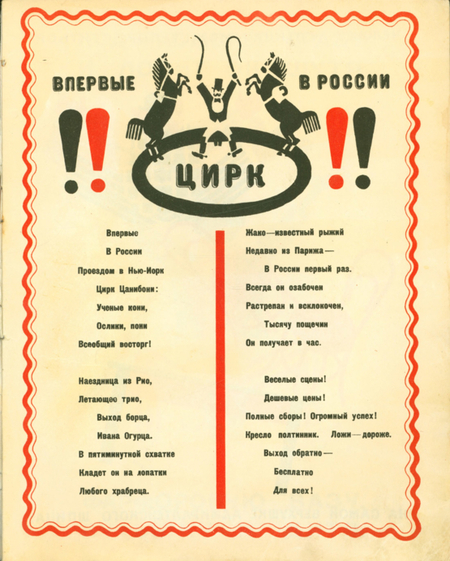
Illustrations for the book «The Circus,» 1925 V. Lebedev and S. Marshak
Lebedev developed his visual language not in an academic studio, but while working on propaganda posters. These had to be created in mere hours, which trained the artist to be extremely concise and precise. His style was characterized by the use of a limited color palette, the creation of recognizable silhouette characters, and the immediate conveyance of visual information. He directly applied this experience to children’s books.
Lebedev maintained a distinct rhythm throughout the book; each page is structured like an individual poster, yet together they form an unfolding performance—the cover acts as a poster, the title page introduces the performers, and then the «acts» of the circus show begin.
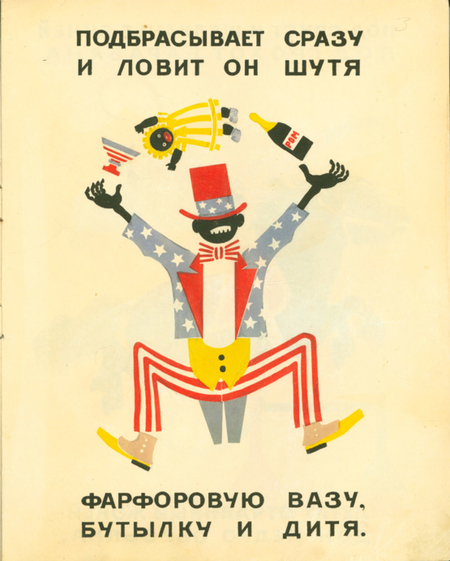
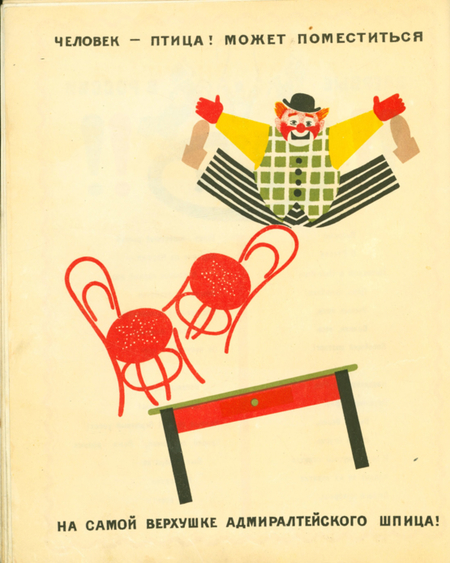
Illustrations for the book «Circus, ” 1925 V. Lebedev and S. Marshak
S. Marshak’s poems were concisely integrated into the page composition, supporting the book’s concept and overall pacing. The illustrations were rendered using localized color patches, precisely placed on a white background. Lebedev employed geometric forms, demonstrating how the visual language of the avant-garde lives within the context of a children’s book. He eschewed traditional detailed rendering and cross-hatching, opting instead for minimal representational elements.
«Art should be just as accessible to a child as it is to an adult. Just don’t let the packaging intended for a child be too hard to open.»
The book was labeled «highly controversial, ” both regarding its narrative and its excessive sophistication. Many criticized it for having „form triumphing over content, ” while the artistic community celebrated the book’s modernity and topicality. They defended the poetic imagery and the playful nature of the book, which critics deemed frivolous.Marshak directly opposed the demand that the entire text be perfectly understandable to a child. He believed this led to an artificially idealized image and a loss of the author’s individuality. The poet recalled reading children’s books in his youth where not everything was clear, and he found that beneficial. Lebedev fully supported his colleague in this regard, demanding that the illustration be active. It needed to explain, to respond, and to be memorable. This signified a break from the tradition of decorative books by Bilibin and Benois, where the illustration served as ornamentation, remaining merely an aesthetic object for admiration.
Illustrations for the book «The Circus,» 1925 V. Lebedev and S. Marshak
The principles established by Marshak and Lebedev were rooted in viewing the children’s book as a unified artistic organism, where text and illustration are equal partners subservient to a singular constructive vision. They championed the right of the children’s book to be art, not merely a pedagogical tool, defending complexity, imagination, and humor against the demands of simplification and perceived «readability.» Their method required the rhythmic organization of the entire book, poster-like clarity and conciseness, while simultaneously preserving their unique artistic vision while accounting for children’s perception. It was this approach that made their collaboration a benchmark for the new children’s book of the 1920s.
2. Ice Cream, 1925
«As my colleague—the artist Lebedev—puts it, ‘a children’s book should be memorized by the kids, pictures should be cut out’—that is the honorable and natural death of a good children’s book.»
Subsequent works demonstrate a continuity of established principles regarding the interplay between text and illustration, a developed visual language, and an approach to children’s literature.
«Ice Cream» is constructed as a caricatured street scene that the child seems to be eavesdropping on. The rhythm of the text mimics the movement of the ice cream vendor’s cart, and the vendor’s shouts sound like authentic advertising. Marshak deliberately uses colloquial, vibrant language, striving to maintain the liveliness and reality of the scene.
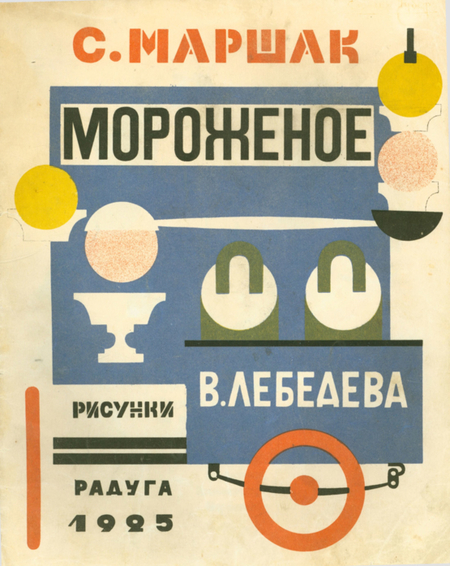
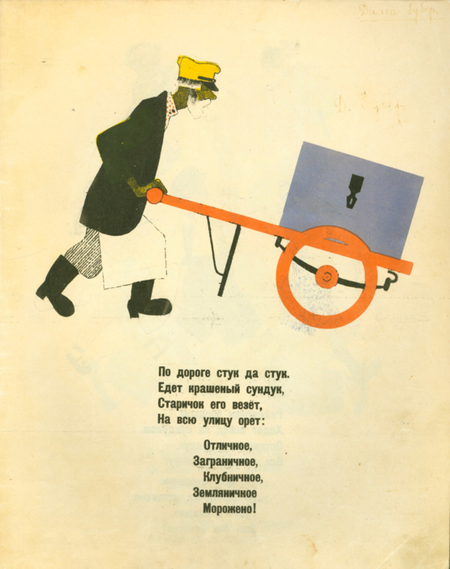
Illustrations for the book «Ice Cream, ” 1925 V. Lebedev and S. Marshak
The plot revolves around a corpulent man who gorges himself on ice cream and transforms into an ice mountain. Marshak often infused the childlike psyche with romantic irony, ridiculing a lack of moderation. At its core lies the idea of disrupting the natural order and punitive retribution as a lesson—yet the ending elicits a bittersweet smile rather than a triumph. The poet deliberately employs hyperbole and irony to convey the absurdity of the situation.
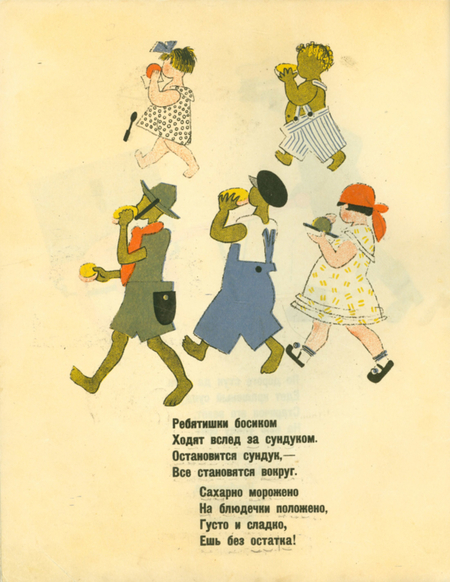
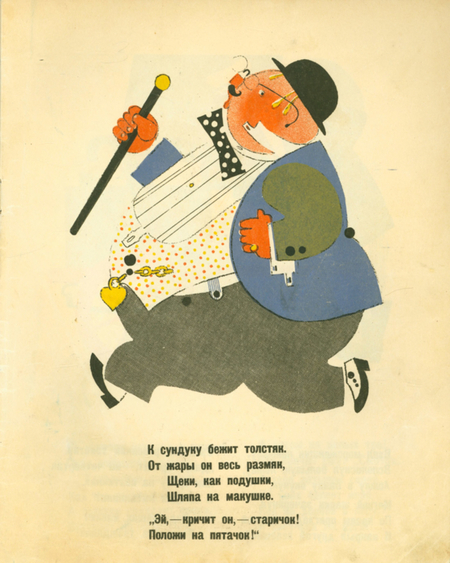
Illustrations for the book «Ice Cream, ” 1925 V. Lebedev and S. Marshak
Lebedev draws a corpulent figure with gentle irony, rather than malicious satire. His caricature doesn’t destroy the character; instead, it makes him simultaneously funny and pathetic. Nevertheless, the visual language remains poster-like. He employs local colors, flat forms, and eschews perspective. Color functions dramatically: the man’s hands and face flush as he eats, and the drawing abruptly darkens in the finale. Lebedev meticulously develops archetypes, endowing the corpulent figure with social markers of a NEPman: a kettle, a mustache, and gold watch on a chain.
Illustrations for the book «Ice Cream, ” 1925 V. Lebedev and S. Marshak
3. Yesterday and today, 1925
«Yesterday and Today» is an enlightening book about the change in lifestyle, built upon a witty contrast. Marshak constructs a dialogue between generations, visually demonstrating the shift of eras through everyday objects. The old items, though cantankerous, evoke warmth and memories. Conversely, the new electric light bulb behaves rudely and shamelessly, taunting the old lamp. Behind the «yesterday» and «today» objects stand the «former» and «new» people. This provides a wonderful opportunity to discuss progress and respect for the past, as well as the relationships between different generations.
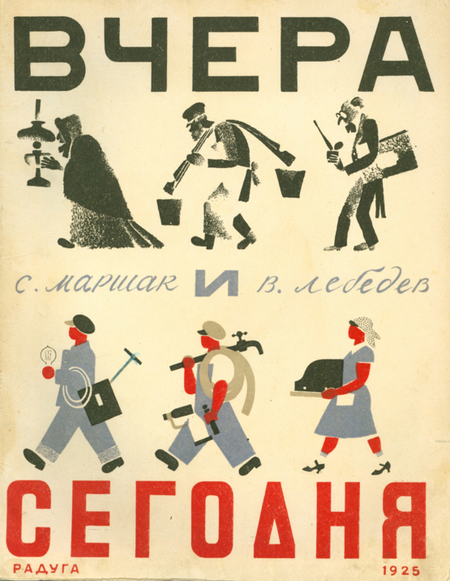
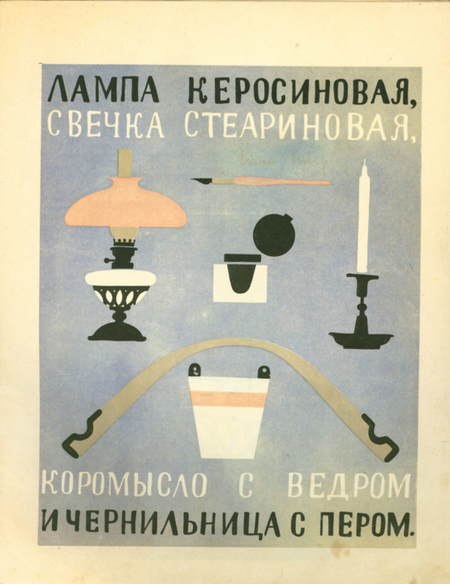
Illustrations for the book «Yesterday and Today,» 1925 V. Lebedev and S. Marshak
It is in the illustrations for this book that Lebedev’s talent as an experimental artist and satirist is fully revealed. The cover establishes a drama through contradiction—both in its title and visually—creating a contrast between the gray, hunched past and the bright, vibrant present.
Lebedev breathes life into objects, endowing them with character and vivid features. A faded kerosene lamp is depicted as crooked and stooped, like an old woman. The electric light is drawn so brilliantly that the page seems to glow from within. The artist deliberately combines various styles to heighten the contrast. A caricatured scene sits alongside a striking advertisement, a technical diagram, and a folk illustration of girls by the river.
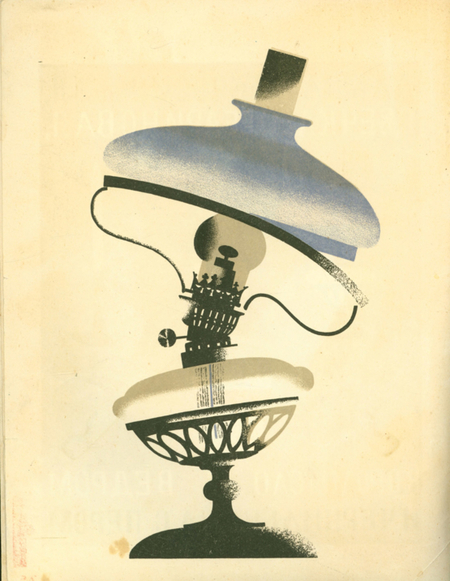
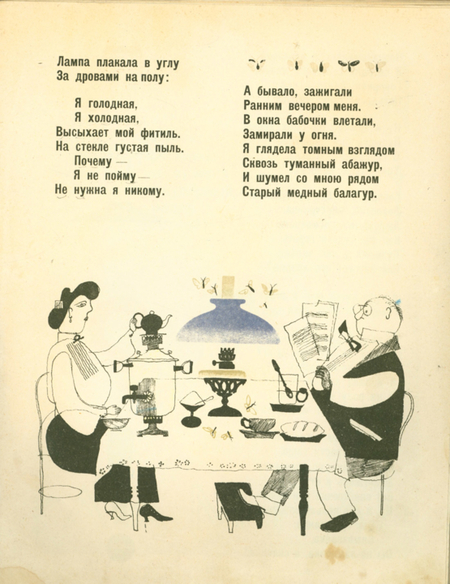
Illustrations for the book «Yesterday and Today, ” 1925 V. Lebedev and S. Marshak
Lebedev blended various styles like different voices in a debate. He showcased conflict, making the pages literally «argue» with each other through their design. A child absorbs this hierarchy not through formal notation, but through visual contradiction.