Concept
Research examines the role of documentation in the artistic practice of the group «Collective Actions”—one of the key associations of Moscow Conceptualism that emerged in 1976. The primary focus is on photographs, reports, schematics, and other archival materials that accompanied the group’s actions. In contrast to the traditional understanding of documentation as a means of preserving information about a past event, in the practice of „Collective Actions, ” the document becomes an independent component of the artwork. Photographs often capture almost empty spaces, reports confirm the presence of the viewer, and schematics describe actions whose meaning cannot be fully conveyed visually. The research explores how the artists use documentary forms to engage with the invisible: anticipation, absence, spatial distance, subjective perception, and memory. Special attention is paid to the paradox of documentation: the less spectacular the artistic event turns out to be, the greater the role played by the materials that remain afterward. By juxtaposing archival photographs, texts, reports, and schematics, the study reveals how documentation ceases to be secondary evidence and transforms into an autonomous artistic language.
Research Question How do the photographs, reports, and schematics in the actions of the group „Collective Actions“ transform invisible or difficult-to-capture aspects of an artistic event into objects of visual perception?
Hypothesis In the practice of „Collective Actions, ” documentation does not so much reproduce the artistic event as it creates additional modes of its perception. The photograph renders the absence of action visible, the report materializes the fact of participation, and the schematic transforms space and the sequence of events into a conceptual construct.
Objective To identify the artistic functions of photographs, reports, and schematics in the actions of the group „Collective Actions“ and to determine how documentation contributes to the formation of the artwork’s meaning.
Rubrics
- Concept
- Art That Is Difficult to See
- Photography: The Image of Absence
- Archive: Proof of Presence
- Diagram: Visualizing the Invisible
- Archive: Event After Event
- The Document as Artwork
- Conclusion
Art that is difficult to see
The group «Collective Actions» emerged in Moscow in 1976 and became one of the significant phenomena of Moscow Conceptualism. Its activity is primarily associated with Andrei Monastyrsky, as well as Nikita Alekseev, Georgiy Kizevalter, Nikolai Panitkov, and other artists and writers who participated in actions at different times. Russian Art Archive Network+1Moscow Conceptualism developed in an environment where official art was bound by specific requirements regarding imagery and artistic content. Artists from the unofficial circle sought alternative ways to engage with reality. They were interested in language, everyday life, ideology, mass imagery, and how humans perceive the surrounding world.Unlike traditional art, where the finished product is paramount, Conceptualism often prioritizes the idea of the work. A text, an instruction, an action, or even a situation that superficially resembles ordinary life can become the artistic object.This characteristic is particularly evident in the work of «Collective Actions.» The artists did not create the kind of conventional performance for the audience with a plot development and a climax. Instead, they orchestrated situations where the viewer had to pay attention to what was happening and find meaning for themselves.Many of the actions took place outside the city. The space of a field or a forest was not merely a backdrop; it became part of the artwork. Unlike a museum hall, where the viewer knows in advance that what they are seeing is art, the natural environment provides no such overt cues. Therefore, the individual had to determine for themselves the moment when an ordinary situation transforms into an artistic event.
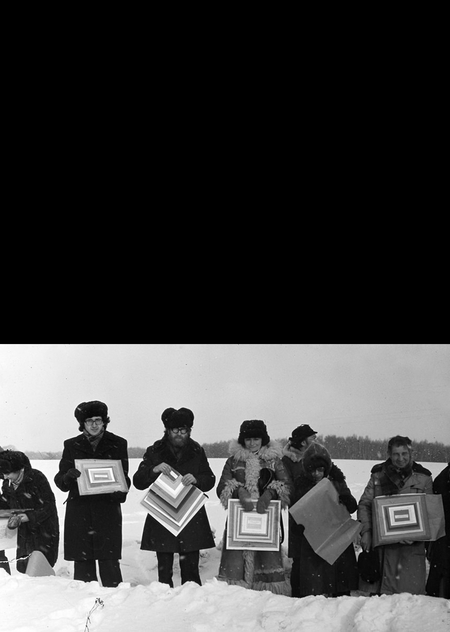
Group «Collective Actions.» Documentary photographs of rural events
The outdoor simplicity of the events is often noticeable in the photographs. People stand in winter clothing, walk in the snow, or gather in small groups. The image almost entirely lacks signs of a deliberately staged performance. This blurs the boundary between art and ordinary events.
In my opinion, this very ambiguity is a crucial artistic device. The individual finds themselves in a situation where they know they are participating in a work, but they cannot always grasp what that work entails. As a result, attention shifts from the observed object to the process of observation itself.
One of the core elements of the group’s actions is anticipation. Typically, an audience member attends an exhibition or performance to see something. In the case of «Collective Actions, ” however, they may spend long periods in a space where almost nothing happens.This waiting cannot be dismissed as merely a pause between significant events. It becomes an integral part of the work itself. The individual begins to notice the surrounding space, the movements of other participants, changes in lighting, their own thoughts, and the sensation of time.This is particularly evident in one of the group’s earliest actions—“Appearance, ” which took place on March 13, 1976, at Izmailovskoye Pole.According to Andrei Monastyrsky’s description, about thirty invited viewers gathered at the edge of the field. A few minutes later, two people appeared from the opposite side. They emerged from the forest, crossed the field, and handed the viewers documents confirming their presence at the action.
«Collective Actions.» «Appearance,» 1976
If one were to recount this action literally, its content seems very simple: several people wait for others to approach them. However, from an artistic perspective, what matters more is the viewer’s state beforehand rather than the figures’ mere appearance.
While the participants are far away, they are almost impossible to distinguish. They are perceived as small points against the backdrop of a natural landscape. Gradually, the figures become more discernible, and the viewer begins to understand that they are people. Thus, a simple approach transforms into a process of an image emerging within real space.
A fascinating parallel arises here with photography. When looking at a picture, the viewer, too, attempts to isolate the object from the surrounding space and discern where attention should be focused.
It seems to me that «Appearance» can be viewed as a piece about the very process of seeing. The artists seem to be inviting the viewer to track how something first is absent from view, then becomes noticeable, and only after that gains significance.
So why is the event almost unnoticed?In traditional art, a significant moment is often highlighted compositionally—through color, light, scale, or expressive movement. In the «Collective Actions» events, everything happens differently. A meaningful event might barely distinguish itself from ordinary human movement through space.This creates unusual relationships between the viewer and the artwork. The viewer does not receive a ready-made visual image that can be immediately understood. They must decide for themselves what to consider primary and what to consider secondary.In this sense, the absence of spectacle does not mean the absence of artistic content. On the contrary, it allows attention to be drawn to those elements of experience that usually go unnoticed.For example, when a person looks at an empty field, they perceive it as an ordinary landscape. But if they know that someone is supposed to emerge from the woods at a certain moment, then the same field begins to be perceived as a space of anticipation. Externally, it does not change, but its meaning becomes different.This is precisely why documentation is so important. A photograph of an empty space can look like a landscape shot on its own. But alongside a description of the action, it becomes a witness to a specific artistic experience.It turns out that the meaning of the work is created on several levels simultaneously: during the action itself, in the participants' memories, and in the documentation that remains afterward.
Photo: Image unavailable
Photography is traditionally perceived as a means of preserving a moment from the past. It captures a specific place, time, and the objects that were before the lens.
In performance art, photography holds a unique significance because the work often exists only during the act itself. After it concludes, the viewer can no longer see the event in its original form. Instead, they can engage with it through images, video recordings, narratives, or other materials.
However, in the case of «Collective Actions,» photography performs a more complex function.
In many of these images, the conventional focal point is absent. A photograph might depict a large expanse of snow, a line of forest, or a barely discernible human figure. This type of composition does not explain to the viewer what exactly happened during the action.
On the contrary, the photograph compels us to consider what is absent within it.
This becomes particularly interesting when comparing such works with standard reportage. A photojournalist would most likely strive to capture the most expressive moment of the action. In the documentation of «Collective Actions,» however, attention is frequently directed toward the space surrounding the event, the distance from the participants, and visual ambiguity.
Thus, photography begins to function not merely as proof of what occurred, but as an autonomous image demanding interpretation.
«Appearance,» 1976. Photographic documentation of the action
If we consider a photograph of the «Emergence» performance from a compositional standpoint, the first thing that catches the eye is the abundance of negative space.
The snowy field occupies a significant portion of the image, and the forest forms a horizontal line in the distance. The human figures appear very small in comparison to the surrounding landscape.
This relationship of scale alters the usual hierarchy between the human and space. Typically in performance photography, the artist or participant becomes the main subject, with the environment serving as a backdrop. Here, the opposite occurs: the space is more significant than the figure.
It seems to me that this technique helps convey a sense of anticipation. When a person gazes into the distance for a long time, their attention is focused not only on the object that is about to appear but also on the space separating them from that object.
The emptiness in the photograph ceases to be just an unfilled part of the composition. It becomes an image of time—the time the viewer spent waiting.
Furthermore, the snowy landscape creates a distinct feeling of silence. There are hardly any bright details in the photograph to distract the viewer. The small number of visual elements compels the viewer to examine the image more slowly.
Here, one can speak of a peculiar visual minimalism. Artists do not remove everything superfluous from the frame artificially; rather, they utilize the characteristics of the chosen space. The open field, in itself, becomes an almost abstract surface.
Nevertheless, the photograph retains a documentary quality. We understand that the depicted space actually existed and that the performance truly took place within it. This combination of documentary evidence and an almost abstract composition makes the shot particularly compelling.
One of the most revealing events for this study was the «Ten Appearances» event, held on February 1, 1981.According to the organizers' plan, participants spread out from the center of the field in different directions toward the forest. After completing their route, they could independently decide whether to return or continue moving. Eight participants returned, while two did not return to the starting point.The returning participants were given photographs depicting sections of the forest and small figures, allegedly indicating the appearance of specific participants. These photographs were taken in advance—about a week before the event—and featured other people.
«Collective Actions.» «Ten Appearances, ” 1981
This piece particularly demonstrates that photography is not necessarily direct evidence of the event it is associated with. Typically, we assume that documentary photography was taken precisely at the moment it depicts. In «Ten Appearances, ” this assumption is disrupted. The photograph outwardly appears to be testimony to the participant’s return, but it was actually created before their appearance. Consequently, the photograph does not merely capture an event—in a certain sense, it predicts or substitutes for it. The caption plays an especially vital role here. Without text, the viewer sees only a small figure near a forest. But when the participant’s name and the date of the event appear beneath the photograph, the image begins to be perceived as a document of a specific incident. It is the caption that transforms an ambiguous human figure into a specific individual. Through this work, it becomes evident how heavily our perception of a photograph depends on the accompanying information. We are accustomed to trusting documentary imagery, but artists show that the link between a photograph and an event can be deliberately constructed.
Photographs from «Collective Actions» can also be seen as a way of engaging with memory. When a person participates in an event, they experience it from a specific spatial perspective. They see only a part of what is happening and do not know what others are feeling. After the event concludes, participants can share their impressions, look at photographs, and read descriptions. At this point, their memories begin to interact with the documentation. A photograph may confirm an element of an event, but it can also change the perception of it. For instance, a participant might have primarily remembered the long wait, while the photo captures a brief moment of movement. Consequently, documentary photography does not replace personal experience; rather, it creates another version of the event. It seems to me that this is precisely what makes the «Collective Actions» archive interesting to the contemporary viewer. We cannot directly participate in the actions of the 1970s–1980s, but we can compare different documents and attempt to reconstruct their content. Yet, it is impossible to fully restore the original experience. The photograph preserves only the visible aspect of the event. It does not convey the cold, the duration of the wait, the sounds of the surrounding space, or the participants’ private thoughts. Therefore, the documentation simultaneously helps to get closer to the event while also reminding us of the distance between the past and the present.
Certificate: Proof of Attendance
One of the most unconventional elements of the «Collective Actions» series is the certificate. Typically, a certificate is associated with an official organization, a confirmation of some fact, and a bureaucratic procedure. It is required to verify that a person was actually in a specific place, participated in an event, or performed a certain action.In art, such a document seems completely out of place at first glance. However, Moscow Conceptualists often used familiar forms from everyday and official culture to illustrate how language and social conventions influence our perception.In the «Appearance» action, the certificate becomes one of the main elements of the work. After two participants pass through the field, the audience receives a document confirming the fact of their presence at the action.
Attendance Certificate for the «Appearance» Event, 1976
I find the contradiction between the document’s form and the event’s content to be the most compelling aspect here. A certificate implies that something significant has occurred, requiring official confirmation. However, if we view the action from the outside, we see a rather simple situation: people gathered in a field, waited for others to arrive, and received paper documents. The significance of the certificate arises precisely from this disproportion. The artists seem to be using serious, official language to validate something that wouldn’t require any kind of certification in everyday life. Because of this, the usual bureaucratic form begins to be perceived differently. The document becomes simultaneously a genuine testament to presence and an artwork that compels us to question the necessity of such a testament in the first place. The certificate is interesting not just for its content, but also for its appearance. Unlike a painting, which can impact the viewer through color, texture, or complex composition, a document typically strives to appear neutral. Its design is subservient to the function of conveying information. The text, the line arrangement, the notation of the event, the date, and the names create a sense of accuracy and credibility. Even if the document is created for artistic purposes, we still recognize the familiar form of a certification. This illustrates one of the characteristics of conceptual art: the visual presentation can be deliberately simple yet carry profound meaning. The certificate does not attempt to look like a traditional work of art. On the contrary, it retains a resemblance to an ordinary document. Because of this, the viewer first perceives it as something familiar and only later notices the peculiarity of the situation.
If we consider the certificate as a graphic object, several important characteristics can be identified.
First, text takes center stage. Imagery is virtually absent, meaning the viewer must read the document rather than just look at it.
Second, conciseness is crucial. The certificate does not explain the artistic concept of the event nor does it recount the participants' feelings. It merely attests to a specific fact.
Third, the official nature of the phrasing creates a distance between the emotional experience and its documentation. What the viewer might have perceived as an unusual or incomprehensible event transforms into a brief documentary statement.
It turns out that the certificate condenses complex personal experience into just a few lines of text.
In my opinion, this is precisely what makes it artistically expressive. Instead of describing the event in detail, the document demonstrates how limited conventional methods of documentation can be.
A certificate usually confirms a verifiable fact. For instance, that a person attended a class, worked in a specific location, or received a certain service.
In the «Appearance» event, the situation is more complex. On the one hand, the presence of the participants can indeed be considered an objective fact. They were in a specific place at a particular time.
On the other hand, the artistic meaning of what transpired cannot be confirmed by a document.
The certificate cannot prove that a person experienced anticipation, felt the situation was unusual, or understood the artists' intent. It can only attest to physical presence.
This introduces an important distinction between participation and perception.
Two people could attend the same event and receive identical certificates, yet experience what happened completely differently. For one, the event might seem interesting; for another, dull; and for a third, incomprehensible.
Thus, the document creates an appearance of objectivity where the artistic experience remains subjective.
I believe this is not a flaw of the certificate, but rather its primary artistic function. It draws attention to the difference between what can be officially recorded and what a person truly experiences.
In this sense, the certificate documents not the perception itself, but the conditions under which it might have arisen.
Another crucial feature is that the certificate emerges directly within the artistic action. In «Appearance, ” the issuance of documents becomes the final component of the performance. The event doesn’t simply conclude when the two figures reach the audience. It culminates in the handing out of certificates that participants can take with them. This changes the status of the document. If the certificates had been produced after the performance and archived, they could be viewed solely as artifacts preserved from a past event. However, because they are given to the audience during the action itself, they become part of it. This means the document exists in two states simultaneously. First, it is an object the participant receives during the performance, and then it transforms into evidence that the performance actually took place. This is particularly significant for understanding the boundary between the artwork and its documentation. In traditional presentation, the artistic work exists first, and only then does its description or photograph appear. In the practice of „Collective Actions, ” this sequence is disrupted. The document can be prepared beforehand and incorporated into the script as a necessary element. Thus, the certificate not only records the event but actively helps create it. The main takeaway from this feature is that, for „Collective Actions, ” the certificate becomes an independent artistic device. It translates a personal experience into official language while simultaneously demonstrating the impossibility of fully capturing that experience through documentation.
Diagram: Visualizing the Invisible
If a photograph captures the look of an event, but a report confirms a person’s attendance, a diagram allows us to represent their spatial organization.
Diagrams are typically used when it is necessary to explain the arrangement of objects, the sequence of actions, or the direction of movement. They do not aim to reproduce reality in minute detail. On the contrary, a diagram strips away superfluous details, retaining only the relationships essential for understanding.
In the artistic practice of «Collective Actions, ” this is particularly important because many events took place in large open spaces. Participants could be far apart, moving along different paths, or not see the actions of others at all.
In such a situation, a photograph can only fix one specific point of view. A diagram, however, allows for the depiction of the entire space.
Archival diagrams and materials from «Collective Action» events
At first glance, diagrams might seem like auxiliary materials needed only to explain what happened. However, in my view, they also hold independent artistic significance.
A diagram transforms real space into a conventional system of signs. A field, a forest, human movement, and the direction of gaze begin to exist as lines, points, and symbols.
As a result, an event can be perceived not only as a sequence of actions but also as a distinct visual construction.