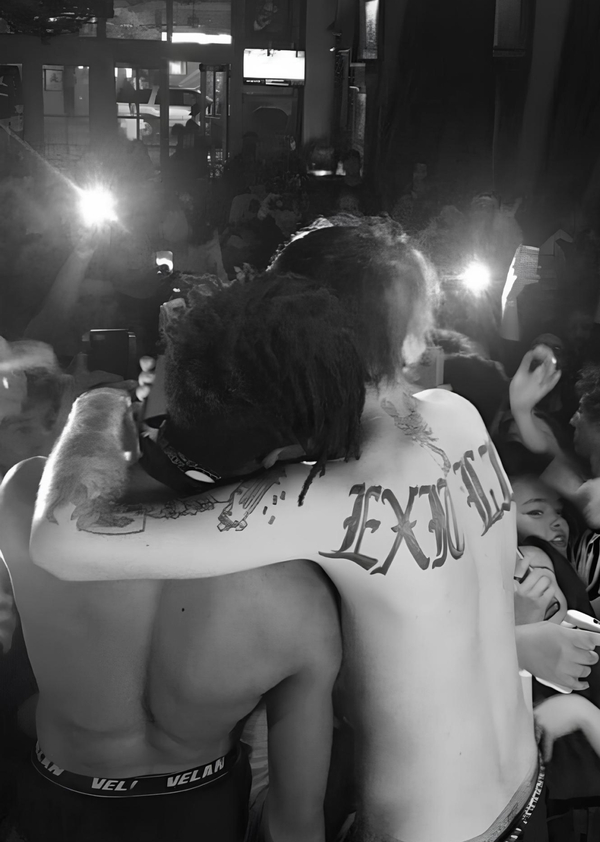
The visual study is dedicated to the aesthetics of emotional vulnerability in emo-rap, using the collaborative work of Lil Peep and Lil Tracy as a case study. The materials from the mini-albums CASTLES (2016) and CASTLES II (2017) examine how the sonic characteristics, lyrics, vocal delivery, and visual imagery of the musicians collectively forge a unified artistic language.
Concept
Emo rap is one of the musical genres that gained traction in internet culture during the 2010s. It fuses elements of hip-hop, emo, and alternative rock—combining guitar samples, trap beats, melodic singing, and rap. However, the defining characteristic of this genre lies not just in its sound, but in its mode of emotional expression. Loneliness, painful relationships, addiction, and internal struggles become an integral part of the artists' musical and visual identity.
I became interested in why emo rap specifically became associated with an aesthetic of emotional vulnerability. Candid lyrics existed in music before, but in emo rap, personal experience is closely intertwined with the artist’s outward appearance, their performance style, and their belonging to a specific internet culture. Furthermore, this vulnerability often exists simultaneously with demonstrations of independence, danger, and self-assurance. It is this inherent contradiction that I decided to investigate in greater depth.
As my primary example, I have chosen the collaborative work of Lil Peep and Lil Tracy—two artists associated with the musical collective GothBoiClique. Their collaboration is particularly interesting because both artists employed a similar musical aesthetic while retaining their unique performance characteristics. The core of this study comprises two mini-albums: CASTLES, released on July 4, 2016, and CASTLES II, released on February 6, 2017. Together, they feature eight tracks.
Selecting these specific releases allows for an examination of the emo-rap aesthetic using concrete and limited musical material. For a detailed analysis, I have selected four songs: «Castles, ” „White Wine, ” „Witchblades, ” and „Your Favorite Dress.“ In these tracks, I examine the interaction of the artists' vocals, musical borrowing, rhythmic features, and recurring motifs in the lyrics. The remaining songs from the two mini-albums help complete the overall picture and reveal similarities and differences within this creative period.
The central question of this research is how musical soundscapes, song lyrics, and visual imagery jointly form an aesthetic of emotional vulnerability. I hypothesize that its recognizability stems not from a single artistic device, but from the combination of several elements. Melancholic musical accompaniment, specific vocal delivery, personal confessions, and visual symbols can reinforce one another to create a cohesive image. Furthermore, outwardly displayed confidence and emotional openness do not necessarily preclude one another.
To develop this theme, I consider not only the musical pieces themselves but also the accompanying visual material. The visual component is built upon the release covers, music videos, archival photographs of the artists, and original comparative diagrams.
Information sources include studies of contemporary popular music and internet culture, official release data, interviews with musicians and producers, and publications from music magazines. Priority is given to materials that allow for the identification of the origin of musical samples, the authorship of the works, and the circumstances of their creation.
01. FROM EMOTION TO EMOTION-REPORT
To understand how the aesthetics of emo-rap were formed, one must examine the history of several musical genres. This phenomenon is rooted in the intersection of two traditions: the emotional expressiveness of alternative rock music and the methods of music creation and performance characteristic of hip-hop.The history of emo begins in the American punk scene of the 1980s. Over subsequent decades, the genre evolved, acquiring new musical and visual characteristics. In the 2010s, elements of emo and alternative rock began to be utilized by certain independent hip-hop artists whose music was distributed online.
1985. Emotional Hardcore
Roberto Keiros. Performance by the Rites of Spring group. 1980s.
One of the origins of emo was the Washington hardcore punk scene of the mid-1980s. The band Rites of Spring, which existed from 1984 to 1986, blended energetic guitar sound with personal lyrics and intense vocal delivery.
Unlike the perception of punk solely as protest music, inner human experiences gained particular significance here. Emotionality was expressed not only in the lyrics but also in the style of performance: sharp shifts in dynamics, vocal tension, and the intensity of the shows.
These characteristics became important for the further development of emo. However, the similarity of emotional themes does not mean that later emo-rap directly descended from Rites of Spring.
Rites of Spring. End on End. Cover art for a music release, 1991.
The cover helps present the visual aesthetic of early emo, but it does not, in itself, prove the characteristics of the music’s sound. To analyze its emotional expressiveness, it is more important to compare it with the recording and the group’s performance style.
The composition «For Want Of» demonstrates the characteristic early emo blend of intense punk sound and emotionally charged vocal delivery. Personal experiences are expressed here not only through the lyrics but also through the performance style. This example helps trace one of the musical traditions that emo-rap later became associated with.
1994. From hardcore to melodic emo
In the 1990s, emo began to move beyond the hardcore punk scene. Musicians started using melodic guitar parts more actively, incorporating contrasts between quiet and intense sections, and employing a wider variety of vocal performances.
A significant example of this period was the American band Sunny Day Real Estate. In 1994, they released the debut album Diary, which combined emotionally charged vocals with melodic guitar work and elements of post-hardcore and alternative rock.
Unlike early emo, which was tied to intense punk energy, Sunny Day Real Estate’s music demonstrates how personal experiences can be conveyed through dynamic contrasts, melodic development, and shifts in performance style. These characteristics became a vital part of the emo musical language in subsequent decades.
Sunny Day Real Estate. Diary. Album Cover. 1994.
The composition «Seven» allows us to examine the shifts in the emotional musical language of the 1990s. Melodic guitar lines and emotionally expressive vocals come to the forefront, while tension is created not only by the intensity of the performance but also by the contrasts between musical passages. For further study, it is important to trace how the guitar sound and emotional delivery, characteristic of a segment of the emo scene, were later reinterpreted in music based on hip-hop rhythms and sampling. In this context, we are referring to similarities in artistic means, not proven direct influence of Sunny Day Real Estate on Lil Pep and Lil Tracy.
2004. emo enters mainstream culture
In the 2000s, emo emerged as a noticeable phenomenon within popular music culture. Where this genre previously existed primarily within independent rock scenes, its associated musical and visual imagery began spreading through television, music magazines, and the internet.One of the most well-known bands of that era was My Chemical Romance. In 2004, the group released their second studio album, Three Cheers for Sweet Revenge, which combined elements of punk rock and post-hardcore with melodic vocals and theatrical emotionality.The band’s visual aesthetic became particularly significant. A contrasting color palette, dramatic imagery, and themes of love, death, and loss forged a cohesive artistic aesthetic. Emotional experiences were expressed not only in the music but also through album covers, the performers' clothing, and music videos.This stage is important for research because it demonstrates how emotional openness became part of musicians' public identity. Later, some representatives of emo-rap also utilized the connection between personal experience and visual self-presentation, though their musical foundation was different.
Gerard Way. Cover art for My Chemical Romance’s album «Three Cheers for Sweet Revenge.» 2004.
On the cover of Three Cheers for Sweet Revenge, two figures are depicted in a moment of intimacy, yet the red splotches, reminiscent of blood, lend a sense of unease to the scene. The combination of black, white, and red intensifies the dramatic quality of the image.
Here, a romantic image merges with themes of pain and danger. This visual contradiction is crucial for analysis: it allows us to trace how emotional vulnerability can be expressed through imagery that appears simultaneously aggressive and romantic.
Later, a similar juxtaposition of opposing emotional states can be found within the visual culture of emo-rap.
The composition «I’m Not Okay (I Promise)» demonstrates how personal emotional expression could coexist with energetic, mass-market-oriented sound in 2000s rock music. The guitar arrangement, Gerard Way’s expressive vocals, and the recurring chorus amplify the feeling of inner conflict.The song’s title is built upon a contradiction: an acknowledgment of personal distress is paired with a promise that sounds like an attempt to convince others otherwise. Emotional vulnerability is not concealed here; instead, it becomes the central theme of the musical statement.This example is important for later comparison with emo rap. In both cases, personal experiences can form the foundation of the artist’s public persona, although the musical means of their expression differ significantly.
The 2010s. SoundCloud and the new music scene
SoundCloud Homepage. Archival snapshot from April 1, 2016.
In the 2010s, the development of digital music platforms changed how independent music was created and distributed. SoundCloud, founded in 2007, became one such platform. It allowed musicians to upload their own recordings, share them with listeners, and find other artists for collaboration.
Various music communities formed around SoundCloud, where the boundaries between genres became less rigid. Young artists experimented with combinations of hip-hop, electronic music, punk rock, and alternative rock. One of the genres related to this environment was emo-rap.
Unlike a traditional rock band, emo-rap music often built around digital instrumentation. Guitar parts could be used as samples, and rap combined with melodic vocals. Personal experiences remained a crucial part of the artistic statement.
However, SoundCloud rap and emo-rap are not synonyms. SoundCloud united musicians from different genres, whereas emo-rap is characterized by a specific combination of musical and thematic traits.
It was in this environment that the work of Lil Pepe and Lil Tracy gained traction. Their music demonstrates how elements of alternative rock and emo were reinterpreted through hip-hop production.