Estrangement as a Visual Strategy for Restoring Perception
I. Introduction: Defining the Unfamiliar
Habit controls the manner in which we perceive the world. We see a chair and we immediately recognize it and move on. The streets of our own city look like something normal because we see them everyday. On the other hand the moment we arrive to a foreign country our reflection of the world completely changes. Our brain goes full power and sees everything because things around us are strange. This automatism of perception, first introduced by Russian literary theorist Viktor Shklovsky, causes us to gloss over life details. To combat this laziness of perception, Shklovsky suggested Estrangement (or «ostranenie» in russian): an art technique that puts familiar objects in an unfamiliar light. It is not the creation of something new — it is the making of something old strange again.
Estrangement is a critical tool of visual culture, a type of visual friction. It is intentional and disruptive and makes the viewer pause and examine the form of the subject and doubt its meaning instead of merely accepting the subject. This essay asserts that, through its application of structural disruption, visual estrangement is a an advanced technique applied in art and in cinema to wake the audience up from their complacency in consumption and bring them back to critical awareness.
II. Formal Disruption: The Poetics of the Unfamiliar in Art
In fine art, Estrangement is created through an act of violation of the rules of representation, or things are made strange by isolating them to the point of depriving their designated purpose.
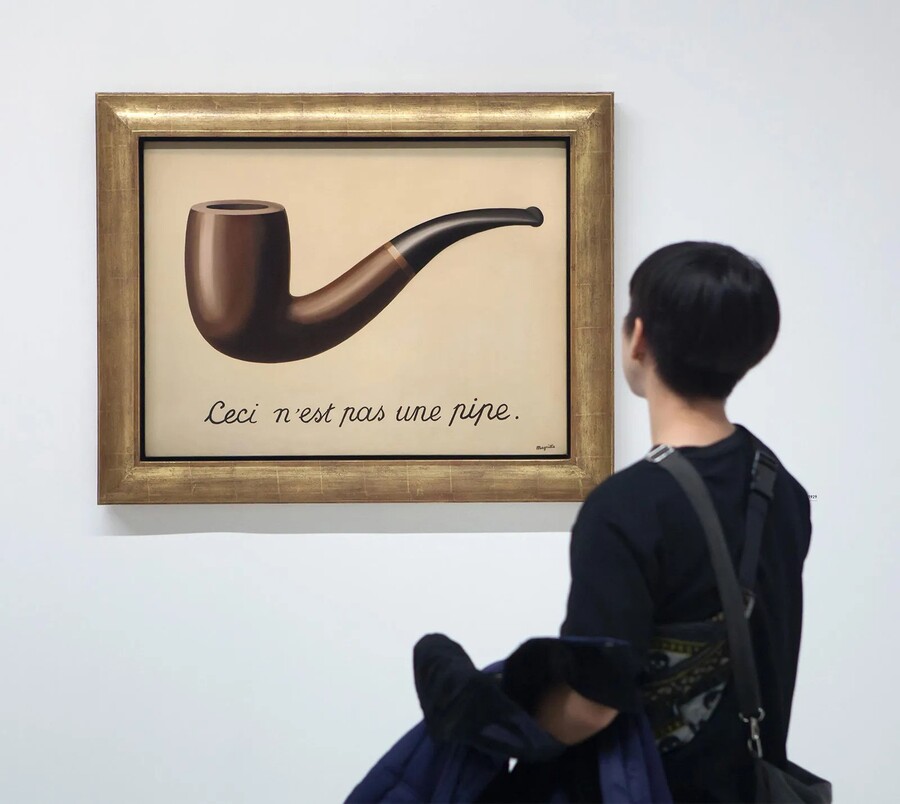
René Magritte — The Treachery of Images (1929)
Rene Magritte, The Treachery of Images (1929) is one archetypal case. Magritte painstakingly painted a pipe; however, underneath the painting, he wrote the well-known phrase: Ceci n’est pas une pipe (This is not a pipe). Through this paradox of the image and the language, Magritte propels the viewer to the real meaning of images. The painting is not merely a pipe, but a representation of a pipe. This break of language in the visual aspect actually alienates the viewer to the easy illusion.
Bernd and Hilla Becher — Water Towers (1972–2009)
More structural, nearly architectural estrangement is in the photographic typologies of Bernd and Hilla Becher. The Bechers deprive the objects of their context in the environment, like their series on Water Towers (1972-2009). They photograph them in the same position, with a clear sky, in a flat position and then arrange them in strict grid-like patterns. These towers that are usually taken as the utilitarian infrastructure are now re-considered. They are rendered independent, colossal figures — the logic of geometry of their structure is underlined. Repetition and de-contextualization are the tools the Bechers apply to estrange these ordinary items making a study of engineering become pure geometrical form and industrial heritage.
III. Cinematic Strategies: Breaking the Narrative Flow
Estrangement as a concept has played a very significant role in the movie industry, specifically in the theory of Bertolt Brecht who applied the V-effect to break the emotional submergence. This is done through filmmakers making their style to be actively felt.
Amelie (2001)
Such films as Amelie (2001) by Jean-Pierre Jeunet make use of stylistic defamiliarization in order to create a feeling of whimsical wonder. The movie often uses hyper-saturated color schemes, extreme close-ups which magnify small details (like a slice of a creme brule cracking), and magic realism, in which the world reacts directly to the thoughts of Amelie. It is a soft variant of ostranenie, gentle dislocation of the ordinary world of Paris, which allows the audience to view the small, ordinary context through the unusual, whimsical eye of Amelie. The effect makes the viewer participate in her subjective reconsideration of the world, where the beauty of the world can be seen in the details that one has never observed before.
On the contrary, the subtle yet disturbing type of critical estrangement is employed by director Michael Haneke. In Cache (Hidden, 2005), Haneke frequently uses long, fixed shots, in imitation of cold, unemotional stare of surveillance camera. More importantly, the camera is frequently held still when it is supposed to be moving as soon as the characters are out of the frame or when the primary dramatic action is already over. It is this rejection of the norms of sensitive filmmaking that makes the viewer detached to the emotional narrative. The audience is denied the comfort of a narrative conclusion, being instead drawn into an intellectual confrontation with the moral grayness of the film and their position as a depersonalized spectator.
IV. Estrangement Beyond the Visual: The Auditory Disruption
The estrangement is not limited to purely visual world, but it is also very powerful when utilized in sound and it essentially disrupts the auditory automatism of the viewer.
John Cage is perhaps the most extreme example of the subject of study. In the case of 4:33 by Cage in 1952, sound theory was studied. The artist sits on his instrument and does not do anything within 4 minutes and 33 seconds. The music of the piece turns into the apparently meaningless background noise in the situation — footsteps, breathing, coughing, and the mumbling of the concert hall, or the silence thereof.
Making background noise as primary sound, Cage’s 4:33 is an intrusion that makes the audience see the concert hall as a space they can be involved in rather than just being a passive observer.
V. Conclusion
The concept of Estrangement is still an essential and influential one in visual communication. It works by creating a purposeful, occasionally unattractive deviation to an otherwise foreseeable stream of aesthetic knowledge.
Brought about by the functional geometry of a Becher photograph, the linguistic paradox of a Magritte painting, the imaginative veil of Amelie or the imposed silence of a Cage composition, the technique encourages the viewer to stop, deconstruct the underlying form and ask about the philosophical implications of the form itself. Estrangement is the required discomfort that does not allow a subject to sink into the background of common knowledge and thus making simple observation a subject of pressing critical enquiry.