Concept
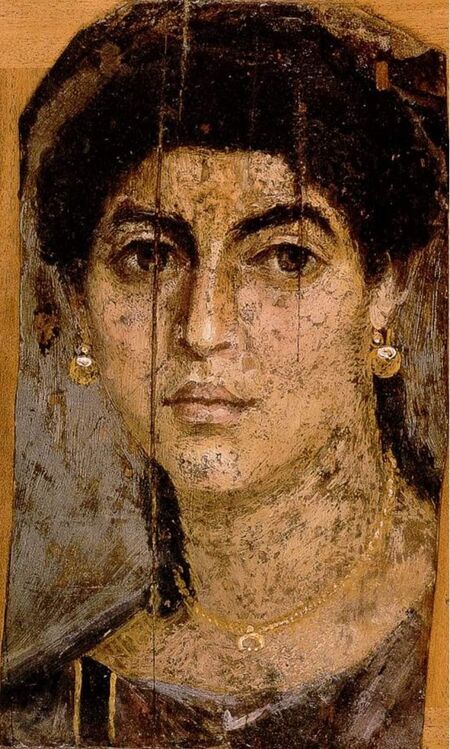
The Fayum portrait is a unique monument of ancient painting: funerary portraits created in Roman Egypt during the 1st–3rd centuries AD. These portraits were painted for funerary rites. They were placed on the mummy’s bandages over the deceased’s face, replacing traditional Ancient Egyptian masks.
Early portraits serve a funerary function through maximum physiognomic accuracy, while later portraits, retaining the same objective, shift the emphasis to the eyes.
Over four centuries of their existence, these portraits have evolved from illusionistic, wax-painted facial molding to a planar, linear style reminiscent of early Christian icons. In my research, I will trace precisely how the face transforms in Fayum portraits across several centuries.
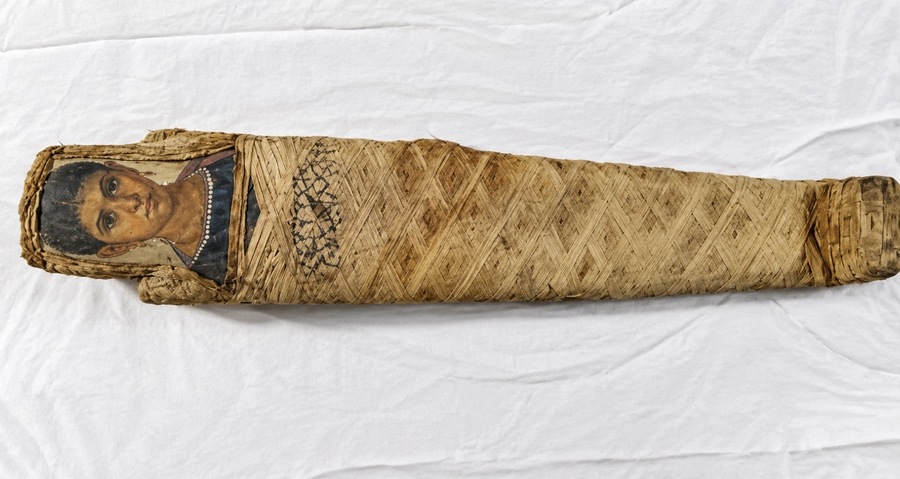
Female mummy with portrait. Antinopolis, Egypt, 2nd century BCE. Louvre, Paris
Hypothesis
The evolution of portraiture is not a uniform simplification; rather, the decline of illusionism is a redistribution of visual means.
Key Question
Is the evolution of the face in the Fayum portraits a smooth fading of the illusionistic tradition under pressure from external factors (technique change, cultural shift), or is it a shift between two visual strategies—from the face as a volumetric mask to the face as a sign of presence?
Structure
The research is structured not only chronologically but also by the formal parameters of the subject. This allows us to view the evolution of images as a system of change.
Topics
1. The Face as Volume: Encaustic and the Living Gaze. 2. The Face as Contour: Tempera and the Loss of Volume. 3. The Face as Sign: Late Portraits and the Birth of the Iconic Image.
Chapter 1
Let’s compare early portraits (1st–2nd centuries), where the contour line is almost hidden beneath the layer of color and chiaroscuro, with later ones (3rd–4th centuries), where the line becomes rigid, emphasized, and often replaces the modeling of the cheeks and nose.
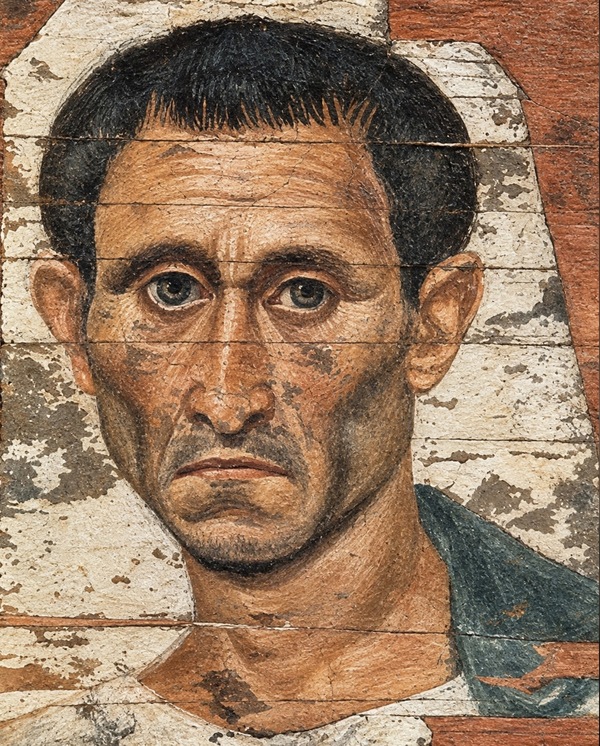
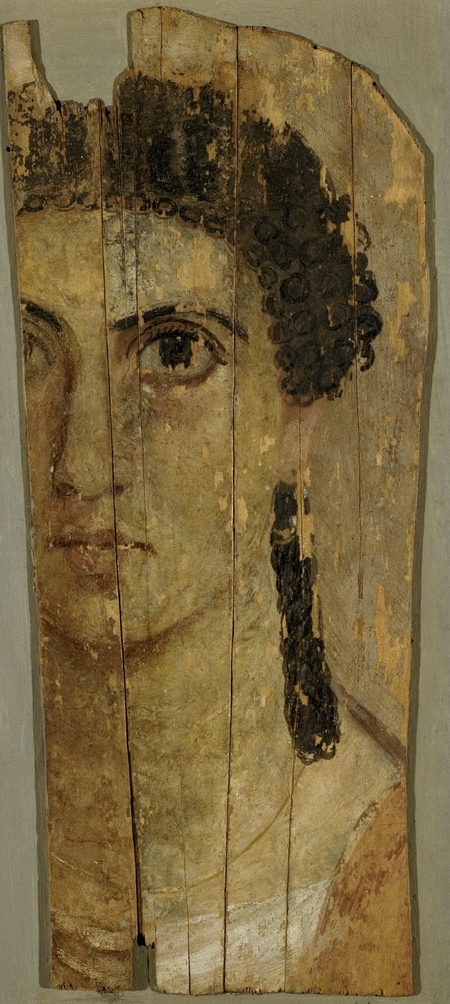
1. Portrait of an elderly person, 1st century CE 2. Portrait of a woman, 2nd century CE
In the portrait of the elderly man, the face is modeled with volumetric depth—an effect achieved by fusing wax. The shadows do not lie in an even layer; the wax seems to fill the skin’s crevices.
In the portrait of the woman, volume yields to clear contour, and facial features are rendered through fragmented, ornamental patterns.
In the early period, a technique called «encaustic» is used (painting with molten wax pigments using a hot tool—a cautery). The masters' brushstrokes replicate facial anatomy.
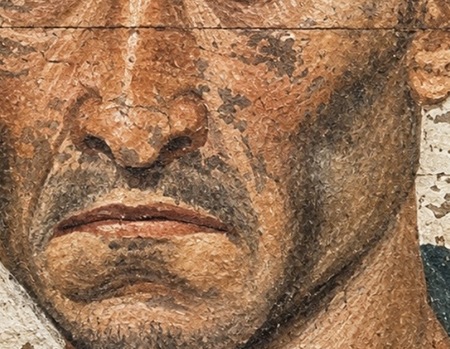
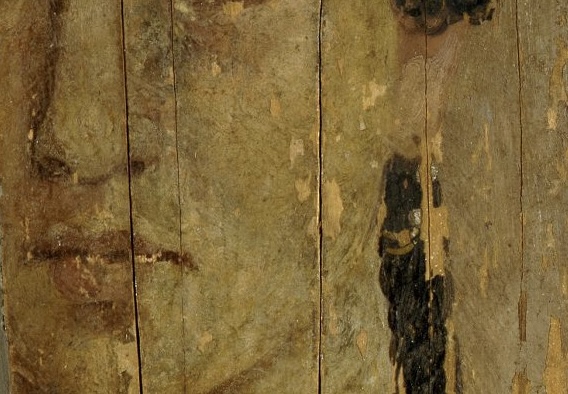
1. Portrait of an Elderly Person, 1 BCE. Fragment. 2. Portrait of a Woman, 2 BCE. Fragment.
The line does not disappear or «simplify»; rather, it changes function: moving from an auxiliary tool for creating volume (as in early encaustic) to an independent carrier of expression and identity.
«The flatness in later portraits is not a loss of skill, but a conscious transfer of information from tonal modeling to linear rhythm.»
Chapter 2
We will analyze how color «breathes» in encaustic through smooth transitions and glazes, versus how it is applied in later tempera with separate, almost mosaic strokes, creating a different visual logic—not an optical illusion, but a structural order.
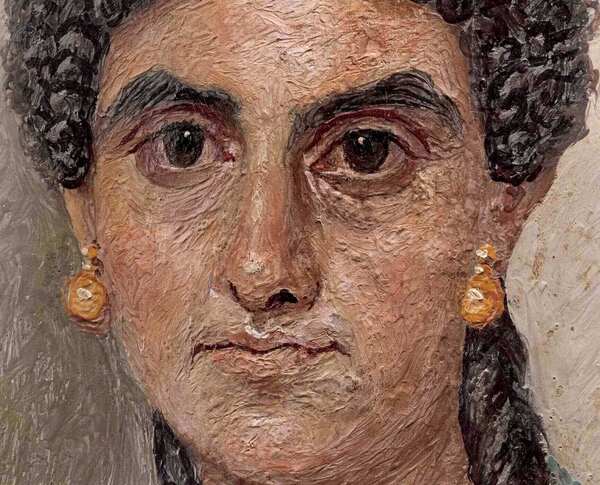
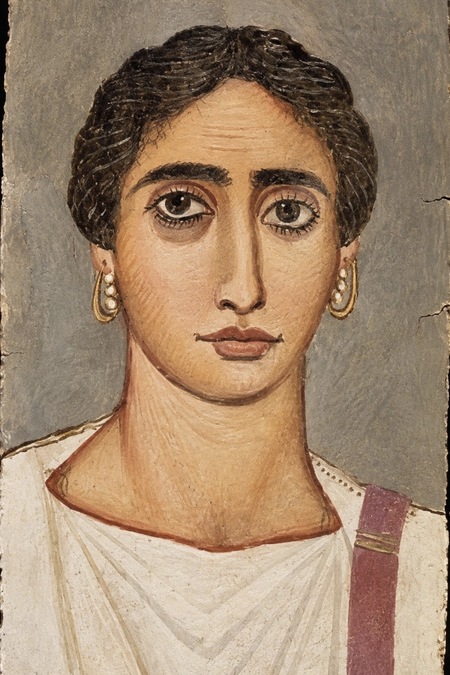
1. Fayum Portrait. Woman in a blue mantle (fragment). 54–68 AD. The Metropolitan Museum of Art, New York. 2. Portrait of a Woman. Second half of the 2nd century AD.
In the first portrait, the paint is applied in thick, impasto strokes, creating a complex, vibrant texture.
The second portrait was painted with tempera; these pigments were created using animal glue and egg yolk. This technique involves a finer, more linear application of color. Facial form is modeled through hatching and delicate lines.
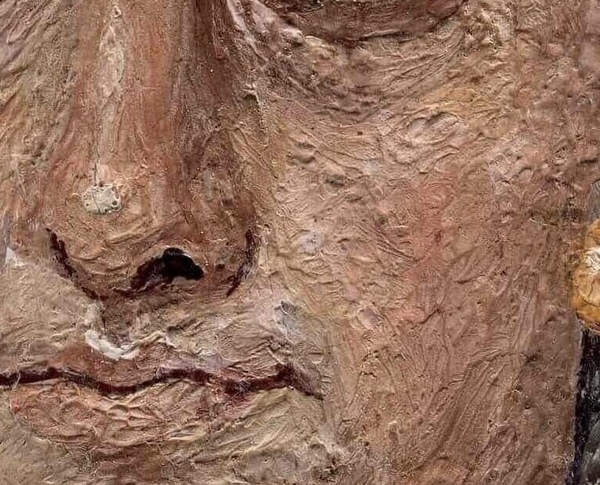
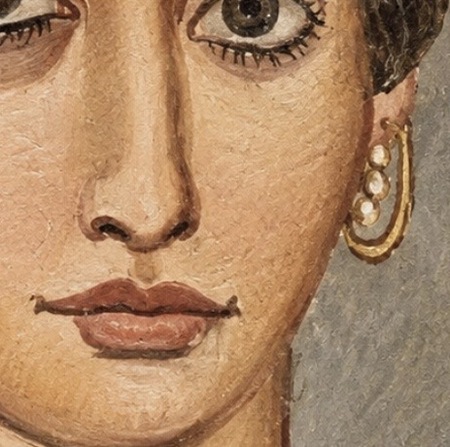
1. Fayum Portrait. Woman in a blue mantle (fragment). 54–68 AD. Metropolitan Museum of Art, New York. Fragment. 2. Portrait of a Woman. Second half of the 2nd century AD. Fragment.
From the mid-2nd century CE, encaustic and tempera began to merge. While a high degree of portrait likeness is maintained, the painting style becomes more balanced. The use of gold leaf (for example, on laurel wreaths or clothing) emphasizes status.
Meanwhile, the eyes grow even larger, acquiring a distinct focus and psychological depth.