Concept
ED-209 — a bipedal police robot from OCP in Paul Verhoeven’s RoboCop (1987) and one of the most recognizable mechanical characters of 1980s cinema. Its massive body on two heavy legs, armed with machine guns and a missile launcher instead of arms—the machine is conceived as a direct opposite to the main character. RoboCop is a human encased in metal; ED-209 has no human element whatsoever. This is evident even in the first scene featuring it: at a demonstration before the board of directors, the robot fails to notice an employee dropping a pistol and shoots him. Later, the formidable machine proves helpless before a simple staircase. The film’s satire largely rests on this gap between the robot’s terrifying appearance and its awkwardness.
Craig Davis and Peter Ronzani, members of Phil Tippett’s team—one of the foremost masters of stop-motion animation in American cinema—designed and built the robot. On screen, ED-209 could only move like a small puppet; it was slightly shifted between frame exposures, and shots were taken in front of a rear projection screen displaying the pre-filmed scene with the actors. They created two such miniatures for the film, and around 55 shots featuring the robot were captured over about three months. A full-sized ED-209—approximately 2.1 meters tall and weighing about 136 kg—did exist, but it could not move and only appeared in static shots. Thus, one machine on screen is assembled from several differently sized parts, and the editing must conceal the seams between them.
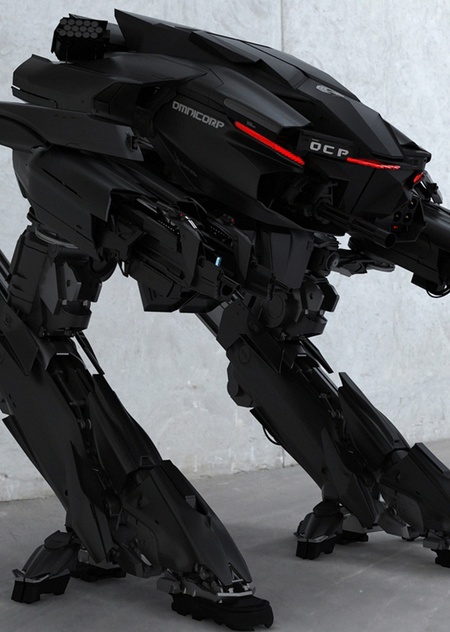
Twenty-seven years later, in 2014, the film «Robocop» was re-shot by Brazilian director José Padilha. ED-209 returned in a revamped form, now as a product of the OmniCorp corporation. At the beginning of the film, the robots patrol the streets of Tehran alongside the EM-208 humanoid drones, and in the finale, ED-209 battles the protagonist in the OmniCorp lobby. All these robots are digital—created by Framestore studio, which has over 600 plans featuring robots and shootouts. The robot was not physically on set. Instead, a frame made of aluminum pipes on wheels was wheeled through the shot so that the crew and actors could gauge its size, and a segment of the «head, ” nicknamed the „machine door, ” was passed through the scene as a lighting reference. Preparing for the final fight, the creators also referenced the movements of the robot from the 1987 film.
Between the two versions, the entire production toolkit changed, but the objective remained the same: the massive machine had to look like it stood on the same floor as the people, was illuminated by the same light, and possessed weight. In 1987, this task was achieved by hand. The animator positioned every movement of the puppet, and the rear projection device dictated the staging—the actor could only be behind the robot or to its side, never in front of it. In 2014, such restrictions do not exist; a digital robot can pass in front of a person or emerge into bright daylight. However, it has no inherent mass, so weight must be created through animation, shadows, ground reflections, and scattering debris.
One could debate for a long time which of the two versions is more convincing. The 1987 doll possesses genuine texture and authentic surface light, yet its movement is jerky and its placement within the frame is constrained. The 2014 digital robot is free in movement and space, but every interaction with the world has been meticulously reconstructed. This is precisely why ED-209 is useful for study: the same character, facing the same prompt, is embodied twice in two opposing ways, and the difference between them is visible in specific frames.
This visual study compares the methods each film uses to convey to the viewer the size, weight, and physical presence of ED-209: how the robot relates in scale to a human, how it plants its feet, whether it touches the floor or casts a shadow, and whether human figures overlap it. What is seen on screen is contrasted with what the creators themselves discuss regarding production methods in interviews, professional journals, and studio materials. The comparison proceeds chronologically: first, the 1987 film, then the 2014 film, followed by pairs of comparable shots.