Introduction
In contemporary society, fashion has moved far beyond its original utilitarian and aesthetic functions. It now operates as a form of communication, through which individuals transmit information about themselves, their social position, values and identity. Clothing becomes a language: non-verbal, symbolic, and culturally embedded.
Communication theory allows fashion to be understood not as a collection of garments, but as a process of meaning-making, transmission, and interpretation. Within this framework, a fashion brand is not merely a producer of objects, but a communicative actor that constructs messages and cultural codes to be decoded by its audience.


Communication as a Systemic Process in Fashion
Clothing operates as a non-verbal language through which identity, status, and self-determination are communicated
Communication is defined as a systemic process of meaning creation and interpretation, shaped by context and never isolated in time. Meaning is negotiated rather than transmitted directly.
Applied to fashion, this means: • the brand acts as the sender, • clothing and visual imagery function as the message, • the audience becomes the receiver and interpreter, • cultural, social, and media contexts shape decoding. For our brand, the core communicative elements are form and color.
They operate not as decorative features, but as primary carriers of meaning. We develop conceptual couture in which silhouette, structure, and chromatic decisions articulate ideas, emotions, and attitudes before any verbal explanation occurs. This approach does more than evoke a sense of confidence. It actively constructs and reinforces it, allowing the wearer to embody confidence rather than merely feel it.
Fashion communication does not begin at the moment of purchase or during use. It starts earlier, through expectations, aesthetics, narratives, and visual culture and continues afterward through social interaction, digital representation, and self-presentation. Within this continuum, our garments function as expressive systems: through form and color they participate in an ongoing dialogue between body, identity, and cultural context.
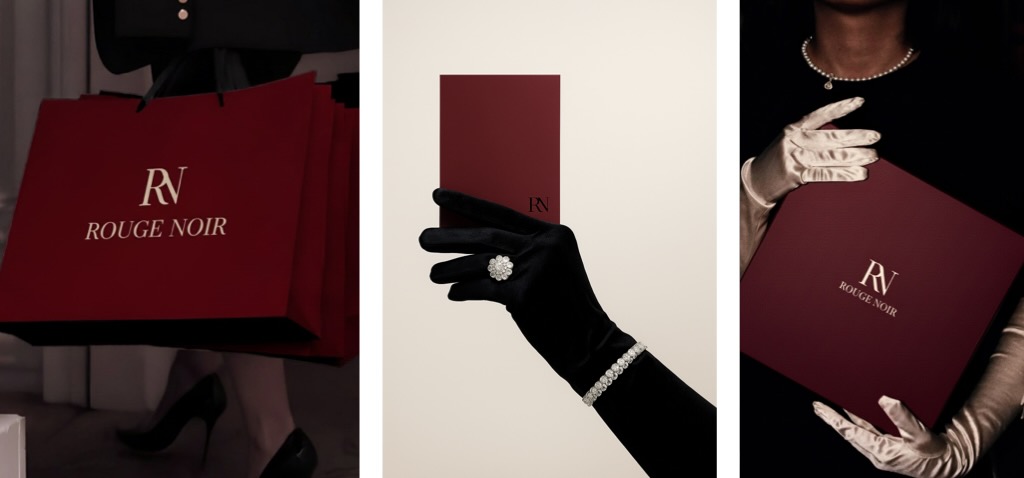
Branding identity of the Rouge Noir
The visual environment also plays an important role: fitting rooms, draperies, light and color are perceived as set design. Space does not function as a background, but as part of a communication statement in which clothes exist in a theatrical, almost ritualistic context. For a professional audience, this is a signal of the brand’s conceptual integrity and its focus on visual thinking.
Branding identity of the Rouge Noir
Fashion as a Symbolic System
From a sociocultural and semiotic perspective, fashion functions as a system of signs. Shape, colour, fabric, cut, proportions, and texture operate symbolically and convey meaning.
Aesthetics of quiet luxury construct a specific communicative code: • rejection of over display, • prioritization of quality over quantity, • understated expressions of status, • emphasis on internal values rather than external validation.
Fashion communication always involves interpretation, where meaning is not imposed but co-created between brand and client.
Images from the Rouge Noir collection
Identity and Self-Presentation Through Clothing
Images from the Rouge Noir collection
From the perspective of interpersonal communication, fashion is deeply connected to identity. According to Erving Goffman’s theory of self-presentation, individuals continuously manage the impressions they make on others using symbolic resources.
In this sense, clothing functions as: • a tool of self-expression, • a means of constructing social roles, • a form of non-verbal communication.
A woman who selects couture fashion based on the principles of elegance, confidence, and self-awareness is the one who appreciates luxury. This message is not expressed through excess, but through restraint.
Images from the Rouge Noir collection
Target Audience Segmentation
We are a fashion brand that sees clothing as a form of communication. Not loud. Not fast. But intentional. Our collections are made for people who use style to express who they are, not to impress. Our brand speaks to two women who may look different, but share the same desire for clarity and meaning.
General audience
We help girls to emphasize their individuality with the help of unusual shapes and patterns. Our fashion does not follow trends. It follows values. We care about authenticity, quality, and thoughtful design. We believe in slow fashion and conscious choices. We design with respect for craftsmanship, materials, and the person wearing the garment.

Рrofessional audience (designers, stylists, fashion-editors)
In this interaction, shape, silhouette, proportion and material become the main carriers of meaning. The brand appeals to those who are able to read fashion codes, recognize work with volume, architectural form and space, thereby forming a dialogue within the professional field.


The form becomes a key communication tool. The accentuated waist, exaggerated shoulders, exaggerated volumes and sculptural lines function as a professional statement, not as following trends. For the designer and stylist, such forms are perceived as independent objects. The brand works with a professional audience and does not seek to be unambiguously read, leaving room for analysis, reinterpretation and dialogue. In this context, the brand does not act as a commercial product, but as a tool and language designed for professional work.
Critical Perspective: Fashion and the Culture Industry
From a critical theory perspective, fashion operates within the culture industry, generating both commodities and ideological frameworks. In this context, Adorno and Horkheimer describe mass culture as a force that standardises perception and constrains critical reflection.
Quiet luxury may be interpreted as • resistance to visual overstimulation, • rejection of aggressive consumerism, • a critique of performative wealth.
In this sense, the brand functions as a cultural statement, offering an alternative mode of participation within fashion capitalism.
Conclusion
As a result of the project, the brand appears as an integrated communication system in which clothes, space and visual image work to create a single statement. Shape, color, and scale become the main carriers of meaning, allowing the brand to speak without direct text. The project demonstrates that fashion can function as a complex and multi-layered language. And it is addressed primarily to those who are able to read it. Thus, the brand establishes itself not only as an object of consumption, but also as a cultural and visual code that forms a dialogue between the designer, the professional audience and the viewer.
All the information was taken from the communication theory course.