Concept
In 1920s Soviet silent film, montage became a primary means of constructing an image. Lev Kuleshov, in his book «The Art of Cinema (My Experience), ” examines montage as the foundation of cinematography: the significance of a frame is determined not only by its content but also by its juxtaposition with other frames (Kuleshov, 1929, 167).This principle is particularly evident in the manipulation of inanimate objects. Kuleshov himself describes „American plans, ” where only what is necessary remains in the frame: a desk drawer, a hand with a revolver, a finger on the trigger (Kuleshov, 1929, 169). The object here becomes an independent unit of montage. Depending on its context, the item transcends its everyday function and acquires emotional, associative, or symbolic expressiveness.
«Various takes, different construction—shot montage—will give a different meaning to the entire episode.»
This principle holds particular interest when examining inanimate objects. Depending on the installation context, an object can transcend its everyday or narrative function, acquiring additional emotional, associative, or symbolic expressiveness.
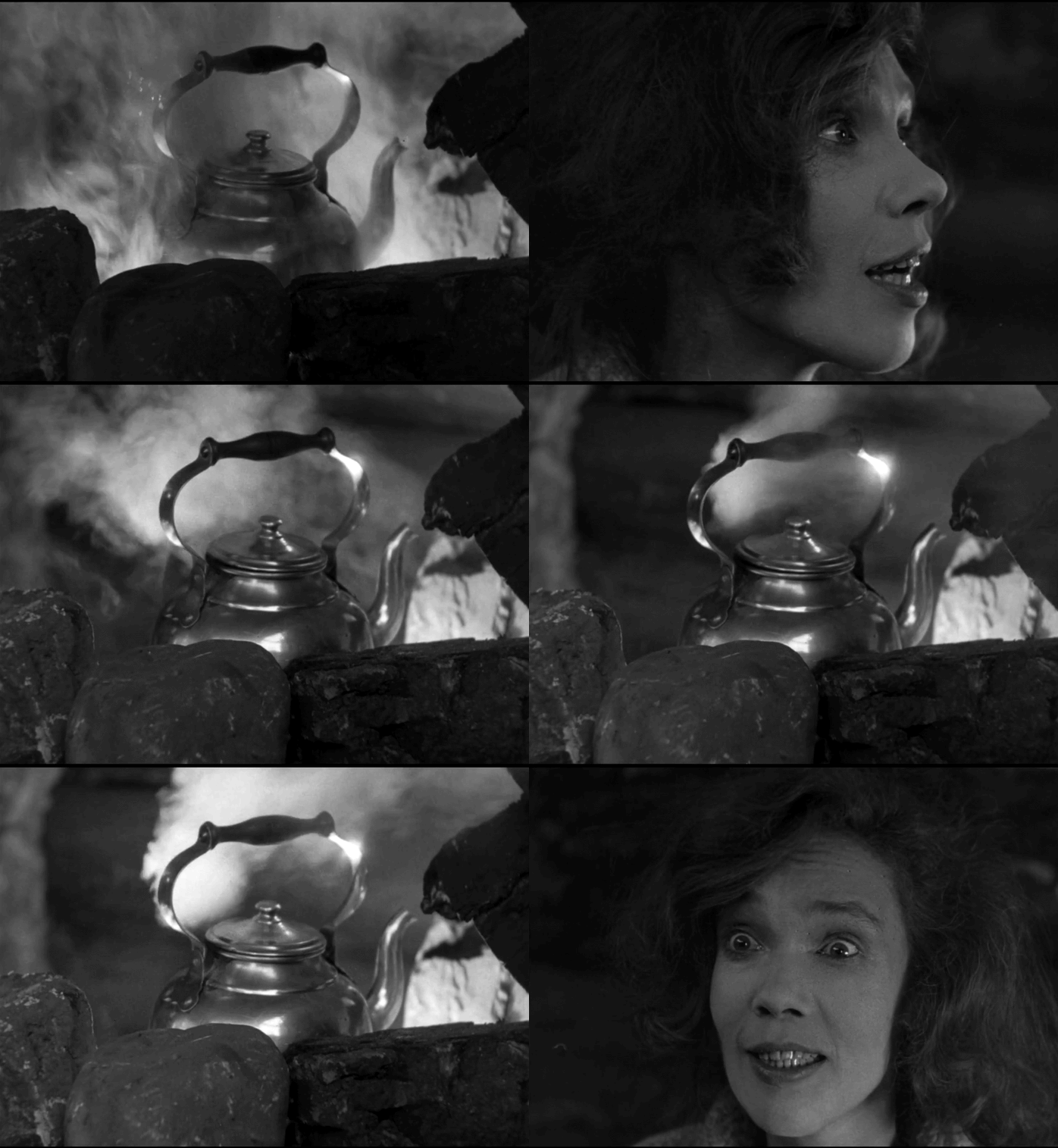
The study began with a scene featuring a boiling kettle from Lev Kuleshov’s film By Law (1926). Within the context of an emotionally charged sequence, an ordinary household object begins to be perceived as a reflection of human experience.
1. «By the Book» (1926, dir. Lev Kuleshov)
In the editing sequence, the image of a boiling kettle is juxtaposed with shots of the characters. The movement of the lid and the steam takes on an emotional significance that cannot be explained by the object’s purely utilitarian function. Thus, the expressive quality of an object is shaped not only within the frame but also by its surrounding montage environment.
Observing this episode defined the core research question: how do editing techniques impart new meaning to the subject, and what determines that specific meaning?
It is hypothesized that the method of montage juxtaposition determines the type of meaning. For example: proximity to a character’s face transforms an object into an expression of their state, repetition and rhythmic alternation — into a carrier of an idea, and inclusion in a sequence of actions — into a participant in the narrative. The hypothesis is based on the Kulëshov effect principle: a constant depiction of a face combined with different shots is read as different emotions. In this research, the focus shifts from the person to the object. Moreover, montage does not always create meaning from scratch; it can amplify properties already embedded in the image of the object.
2. Stills from Lev Kuleshov’s montage experiment («the Kuleshov effect, ” 1920s)
The study material comprised episodes from Soviet silent cinema of the 1920s, where the significance of an inanimate object is revealed through its interaction with other images. The selection process considered the possibility of tracking how editing alters the perception of an object, imbuing it with new expressive functions. Referencing films by various directors allows for the identification of the diversity of such transformations. The work itself is constructed by comparing individual frames and their editorial surroundings. The sequential presentation of images allows for an examination of the connections that emerge between them, tracing the influence of sequence, movement, and repetition on the formation of the object’s image. Comparing episodes from different films helps to reveal common patterns and variations in the use of these techniques. The research material is categorized according to the nature of the resulting object meanings: emotional, associative, metaphorical, and those related to on-screen action.
Subject as an Expression of Emotion
Image montage allows us to convey characters' emotions not only through facial expressions and gestures but also through the imagery of inanimate objects. An object included in a specific sequence can acquire emotional significance that is not apparent when considered in isolation.
This section of the research examines various ways to form an object’s emotional expressiveness: through contrasting its conventional meaning with the characters' state, changing the object’s emotional context, and juxtaposing it with images that convey the hero’s inner experience.
2. «By the Book» (1926, directed by Lev Kuleshov)
In the film By Law (1926), Lev Kuleshov employs montage juxtaposition of object details and character reactions to create emotional tension. The alternation of disparate shots establishes a semantic connection between them, allowing individual images to be perceived as parts of a unified psychological state.
3. «By the Law» (1926, directed by Lev Kuleshov)
As the episode develops, human reactions give way to close-ups of the burning cake. The repetition of the subject, changes in scale, and the gradual exclusion of characters from the composition shift the viewer’s focus from the person to the object. Through montage juxtaposition, the fire on the cake—initially associated with a festive atmosphere—acquires a contradictory meaning, becoming an expression of anxiety and rising tension. Thus, the montage transforms the perception of an everyday object, endowing it with new emotional significance.
4. «The Third Bourgeois» (1927, dir. Abram Romm)
5. «The Third Bourgeoisie» (1927, dir. Abram Romm)
In the film The Third Bourgeois (1927), Abram Room employs montage juxtaposition of object details and Vladimir’s reactions to convey the moment of realization regarding the rekindled intimacy between Lyudmila and Nikolai. Shots of the protagonist alternate with images of a screen displaying clothing and a decanter, guiding the viewer’s attention toward indirect evidence of what has occurred. The return to a closer shot of Vladimir’s face reveals the emotional significance of these details. The screen with the clothes and the decanter become symbols of intimacy existing just outside the frame, and their juxtaposition with the protagonist’s reaction lends them a painful meaning for him. Thus, the montage transforms the mundane setting into a vehicle for expressing jealousy and the changed relationship between the characters.
The subject as the basis of association
The image of an object can serve as the starting point for developing an association. By relating the object to subsequent shots, the viewer discovers connections that go beyond its everyday function. The montage unites diverse images into a semantic sequence, allowing the specific object to reference an experience, an event, or a perception of the future.
This chapter examines how associative links between shots transform the meaning of an object. Special attention is paid to how the meaning established by the object develops in subsequent images, even after the object itself is no longer on screen.
6. «The Mother» (1926, dir. Vsevolod Pudovkin)
«By combining two ‘representational’ elements, the graphically unrepresentable can be drawn.»
The principle described by Sergei Eisenstein is evident in Vsevolod Pudovkin’s film Mother (1926). The letter serves as the starting point for montage association: the news received by the protagonist is linked to the movement of water and the image of a laughing child. By juxtaposing these images, the content of the message transforms into an image of joyous anticipation, and the mundane object gains the significance of a promise of change.
7. «Mother» (1926, directed by Vsevolod Pudovkin)
In the film «Flotsam of the Empire» (1929), Friedrich Ehrmler reveals Filimonov’s return to memory through montage associations. In the selected episode, the movement of the film reel connects the space of the room with the emerging images of the past. The alternation between shots of objects and the protagonist’s reactions allows one to trace how an ordinary item becomes incorporated into the process of recollection.
8. «Fragment of an Empire» (1929, directed by Friedrich Ermler)
9. «Fragment of an Empire» (1929, dir. Friedrich Ermler)
The association develops through the resemblance between rotational and translational motion: the reel is matched with wheels and a train. The montage unites objects of different scales, shifting the viewer’s attention from a small detail on the floor to images of motion beyond the room. The female face lends a personal meaning to this sequence, while the returns to Filimonov tie the disparate images to his perception.