Concept
The problem addressed in this work is formulated as follows: can a modern rap battle be considered a form of the «agonistic culture of poets» described by Johan Huizinga, and what new dimensions does the digital age—video hosting, viewership, commercialization, censorship—introduce to it? The working hypothesis consists of three parts.
First, there is no continuous line of succession between the medieval singers' contest and the battle rap, but there is a typological kinship: both forms are assembled from the same structural elements of poetic agon.
Second, the difference lies not in the «spirit» of the game, but in its medium (manuscript and guild «Tablature» versus video hosting) and in the positioning of the «magical circle» relative to society.
Third, it is the digital environment that exposes the issues that the course’s philosophers considered central to the game: professionalization, spectacle, the «corruption» of the agon, and the invasion of the «serious» world into the world of play.
Introduction
In August 2017, two rappers met at a joint event hosted by two battle platforms, Versus and #SLOVOSPB, in St. Petersburg. One was a star of Versus who hadn’t lost on that platform up to that point; the other was Slava KPSS, also known as Gnoyny, who came from the St. Petersburg «Slovo» school. Three rounds, five judges, two hosts, and a verdict of 5–0 in favor of Slava KPSS. The recording, published in mid-August, garnered around ten million views in its first day, according to different estimates, and was discussed on federal channels. To a history of games expert, this event is strikingly familiar: two compete with words, the rules are known to everyone, the victor is recognized by connoisseurs, and the stake in the game is not money, but honor and name.
We find the same construction many centuries earlier in «The Song of Wartburg Singers» and in the practice of guild singing master workshops.
Hyo-jing: Culture grows from play; poetry is its most ancient stream.
The original thesis of «Homo ludens» posits that play predates culture and is not reducible to a biological function: culture emerges in the form of play and is initially enacted through it. For Huizinga, play is a free act that can be suspended or terminated; an exit from «ordinary» life into a special sphere; an action bounded by time and space—a «playing field,» whether an arena, stage, court, temple, or «magic circle.» It involves the creation of an order where rules are absolutely mandatory; tension and uncertainty regarding the outcome; and the absence of direct material benefit. To this is added the tendency of play communities to surround themselves with mystery, special attire, and badges of distinction.
For our topic, the agon is paramount. For Heo Jing’s, this contest is not a mere byproduct, but one of the principal generative forces of culture: the drive to be first, to gain honor, and to achieve «prestige» is manifested in competitive forms, from the Greek agon to ancient gift exchanges. Most often, the agon takes verbal form. Heo Jing gathers examples: the Scandinavian skaldic, which is a poetic joust between gods and heroes in the Poetic Edda; contests in «comparing husbands»; chivalric boasting—the gab; the Arabic hijāʾ, a satirical poem considered a weapon; Eskimo singing duels, where disputes are settled by a mocking song rather than fists; and mysterious contests of knowledge where the loser could forfeit their life, from the Edda to the Sphinx myth.
The schema is the same everywhere: a word, subservient to form, becomes a weapon—but a playful weapon—it strikes without killing, and that is why it is permitted in both celebration and in court.
Poetry, in Hyogins' view, is fundamentally a game: rhythm, rhyme, stanza, alliteration, and meter constitute the rules, and the poet of archaic culture merges the roles of priest, prophet, jester, and competitor. Therefore, the poetic duel for him is not a marginal genre, but one of the primordial forms of poetry itself. Two of Hyogins' ideas will be useful later. In the chapter «Play and War,» chivalry is described as a «refined» agon: the challenge, honor, and rules of tournaments and duels transform violence into a game-like form, and the Minnesang troubadour lives within the same value system. In his concluding chapters, however, Hyogins warns against the decay of the element of play: the professionalization and commercialization of sport and art, spectacle devoid of intrinsic play, and «puerility.» We will apply these criteria to modern battles.
Kaiua: Four Game Categories and Two Poles
Roje Kaiua criticizes Hyojin for being too vague: he describes almost exclusively the agonistic aspect of the game. Kaiua himself divides games into four categories. Agon is competition where the equality of chances is artificially created, and victory is granted by personal merit—attention, training, perseverance, will to win. Alea is chance, where fate, not merit, decides. Mimicry is playing another: mask, role, imitation. Ilix is «dizziness, ” the disruption of stable perception. The second axis runs from paidia, spontaneous, noisy, improvisational play, to ludus, play disciplined by intentionally complicated rules. Real games blend these categories: agon often combines with mimicry, for instance, in sports as spectacle, where the spectator identifies with the champion.
Three ideas from Kaioua are particularly relevant to us. First: the agon has a condition of purity—that is, equality of starting conditions—so regulations and judges are necessary. Second: each category has a degenerate form; the agon «spoils» when the rules of the game yield to extragame objectives, and instead of competition, violence, deception, and the will to power emerge. Third: the professional, for whom play has become a craft, transcends the game itself.
Finck: Play as the Primary Phenomenon of Existence
Johan Huizinga arranges play alongside five fundamental phenomena of human existence: death, labor, domination, love, and play. For him, play is an «oasis of happiness» amidst labor and death—an end in itself, not preparation for something else. Within play, a unique, unreal world emerges, and the player lives simultaneously in two worlds, fracturing into the real self and the role. The audience also belongs to play: the public is not outside, but inside; they co-play and share the world of the game. Finally, play relates to other phenomena.
In Finke’s logic, the poetic duel is a staged dominance: a struggle for recognition and precedence, stripped of any real threat to life or subjugation.
Junger: Autonomy, Rules, and the Critique of Utilitarianism
Friedrich Georg Junger explains the game through utility, instinct, or preparation for life: the goal of the game lies within itself, and its seriousness is of a different kind than the seriousness of labor. For Junger, the rule is not a limitation but a condition for the freedom of the game—it separates play from chaos and makes honesty possible. In Junger’s logic, which critiques the techno-utilitarian thinking of the era, the game is threatened with becoming a means of earning money, raising children, or self-actualization.
This criterion will be useful for evaluating the digital aspect of the battles: where the game of self-directed mastery ends and content production begins.
Runner: «The Playing Person» and Christian Game Theology
Hugo Rainer, a Jesuit theologian, responds to Heidegger from the perspective of Christian anthropology: play is not the opposite of seriousness, but rather one of its highest forms. He draws upon Plato, the Proverbs of Solomon about Wisdom, which played before God «always, ” and Thomas Aquinas, who incorporated play into the virtuous life and described a specific virtue, euthrapelia—that is, the ability to play and jest in moderation, between coarseness and buffoonery. For our theme, this resolves the apparent paradox: how medieval contests among singers could discuss the Bible and the boundary of sin, function as a clerical guild practice, and still remain a game. Medieval culture holds a theologically meaningful place for play.
Humanistic Toolkit: Bakhtin, Likachyov, Lotman, Vygotsky
Additionally, four humanistic approaches are required. Bakhtin describes popular humor culture: the carnival, «public speech, ” the ambivalence of insult and praise, and „de-coronation“ as a mechanism where insult within the festive space functions not to destroy, but to renew. Likhachyov, Panchenko, and Ponyrko illustrate the „world of laughter“ in Old Rus’ with its skomorokhi (jester tradition), yurodstvo (foolishness), and anti-behavior—that is, the Russian interpretation of how laughter and the „inverted world“ are embedded in culture. Lotman views daily life and behavior as a „text“ with a code: the duel as a codified system of challenge and honor, the theatricality of behavior, where a person lives „in a role.“ Finally, Vygotsky defines play as an imaginary situation with hidden rules, in which the individual operates „a step above themselves“ by playing within the zone of proximal development.
Minnezaing: Courtly Games of Love and Honor
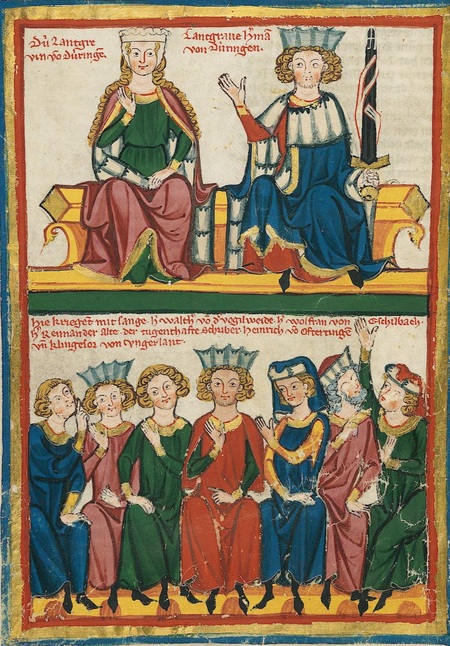
Minnelied is the courtly love lyric poetry of German-speaking lands from the 12th–13th centuries. It flourished at various courts—with the Babenbergs in Vienna, on Wartburg with Landgrave Hermann I of Thuringia, and within the court of the Hohenstaufen. The central concept is minne: service to a lady that does not expect reward. The lyrical hero is a knight-vassal who serves his lady in the song with the same devotion he serves his lord in life. The primary source is the Manesse Codex, containing about 140 poets, each with a miniature bearing a coat of arms and a scene. This manuscript transformed minnelied into a readable and comparable text; before this, the songs existed only as performances.Minnelied was not written purely for storage: the songs were performed before the court, where they were listened to, judged, and compared. The most famous pair is Heinrich of Torun (Reinhard the Old) and Walther von der Vogelweide. Heinrich was a master of «high minne”—unrequited love celebrated for the sake of service itself. Walther, whom tradition views first as a student and later as an opponent of Heinrich, challenges him in his songs: he introduces mutual love, ironically inverting the models of the senior poet, and several of his stanzas are read as a direct response to Heinrich’s verses. Scholars still debate whether this was genuine rivalry or a literary game designed for courtly consumption.
From Hyogins’s perspective, courtly love is a quintessential example of how serious content is encased in a playful form. The court is a «magical circle»: outside of it, discussions of unrequited love would seem absurd, but within it, they are a move within a game. A game has rules, conventional signs, and a circle of initiates. The stakes are ere and hulde—the honor and grace of the lord or lady; the prize is the patron’s favor, which at court is almost equivalent to social status. The chivalric ideal Hyogins describes in the chapter «Play and War» establishes the same system: the challenge, honor, and form transform conflict into a noble contest.
Kayua allows us to describe Minnesang as a union of agon and mimicry: the Minnesinger’s «I» is a lover’s mask, not a confession. Therefore, the same poet writes both «high» and «low» songs, much like an actor changes roles. Concurrently, this is a typical ludus: a system of complex rules where mastery is measured by the precision of form, not spontaneity; paideia appears only on the periphery, such as in Walter’s «girl» songs. The condition of an uncorrupted agon is met: both poets master the same repertoire of forms and address the same audience. According to Fink, the knight playing the «lady’s vassal» embodies a role, and the court acts as a co-player.
Here, three of Finck’s five phenomena—love, dominance, and play—are simultaneously at play: the feudal hierarchy is overturned, presenting a performed authority and a stylized affection. The poet’s actual labor, namely receiving payment and patronage from a protector, remains outside the «oasis» and surfaces in Walter’s complaints about stingy lords. Finally, in Rane’s work, the courtly ideal of moderation—the ability to balance coarseness and affectedness—finds a parallel in eutrapelia: a play constrained by measure, not a sinful diversion, but a virtue.
«The Singers' War in Wartburg»: A Game of Life Stakes
The epic poem «The Battle of Singers at Wartburg» was composed in the 13th century and has survived in later manuscripts. It recounts a competition that supposedly took place at the court of Landgrave Hermann I around 1206–1207. Five poets compete against Heinrich von Osterdingen, among them Walter von der Vogelweide, Wolfram von Eschenbach, and Biterolf. The first part, «Praise to the Princes, ” is a debate over which ruler deserves greater praise: Osterdingen glorifies the Duke of Austria, while the others praise the Landgrave himself. The condition is severe: the loser faces the executioner; the noose has already been prepared. The defeated Osterdingen secures a delay and calls the sage and sorcerer Klingers from Hungary. The second part, „The Riddle Game, ” is a contest between Klingers and Wolfram: riddles concerning scripture, the heavens, and the mysteries of the world; Klingers summons the demon Nason, but Wolfram, the „layman, ” prevails through theological wisdom. The historical accuracy of the event is questionable—it is likely a legend that solidified the image of the singer’s tournament in culture. For the history of games, the structure matters more than authenticity.