Introduction (Concept)
Chess allows us to represent society within the confines of a game board: pieces occupy different positions, possess distinct capabilities, yet all operate under a shared set of rules. Their names and appearance reference authority, military service, clergy, and labor. The research topic is «The Hierarchy of Chess Pieces as an Image of Society.» The study focuses on European chess from the 12th to the 15th centuries—their visual design, social interpretations, and rules. By «hierarchy» in this work, I refer to the differences between the pieces examined across three levels: the social standing of the depicted character, the visual prominence of the game piece, and its capabilities on the board. These levels do not necessarily align—a character’s social standing, the expressiveness of its depiction, and the piece’s board capabilities require separate consideration.
Examining chess as an image of society allows one to explore how concepts of power and the distribution of social functions are expressed through the pieces and the rules. This connection has already been noted in scholarly literature: Jenny Adams studied the political and social meanings of chess in late medieval texts, while Marilyn Yalom explored the history of the queen in culture. In my work, the focus is on correlating visual markers of status with the social roles and gameplay mechanics of the pieces. This correlation will allow us to examine hierarchy not only as a distribution of dominance and subordination but also as a combination of various, mutually complementary functions.
The key research question is: how do the appearance and gameplay capabilities of chess pieces reflect concepts of social hierarchy? The objective of this work is to determine the visual and mechanical means by which chess portrays inequality and the interdependence of social roles, and to define the boundaries of this social analogy. It is hypothesized that chess is an image of society as a system of unequal yet interdependent roles. Moreover, a piece’s high status does not necessarily equate to the greatest freedom of action, and pieces with comparable arbitrary game values can possess different, non-interchangeable capabilities. The study explores this distinction through the philosophical problem of the relationship between power, dependence, and order.
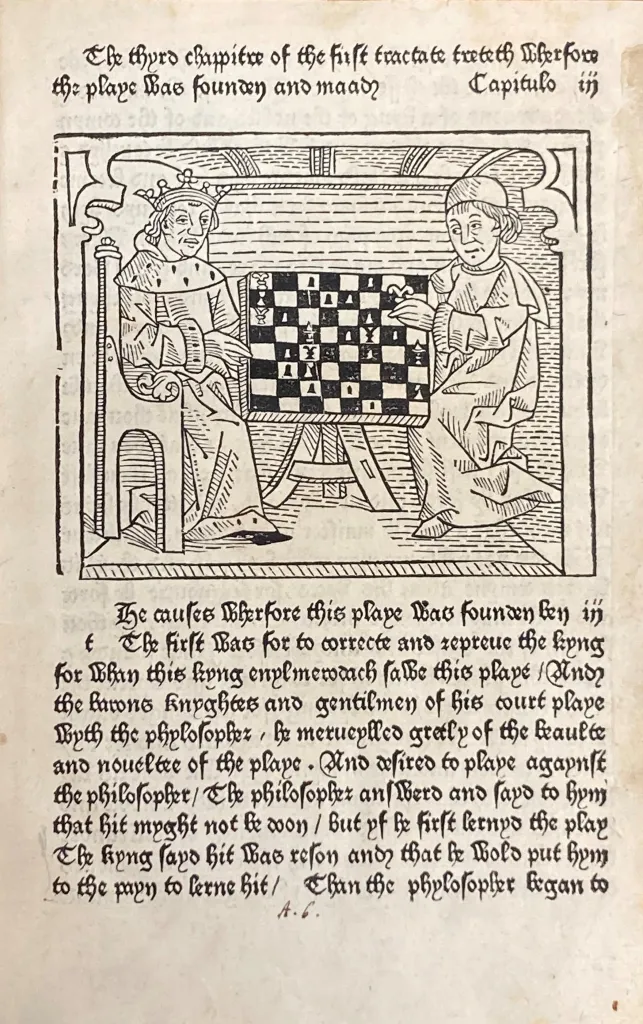
Page from Jacob Ceselles' treatise, «The Game and Play of Chess,» translated by William Caxton. Second edition. Westminster: William Caxton, circa 1483. St. John’s College Library, Oxford, A.2.7.
The foundation of the visual material consists of chess pieces from the Isle of Lewis and illustrations from Jacob de Cessonilis’s treatise, translated by William Caxton. These materials help to correlate the appearance of game pieces with depictions of social roles. The selection principle is the presence of established dating and discernible status markers: scale, posture, clothing, and attributes of power and labor. Comparative and iconographic methods are used for analysis. Written sources are selected based on their connection to the social symbolism of chess and the history of its rules: Cessonilis’s treatise is examined as a testament to the era’s conceptions, while the studies of Jenny Adams, Marilyn Yalom, and Harold Murray help to reveal the historical context.The work examines the transformation of the pieces’ imagery in Europe, the visual signs of inequality, the distribution of social duties in Cessonilis’s treatise, and the correlation between status and gameplay potential. Special attention is given to the king, queen, and pawn. Comparing their depiction and function will allow us to test the hypothesis and define the boundaries for interpreting chess as a model of social organization.
Image of the «Stanton» chess set from Howard Stanton’s book, «The Chess-Player’s Text-Book.» 1849. Digital vectorization of a printed illustration. Wikimedia Commons.
For comparative analysis, select European chess pieces from the 12th–13th centuries, sourced from the Metropolitan Museum of Art, are also utilized; the familiar Stanton-type set serves as a more recent comparative example outside the main period of study.
1. From Military Drill to Public Order
The imagery of chess pieces evolved alongside the culture in which the game spread. In its Indian predecessors, the set represented the composition of the army. In medieval Europe, the Queen and Bishop appeared among the pieces. While military symbolism was preserved, it was supplemented by images of the court and the church. Thus, the game’s hierarchy gradually took on traits familiar to those in the established social order.
1.1. Military Roles in the Precursors to European Chess
The military foundation of chess can be traced back to Indian Chaturanga. Its name is linked to the four divisions of the army: infantry, cavalry, war elephants, and chariots. Differences between the pieces signified their belonging to a specific branch of the military. The confrontation on the board represented the clash of armies, whose participants fulfilled different roles.
In Persian and Arabic traditions, an advisor was present alongside the ruler. The set included the figures of the Shah, the advisor, elephants, knights, chariots, and pawns. Here, the basis of hierarchy is already evident: the ruler occupies a special place, and the other pieces represent parts of the army subordinate to him.
Chess set. 12th century. Likely Nishapur, Iran. Quartz ceramic, molding, glaze. Metropolitan Museum of Art, New York.
To denote these roles, symbolic forms were sufficient. In the medieval Iranian set from the Metropolitan Museum of Art, the pawns resemble a throne, while the advisor is a smaller version of the same throne. The elephant can be identified by two protrusions resembling tusks, and the knight by a protrusion indicating the head. The pawns have a compact form with a small finial. The size and silhouette allow for the distinction of roles without detailed depiction of the body, clothing, or weaponry.This set demonstrates that differences in figure placement can be conveyed even without human likeness. By comparing it with European chess, one can observe what additional attributes make the pieces recognizable in those versions.
1.2. Changes in Figure Names and Representations in Europe
As chess spread across Europe, some pieces acquired new names and imagery. The Queen replaced the Advisor next to the King, and in several European traditions, the Bishop piece evolved into the Bishop. The names and appearance varied by region—the same set of game pieces could represent different social roles. The introduction of the Queen transformed the central pair of pieces into a royal couple. Now, a character associated with the dynasty and the royal court stood alongside the ruler. However, changing a piece’s image does not automatically mean changing its gameplay. A piece’s status and its power on the board must be considered separately.
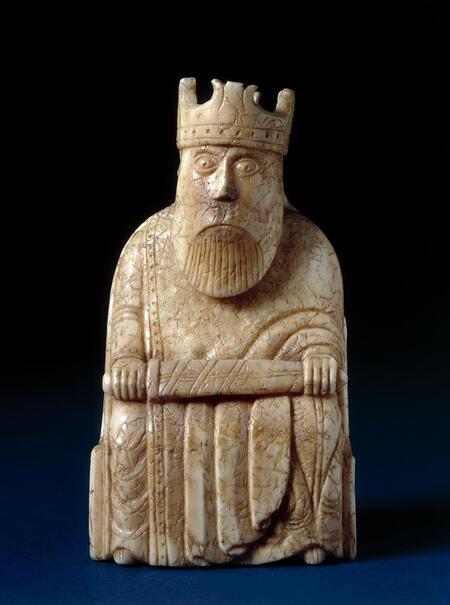
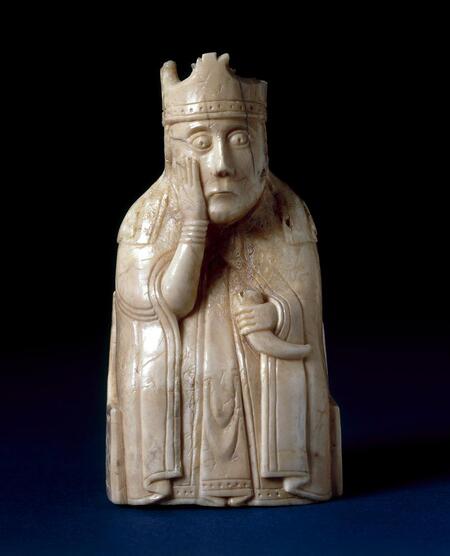
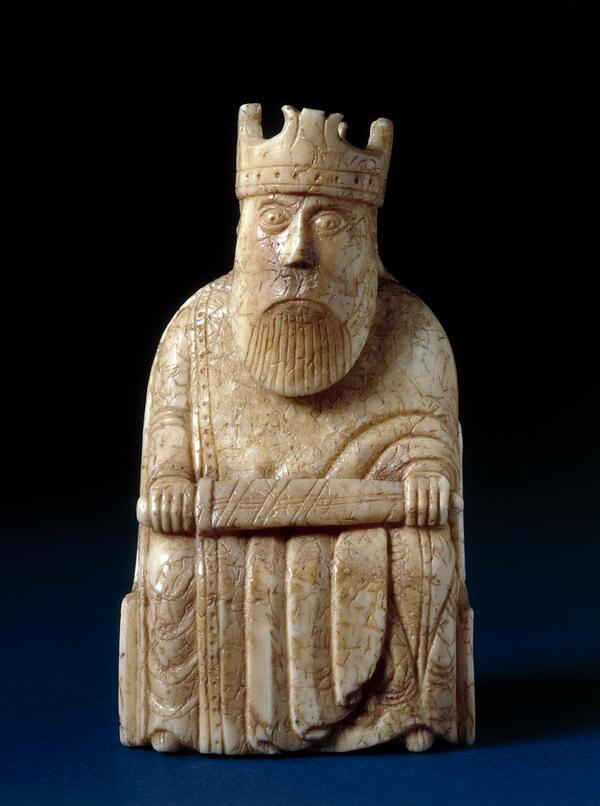
King and Queen from a chess set recovered from the Isle of Lewis. Circa 1150–1200. Scandinavia, possibly Norway. Walrus tusk, carving. British Museum, London.
Another example of this reinterpretation is the appearance of a bishop in place of an elephant. In chess, on the Isle of Lewis, its role is designated by a mitre and a crozier. Through these items, the figure is recognized as a representative of the clergy. By taking on a new form, it introduces the image of ecclesiastical authority into the chess set.
Bishop from a chess set found on Lewis Island. Circa 1150–1200. Scandinavia, possibly Norway. Walrus ivory, carving. British Museum, London.
Alongside the military figures on the board appear characters representing secular and spiritual authority. The chess set begins to resemble the structure of medieval society, although it does not reproduce it in its entirety. It highlights specific roles while leaving others outside its scope. Therefore, both the composition of the set and the characteristics assigned to each piece’s position are significant.
2. What Inequality Looks Like
Distinctions between chess pieces are apparent even before the game begins. Height, silhouette, headwear, and objects held in hand help to identify characters and differentiate their roles. However, the social status depicted, the prominence of the piece itself, and its potential in play may not align. This chapter examines how hierarchy is expressed in the external appearance of the pieces.
The basis for comparison consists of medieval items: pieces from Lewis’s hoard, a bishop with two attendants, and a knight battling a dragon. Next to these are examined the familiar «Staunton» type set. This later example allows us to see which markers of social roles endure even in a highly simplified form.
Stunton-type pieces. From left to right: king, rook, queen, pawn, knight, bishop. Photograph by Alan Light; published on Wikimedia Commons in 2004.
2.1. Symbols of Power: Thrones, Crowns, Weapons, and Ecclesiastical Regalia
In the photograph, the human body in the typical set is almost absent. The King is designated by a tall, vertical form with a cross, the Queen by a crown-like finial, and the Rook by the notched wall of a tower. A few distinct features are enough to differentiate the roles. The Knight stands out from the other pieces with its recognizable animal head.
In the previously examined Louis King and Queen set, the positioning is depicted differently: we see seated people in crowns. Faces, hands, clothing, and thrones are visible. The sword resting on the King’s knee connects his image to armed power, while the Queen’s gesture sets her apart from the other characters. Compared to the «Staunton» set, the role here is revealed through a complete human figure rather than just a silhouette and finial.
This comparison does not imply that all chess sets evolved sequentially from detailed sculpture to abstract form. Even the 12th-century Iranian set displays symbolic figures. What remains important, however, is that a social role can be expressed either by a human figure or by a distinct attribute that becomes the sign of that role.
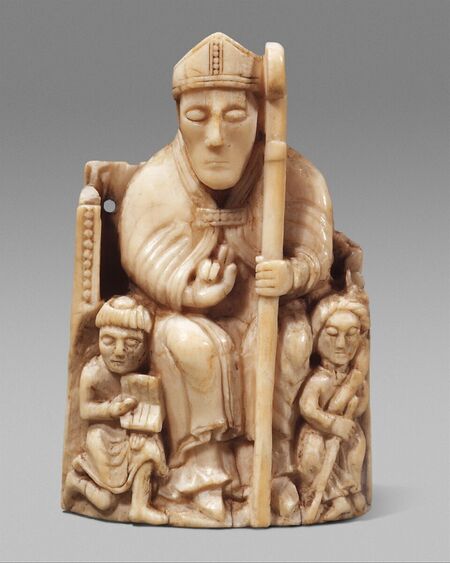
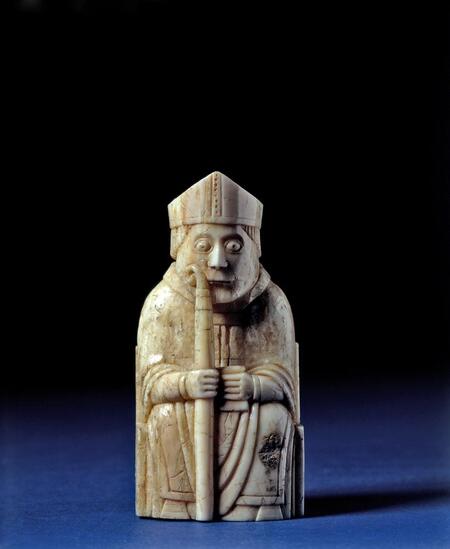
Left: Bishop chess piece with two attendants. 1150–1200. Scandinavia, possibly Trondheim, Norway. Walrus tusk. Height 9.6 cm. Metropolitan Museum of Art, New York. Right: Bishop from a chess hoard from the Isle of Lewis. Circa 1150–1200. Scandinavia, possibly Norway. Walrus tusk, carving. British Museum, London.
In both images, the bishop is identifiable by his mitre and crozier. However, the figure from the Metropolitan Museum includes two additional people. The central character is significantly larger than the accompanying figures, who are positioned to the sides and below him. This difference in scale and placement establishes him as the primary focus within this small composition.
According to the museum’s description, the smaller figures represent assistants to the bishop during the ceremony. One holds a book, while the other is possibly involved with leading the choir. Therefore, the figure can be read as an embodiment of power sustained by the actions of those around him. The bishop’s status is conveyed not only by his attributes but also by the relationships between the characters.
In Lewis’s figure, the bishop is presented alone, whereas here he is depicted alongside people performing other duties. This juxtaposition demonstrates how distinctions in roles and mutual dependency can be communicated within a single game piece.
A knight chess piece battling a dragon. Circa 1250. Presumably London, England. Walrus tusk. Height 7.8 cm. Metropolitan Museum of Art, New York.
The knight figure from the Metropolitan Museum presents an entire scene. The rider engages in combat with a dragon—the horse is raised, and the shield and armor denote an armed warrior. Thanks to the adversary, the role is revealed through action: before us is a participant in the struggle.The museum description compares the composition to the image of St. George. It is important for study that the figure conveys more than what is necessary to recognize the chess knight. The military role takes on a heroic character.In the usual set, the horse’s head signifies the same game role. The medieval figure depicts an armed rider and his opponent; the later set retains one recognizable feature. By comparing them, one can see how thoroughly chess reveals social roles. Moreover, the richness of the image itself does not determine either the figure’s status among the others or its possibilities on the board.
2.2. Scale and Detail Differences: Highlighted Figures and Repetitive Pawns
Size also helps to define the figure, but its significance depends on comparison. In the composition of the bishop with his retinue, the difference in scale reveals the relationship between the characters. It is more difficult with individual game pieces: in photographs, they might be shot at different magnifications.Therefore, museum measurements are needed to compare heights. In the previously examined Iranian set, items belonging to the same set can be compared: the height of the largest figure of the Shah is 5.1 cm, while a small pawn is 3.3 cm.
Chess set. 12th century. Possibly Nishapur, Iran. Quartz ceramic, molded, glazed. Height of the largest king figure is 5.1 cm; a small pawn is 3.3 cm. Metropolitan Museum of Art, New York.