Introduction
There are countless paintings and icons in the world created based on scenes from the New Testament. One of the subjects that frequently appears in visual arts is the story of Herodias’s daughter, Salome—a Galilean princess who was indirectly involved in the execution of the ascetic and prophet John the Baptist.
During the celebration of the birthday of King Herod Antipas, the daughter-in-law Salomé danced before him, and her dance was so beautiful that Herod promised to grant her any wish. At her mother’s instigation, Salomé asked Herod for the head of the prophet John the Baptist. Herod granted Salomé's wish—John’s head was brought to her on a large platter, which she subsequently gave to her mother.
Iconography
The Middle Ages and Early Imagery
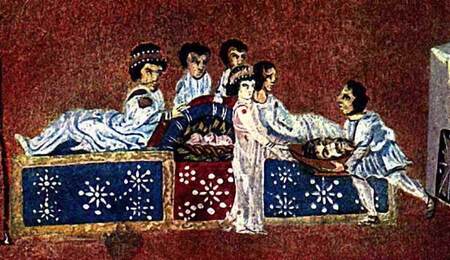
The depiction of Salome, who receives a platter with the head of John the Baptist, has undergone significant transformation and active reinterpretation in the visual arts over the years. The earliest illustration of Herod’s famous banquet that has reached us is believed to be an image found in the Synoptic Codex, dating to the 6th century. It is not entirely clear whether the woman in the image is Salome, but it is to her that the servant presents the severed head—thus forming the basis of the established visual archetype.
This image does not yet suggest any interpretations of Salome’s emotional state or experiments with her appearance—the figure is maximally abstract; the artist is not reflecting on anything, purely striving to illustrate the existing biblical narrative.
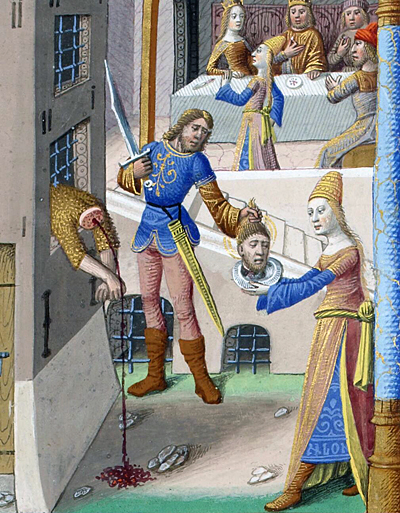
In later medieval depictions, there is a growing tendency to illustrate the grim details of events. In several works, the beheaded and bleeding body of John the Baptist is «displayed for all to see,» ensuring the viewer never forgets the prophet’s martyrdom.
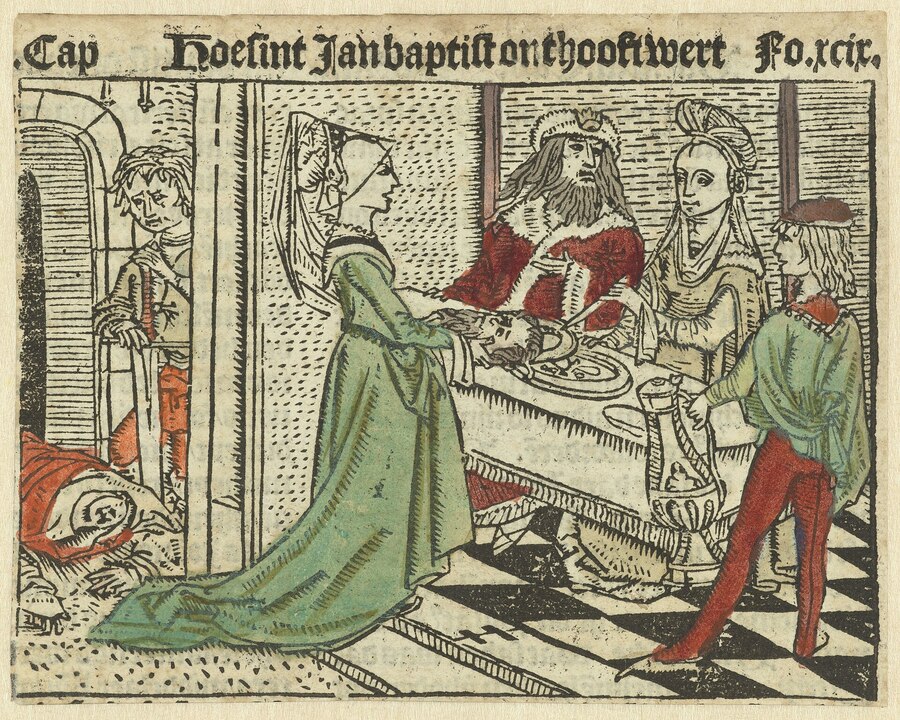
Unknown master from Antwerp. Between 1485 and 1491.
Unknown Master. Baptistery of St. Mark’s Basilica in Venice. Between 1343 and 1354.
Orthodox Icon Painting
The image of Salome with the head of John the Baptist often appears in both Orthodox icons, notably in «The Beheading of John the Baptist.» In most of these depictions, Salome is shown with unbound hair, dressed in ceremonial robes, and wearing a royal headdress. Around John the Baptist’s head, a bright halo is invariably present.
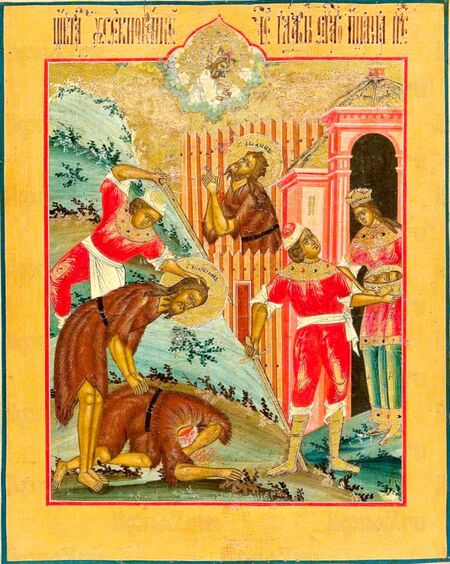
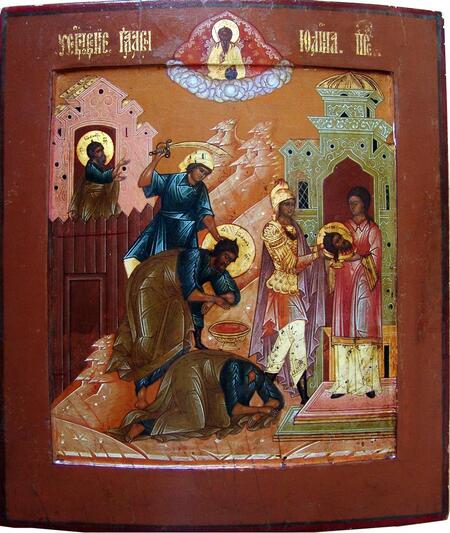
The Orthodox canon unites different moments of the biblical narrative of John the Baptist’s execution in similar icons. Therefore, the same image might feature both the yet-living Forerunner John, with the executioner standing behind him holding a raised sword, and Salome with John’s already severed head on a platter.
The Renaissance
A rather interesting transformation of visual imagery occurs with this subject matter during the Renaissance. Many paintings were created with Eurocentric assumptions in mind; therefore, figures from the ancient Middle East often appear dressed in European Renaissance attire and are placed in European city settings. In some paintings, you can see a dense accumulation of narratives—everything at once—the entire «plot arc» involving the beheading of John the Baptist led by Salome, who holds a large platter onto which the executioner places the severed head.
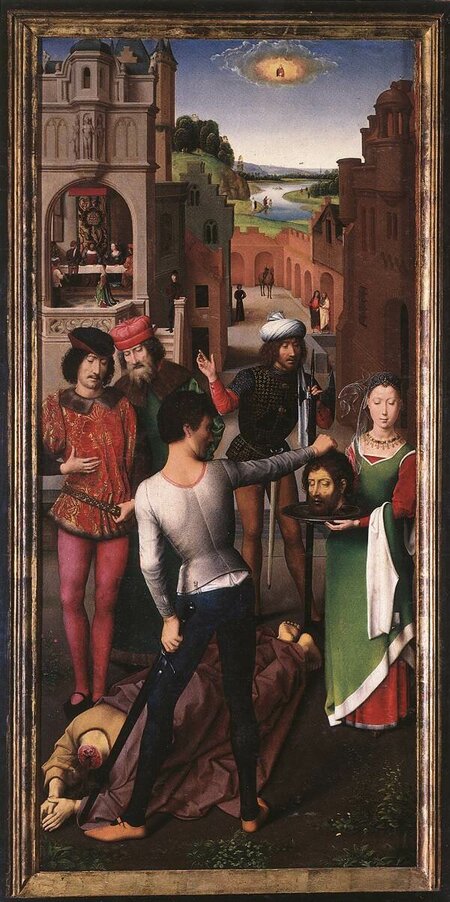
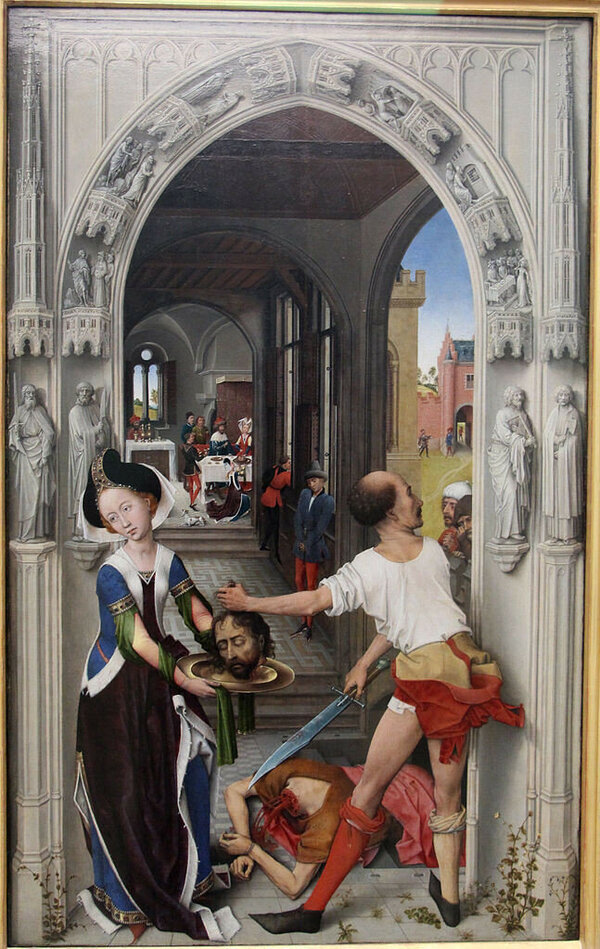
Hans Memling. Triptych of St. John the Baptist and St. John the Evangelist, left panel. c. 1474–1479; Rogier van der Weyden. Altar of St. John the Baptist, right panel. c. 1455.
Taking Rogier van der Weyden’s work as an example, we can observe that in some of the paintings illustrating this narrative, Salome turns her gaze away from the dish holding the severed head.
Some paintings from that era depict Salome with the head of John the Baptist, drawing inspiration from the iconography of another biblical scene—Judith beheading the Assyrian commander Holofernes. The illustrations of these two scenes can sometimes be so similar that they are nearly indistinguishable without a close look at the details.
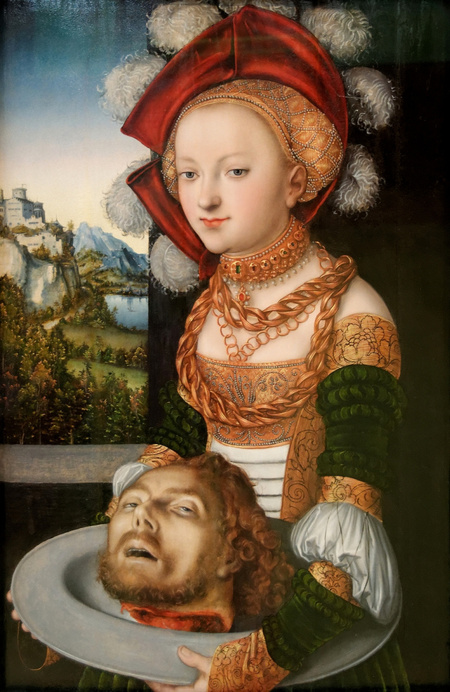
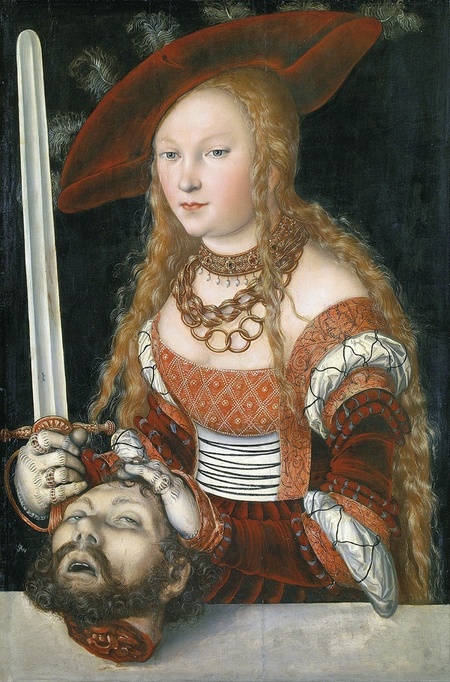
Lucas Cranach the Elder. Salome with the head of John the Baptist and Judith with the head of Holofernes. c. 1530.
By the 16th century, iconographic depictions gradually moved away from multi-figure compositions that combined various scenes from the narrative of John the Baptist’s execution, increasingly shifting the focus directly onto Salome. In some instances, artists essentially borrowed color, light, and composition wholesale from one another. Thus, many works can be described using the same vocabulary:
Salome almost always stares away from the dish upon which the executioner places the prophet’s severed head. The girl seems to be attempting to distance herself from the bloody scene—a scene in which she is now an accessory—or, conversely, she might be delighted that she fulfilled her mother’s wish, with no interest in anything else—some of this is suggested by the carefree smile frozen on the girl’s lips, as if nothing terrible had occurred at all.
Andrea Solario. 1506–1507.
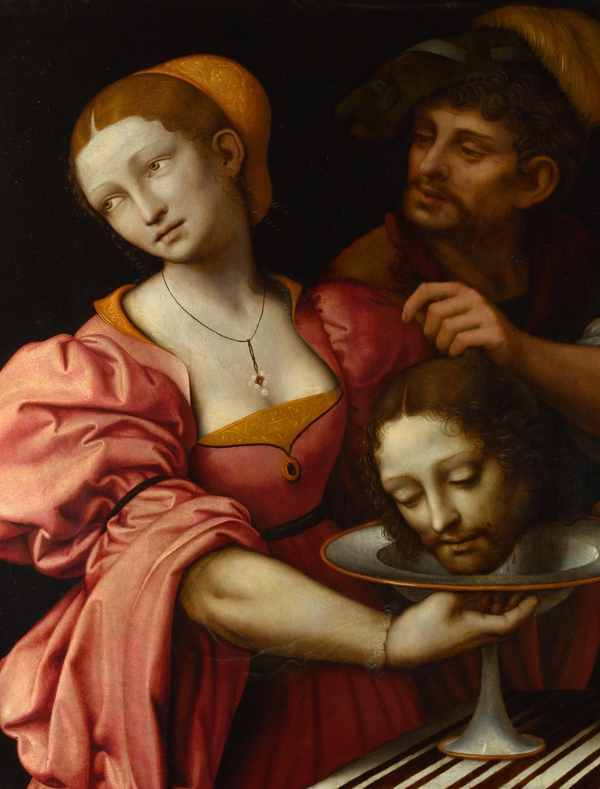
Bernardino Luini. c. 1527.
Jumpetrino. Approx. 1510–1530.
The composition will be established, and subsequently, when the Renaissance concludes, we will see a nearly identical version of it in Caravaggio’s interpretation of this subject.
Caravaggio. circa 1607.
The New Era
Gradually, the executioner’s arm disappears from the frame, and the center of the composition is completely given over to Salome. She is still predominantly dressed in a European style, but now occasional stereotypically Eastern elements are incorporated into her image.