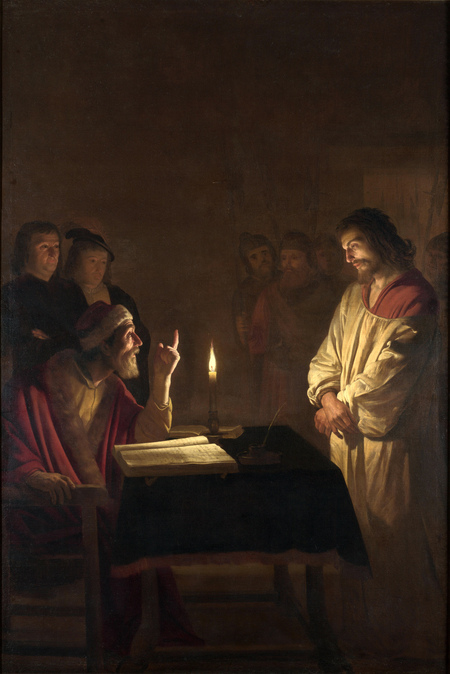
How darkness structures composition and intensifies narrative drama.
I. Concept
The nocturnal scene in painting is determined not only by a dark background or the absence of daylight. Night becomes an autonomous artistic space when the artist portrays the limitations of visibility and compels the viewer to interpret the image through discrete zones of light. A torch, a candle, a lamp, a fire, or a moonlit reflection does more than simply illuminate the depicted world. They dictate which figures will be noticed first, which gestures will be most expressive, and which areas of space will remain undefined.My research focuses on the interpretation of night and artificial lighting in painting from the late sixteenth to the first half of the seventeenth century. The primary focus is on the works of Tintoretto, Adam Elsheimer, and artists of the Utrecht Caravaggisti. Selecting these masters allows for a comparison of several different ways to organize dark space: the multi-figure composition, the nocturnal landscape, and the intimate scene built around a single candle.In this study, I am interested in how the compositional and dramatic role of artificial lighting evolves as one moves from Tintoretto’s multi-figure spaces to Adam Elsheimer’s nocturnal landscapes and the intimate scenes of the Utrecht Caravaggisti.The central hypothesis of this research is that within this range of visual examples, several methods for transforming darkness into an active pictorial structure can be discovered. For Tintoretto, light contributes to organizing expansive space and sustaining the viewer’s gaze between numerous figures. Elsheimer employs several small light sources to create discrete fields of vision within the nocturnal landscape. For Honthorst and other Utrecht masters, localized light more often concentrates attention on nearby faces, hands, and objects. What changes is not merely the brightness of the image, but the character of the viewer’s engagement—shifting from observing a spatially unfolding event to sequentially discovering details and finally to carefully examining a limited circle of actors.
quote
The goal of this research is to demonstrate how an image directs the viewer’s attention before they engage in a detailed interpretation of what is occurring.The primary methodology for this study is comparative analysis. For each image, we examine the position of the light source, its scale relative to the painting, the distribution of illuminated areas, the nature of the transition from light to shadow, and the degree of background visibility. Special attention is paid to how light affects images of hands and faces. These elements often become the primary carriers of action when the surrounding environment is enveloped in darkness.Another crucial condition of the research is identifying the differences between the depicted illumination and the overall pictorial lightening. A visible candle does not always account for every bright area in a painting, and a brightly lit face does not prove the presence of a candle outside the frame. Therefore, the work separately examines pieces with a visible light source and a control example where the source is not shown. This prevents the analysis from substituting observable evidence with assumptions about what is absent from the image.The visual sequence is organized not only chronologically but also according to the principle of sequential change in lighting situations. We first examine a large interior space, followed by a fire and a night landscape with several light sources, and then scenes centered around a candle. The sequence concludes with a comparison between a visible and an invisible light source. This progression allows us to verify whether the reduction in illuminated space truly enhances the significance of individual gestures and facial expressions.
Navigation
I. Concept II. Light as Trajectory: Tintoretto III. Fire as Medium: Adam Elssler IV. The Candle as Compositional Center: Gerrit van Honthorst V. Light as an Interacting Element VI. One Source—Varying Degrees of Participation VII. Comparative Analysis: A Dark Background Does Not Necessarily Mean Night VIII. Comparative Spread: From Expansive Space to Illuminated Node IX. Conclusion and Bibliography
I decided to structure the series this way: first, to examine a large interior space; next, a fire and nighttime landscape with multiple light sources; following that, scenes built around a single candle. The series concludes by juxtaposing visible and invisible light sources. In my view, this sequence allows me to test whether reducing illuminated space truly intensifies the significance of individual gestures and facial expressions.
II. Light as Trajectory: Tintoretto