Humanity has always sought to conquer death. Ancient Egyptians transformed this pursuit into a complex technology, a religious ritual, and a unique art form. They were not simply preserving the body—they were creating a new form for it, imbuing it with symbols, adorning it, and placing it within a space designated for eternal existence.
Concept
In ancient Egypt, death was not perceived as an absolute end of existence, but as a transition to another form of life. The human body needed to be preserved so that the person could continue their existence in the afterlife. This concept gave rise to a complex system of embalming, rituals, funerary objects, and artistic body adornment. As a result, a new image of the human being emerged—the mummy—which combined the material body, religious beliefs, artistic canons, and the idea of eternity.Mummification was an attempt to transform death into art, and decay into preservation.The goal of this study is to trace how ancient Egyptians sought not just to preserve the body as it was in life, but to create the conditions for its eternal existence, giving it a special, idealized form.
Navigator
1. Death as the Art of Transition to Eternity
2. The Ritual of Mummification
3. The Symbolism of Immortality
4. Architecture of Eternal Life
1. Death as the Art of Transition into Eternity
To understand why the Egyptians built such complex burial structures and preserved bodies, one must delve into their conceptions of death. For the ancient Egyptians, death did not signify the final cessation of a person’s existence. It was perceived as a transition from earthly life into another world—a space where life could continue in a transformed state. This is precisely why burial rituals held profound significance: they were meant to ensure the individual could successfully navigate this transition.
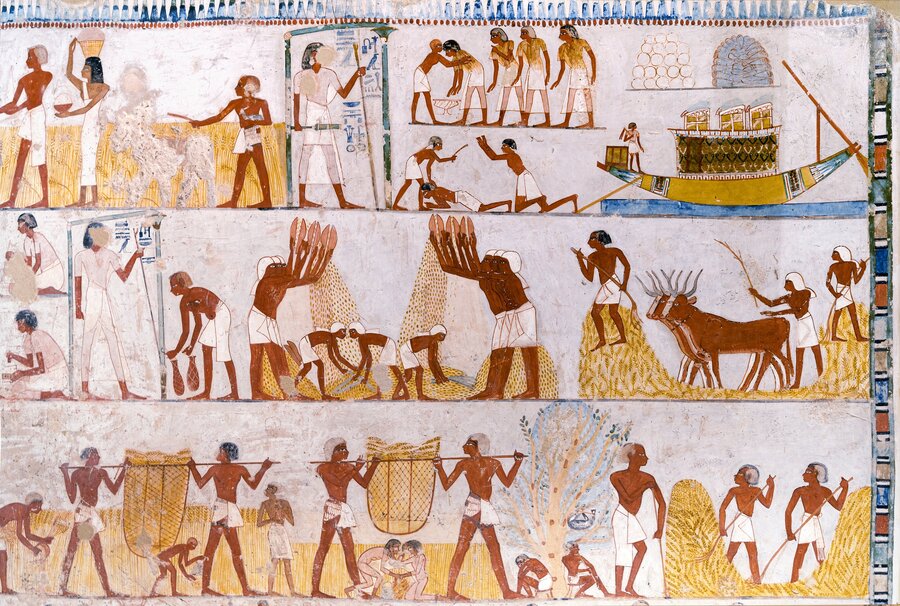
Image of a tomb fresco, a scene of human daily life, Nahta and Fiva’s tomb.
The Concept of the Afterlife.
Ancient Egyptians believed that after death, a person traveled to the realm of gods and the deceased, where trials and transformation awaited them.
The afterlife was not always depicted as gloomy or frightening. In texts, it could be described as a space where the deceased continued their accustomed life: receiving food, meeting with gods, traveling, and finding peace.
After death, the deceased was required to stand before the judgment of Osiris. One of the most well-known episodes of the afterlife journey was the weighing of the heart.
Weighing of Souls, Papyrus from the Book of the Dead. Egyptian Museum, Turin, Italy
2. The Mummification Ritual
The ancient Egyptians adopted the art of mummification from Anubis—the god of the dead. Initially, the funerary rites in Ancient Egypt were very simple. The deceased’s body was not preserved; instead, it was placed in a fetal position, wrapped in cloth, and laid in the grave. Items the person used during their life were interred with them. Later, methods of artificial mummification emerged in Ancient Egypt. These techniques were based on dehydrating the human body.
Image of a mummy, 337–302 BCE
The Mummification Process
Before commencing the embalming ritual, the deceased was taken to what was known as the House of Purification. First, the brain was removed from the body, followed by the extraction of the internal organs, excluding the kidneys and heart. These organs were embalmed and placed in canopic jars, which were kept beside the body.
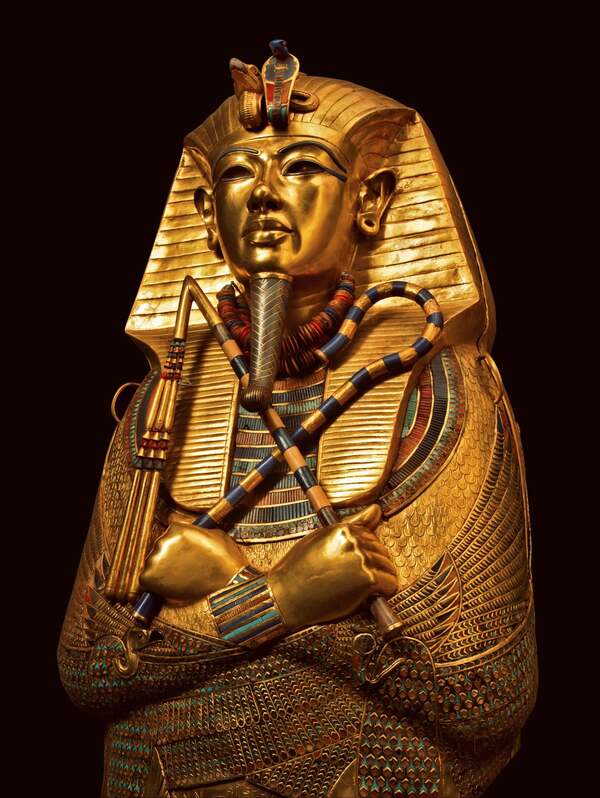
After this, the body was treated and dried. To prevent the skin from darkening, ochre—red for men and yellow for women—was applied to the bodies. Linen bandages, sand, and sawdust were placed in the abdominal cavity. The incision was covered with a wax or metal plate. The deceased’s body was washed with palm wine. Subsequently, the mummy was wrapped. Each toe or finger was bandaged individually, and then each limb was wrapped entirely. The final step was placing the death mask on [1].
Canopic Jars, 380–343 BCE, Oxford University Museum of Art and Archaeology
Funerary InventoryThe ancient Egyptians believed in the afterlife, so they strove to provide the deceased with everything necessary. Since the deceased’s body was mummified—and thus protected from decay—it was provisioned with necessary items for the next world. It was believed that in the afterlife, the deceased would lead a life identical to their earthly one.
Tomb of Tutankhamun, c. 1550–1069 BCE, The Grand Egyptian Museum in Giza
Ushabti were small figurines placed in large numbers within tombs. They depicted people holding agricultural tools—hoes, baskets, and other implements. The ushabti were meant to respond in place of the deceased person and perform their labor.
Jewelry and precious stones were also included. These items preserved the individual’s social status and appearance, and some of them also functioned as amulets. Cosmetics and incense were associated with beauty, purification, and ritual protection.
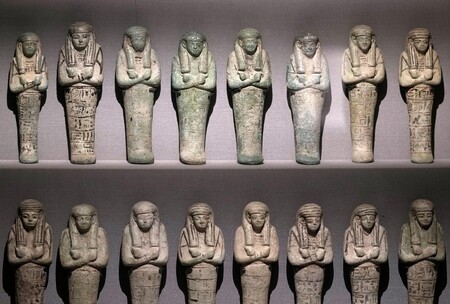
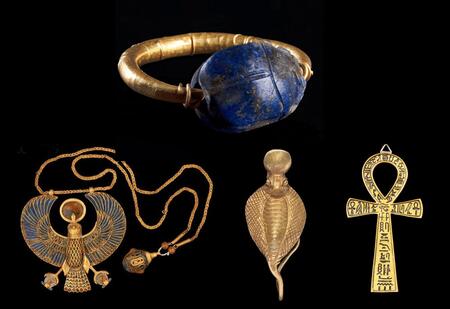
Image of an Ushabti and jewels from the tomb
The ancient Egyptians believed that the afterlife largely mirrored earthly life. The deceased might require food, clothing, furniture, jewelry, cosmetics, weaponry, and even tools. Furthermore, every object held both practical and religious significance. The tomb was not merely a burial site; it was an entire material world created to sustain the individual’s existence. The items within served as a kind of eternal kit.
3. Symbolism of Immortality
The painting on tombs and the objects within them constituted an entire system of images, inscriptions, and symbols intended to protect the deceased, aid them in passing the trials of the afterlife, and ensure eternal life. The scene depicting food provided sustenance for the deceased, an image of a deity offered protection, and a ritual inscription helped facilitate the transition to the other world. The gods and various symbols formed the core of the pictorial narrative; each possessed specific meaning. They constructed the persona of the deceased and linked it to the divine.
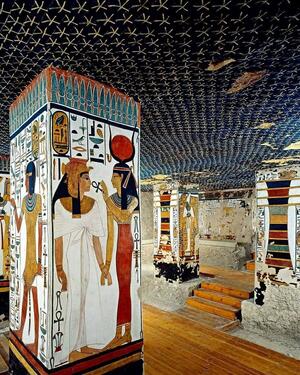
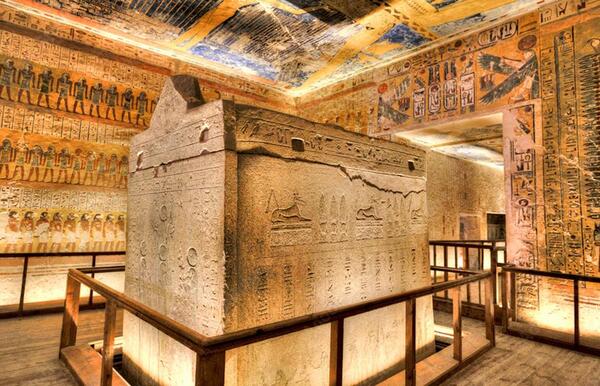
Tomb of Nefertari, c. 1279–1213 BCE, and the tomb in the Temple of Hatshepsut
For painting tombs, sarcophagi, and funerary objects of Ancient Egypt, mineral pigments were used—natural pigments mixed with a binding agent [4].
Primary Colors and Pigments: Red — red ochre. Yellow — yellow ochre and auripigment. Blue — Egyptian blue. Green — malachite. White — gypsum and chalk. Black — soot and charcoal.
Egyptian iconography became one of the early examples of how artistic convention can supersede photographic accuracy.
Nut, the goddess, was the heavenly protector of the deceased. She was depicted as a female figure with an elongated body, sometimes with outstretched wings. Her image could cover nearly the entire interior surface of the sarcophagus lid. Her depiction above the deceased symbolized the protection of the body, the acceptance of the deceased into the celestial realm, and rebirth.
The Eye of Horus was a symbol of protection and restoration. It was represented as a stylized human eye with characteristic lines and a swirl beneath it. It signified: healing, protection, and well-being.
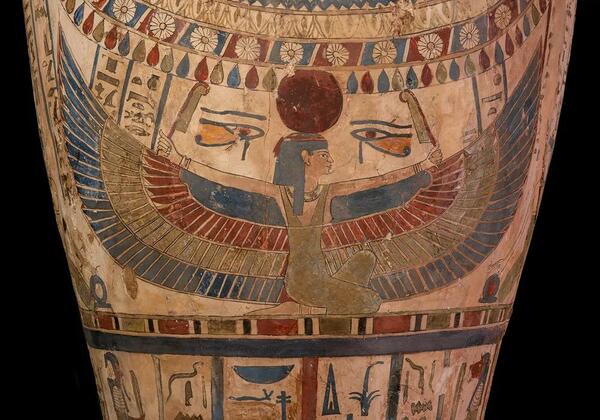
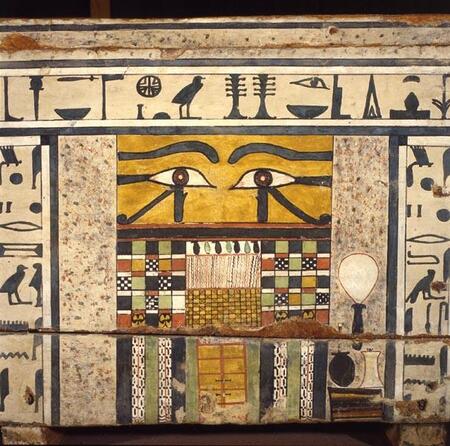
Image of Nut Goddess and the Eye of Horus
Anubis is the god of embalming. He was depicted as a man with the head of a jackal. Sometimes Anubis was shown next to a mummy on a funerary couch. This signified the proper performance of burial rites.Osiris is the symbol of death and rebirth. He was depicted as a mummy, with his tightly wrapped body and arms crossed over his chest, holding royal symbols—a staff and a flail. Osiris was the ruler of the underworld and a symbol of rebirth [2].
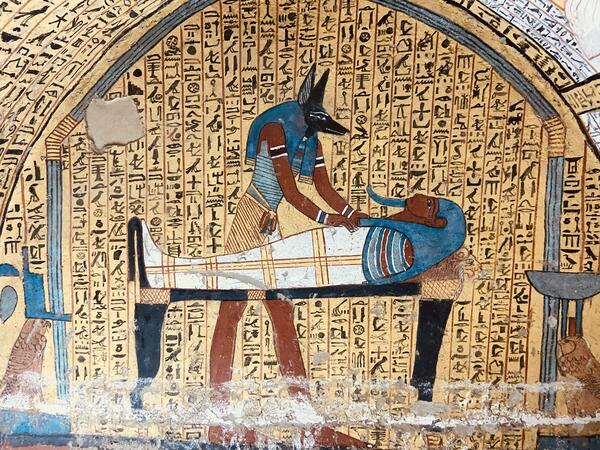
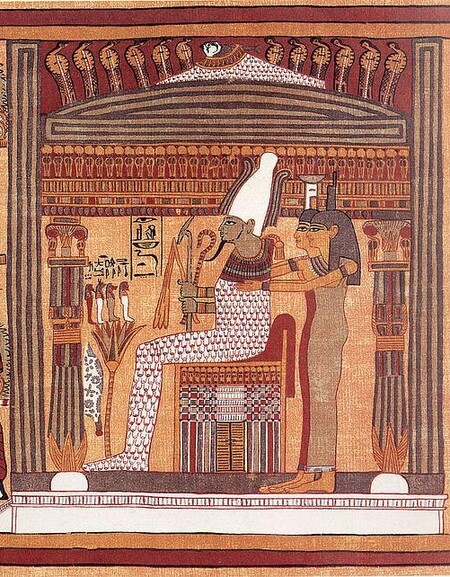
Image of the God Anubis and the God Osiris