Museums, artists' archives, photographsStudio Olafur Eliasson—the Weather Project installation and photographs of the setup.MASP—Lina Bo Bardi’s glass supports and the exhibition organization.Fondazione Prada—changes to Atlas and the juxtaposition of works.The Louvre—the placement of Nike of Samothrace on the Daru staircase.Benesse Art Site Naoshima—the architecture of Chichu Art Museum and natural light.Wikimedia Commons—photographs with author, date, and license information in the file card.
Material EntrySource: project title, author, museum, city, year or exhibition period, link, date of retrieval, and excerpts that verify the facts.Image: file, link to the photo page, photographer, caption, and usage terms.Editorial Section: chosen technique, observation about the photograph, text, version number, and status.The entry connects the source material, the draft, and the published post. A new version is created after edits; the editor approves a specific version.
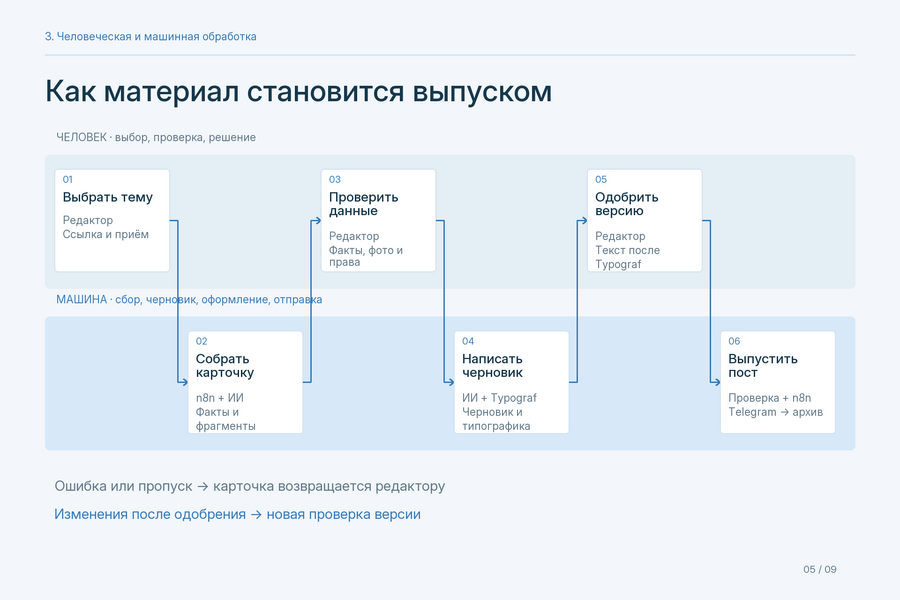
How a Material Becomes an Issue
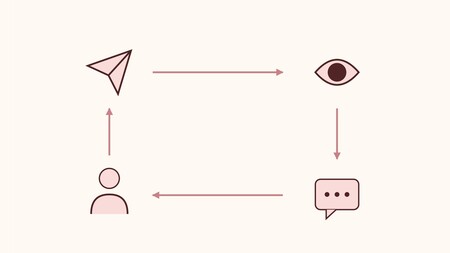
The Editor selects the topic and source → n8n and AI compile the card → the editor verifies facts, photos, and terms of use → AI drafts the text, Typograf formats it → the editor revises and approves the version → services verify and publish the issue.
Incomplete data or errors return the card to the editor. Any revision after approval requires a new review.
n8n: Save SourceInput — a link selected by the editor from the source list. The collection is initiated based on an editorial assignment.Retrieve the text from the open page, the title, photo captions, and the retrieval date. Save the original separately from the translation and summary.Match every fact with a corresponding snippet from the source. Record the work date, exhibition date, and photo date separately.Remove duplicates based on the link and the «project — museum — period» combination. Create new data as a new version.If the page is unavailable or mandatory data is missing, stop processing the card and pass it to the editor.
AI: operate within the cardWhen extracting data, use only the original text. For each fact, return a confirming snippet and a citation; flag contradictions for the editor.To write, receive verified facts, editor notes, and the selected technique. Structure: headline → context → technique analysis → question for the reader.The main body text should be 600–800 characters. The language should be calm and clear; each entry should explore one technique. Verify all names, titles, and dates against the card.Do not add fictional quotes, impressions from personal visits, or the artist’s intentions not present in the source.Output—a draft and a list of facts used. The editor makes the final publication decision.
Publication after approval
The typographer formats quotations, dashes, and non-breaking spaces while preserving names, dates, and links. The editor reviews the formatted version.
The auto-check requires completed source links, photo captions, confirmed usage terms, and approval of the current version.
The output, along with the photo caption and links—must be under 1024 characters after markup parsing. Exceeding this limit returns the material for revision.
n8n sends the approved version via the Telegram Bot API and saves the message date and ID.
Resending published material is blocked. If the sending result is inconclusive, the editor first checks the channel.
The Weather Project: From Fact to Analysis
Source: Studio Olafur Eliasson, The Weather Project, Tate Modern, London, 2003.
Machine Card: A semicircular screen, a mirrored ceiling, and artificial fog create the image of the sun. The facts relate to the project’s description.
Editor’s Observation: People and their reflections are visible in the frame; the viewer becomes part of the overall scene.
Program Excerpt: «The light here itself becomes the material of the work. Half of the disk is completed by reflection, and visitors find themselves inside an artificial sunset.»
Question for the Reader: «Is it more important to preserve the illusion or to understand its structure?»
Data Sources
Studio Olafur Eliasson — The Weather Project Description of the installation device, materials, and methods of working with light. Photographs of the installation with author attribution.
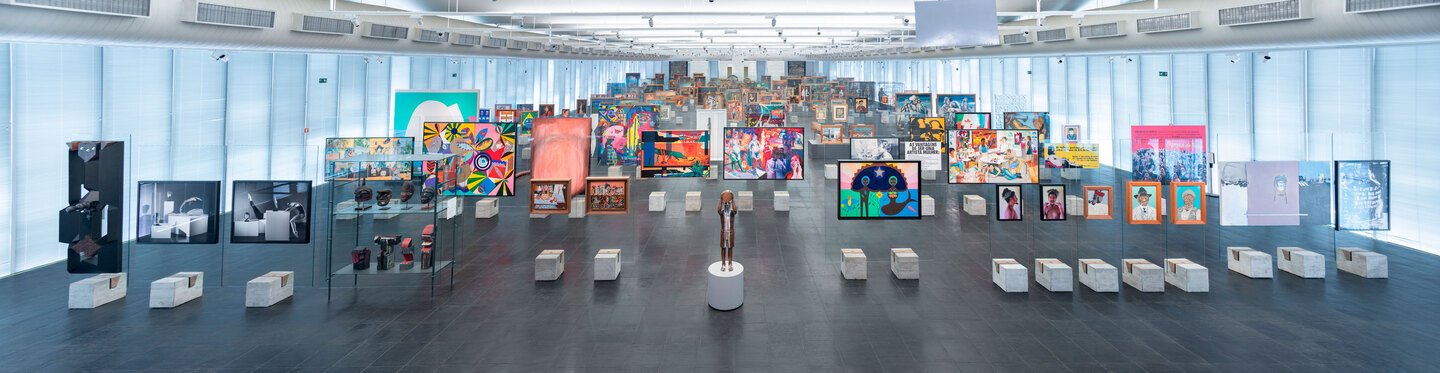
MASP — Picture Gallery in Transformation Information on Lina Bo Bardi’s glass supports, the history of their use, and the organization of the museum space.
Fondazione Prada — Atlas Description of the shifting exhibition, the juxtaposition of works, and the use of space. Photographs of the halls.
The Louvre — A Stairway to Victory The history of the placement of Nike of Samothrace on the Daru staircase and the connection between the sculpture and the architecture.
Benesse Art Site Naoshima — Chichu Art Museum Materials regarding Tadao Ando’s architecture, the underground placement of the museum, and natural lighting.
Wikimedia Commons — The Seven Heavenly Palaces Photograph of Anselm Kiefer’s installation in Pirelli HangarBicocca. The card indicates the author Gampe, the date of the shot, and the CC BY-SA 4.0 license.
Automated Service Documentation
n8n — HTTP Request — fetching data via a link.
n8n — HTML — extracting page content.
MediaWiki API–Imageinfo — retrieving information about an image file.
Typograf — formatting quotation marks, dashes, and spacing.
Telegram Bot API — sending a photo with text to a channel.
Date of reference to sources: November 8, 2026.