Navigation
1. The Arch of Trajan: Creation and its Role in the Roman Empire
2. The Dacian Wars from Written Sources
3. Description and Imagery of the Relief
4. Differences in the Depiction of the Emperor and the Enemy
5. What the Relief Truly Tells Us and What Influence It Had on Public Consciousness in the Roman Empire
6. Conclusion
7. Bibliography
8. Image Sources
Epigraph
«Non times bella nec provocas»
«You do not fear wars nor provoke them»
Concept
In my research, I aim to examine Trajan’s Column not merely as a significant historical monument, but as one of the earliest forms of visual communication of power to the populace and as a source of valuable data regarding the Dacian Wars and how they were perceived by the Romans themselves. During this research, I plan to study the structure of the column and its relief, compare written sources describing the Dacian Wars with the images on the Column, and identify any similarities or differences between them. This could help me understand the authenticity of the monument’s depictions and what exactly they reveal to us about the Roman state and the triumph of Rome. The central question of my research is to determine how Trajan’s Column recounts the progress of the wars through its visual elements and what role the image of the Emperor plays in that narrative.
Rationale for Topic Selection
I chose this topic precisely because I am interested in learning more about the image of the emperor and warfare that the Column of Trajan created for the Romans. I am also keen to study how the course of the Dacian Wars and the victories of the Roman army were conveyed through the drawings and symbols on the Column.
I believe this topic is relevant to our course because it allows for an examination of how imagery shaped the public’s perception of Roman power.
On one hand, the Column of Trajan narrates real military events; however, it is crucial to understand the extent to which the relief accurately reflects their authenticity and how the emperor’s image is portrayed within it.
My interest in the Roman Empire dates back to my school years. I was curious to study how the hierarchy was structured, how elections were conducted, and how laws were established. Overall, the organization of the ancient world has always fascinated me because it shares surprising similarities with the organization of the modern world.
Rationale for Textual Source Selection
For my visual research, I selected several textual sources. These works include:
«Panegyric» by Pliny the Younger «Roman History» by Dio Cassius «Dacian Wars: Justification and Causes in Trajan’s Ideology» by V. Yu. Danilov «Dacia in Flames. Part One» by Lucius Quinctius Barca «The Legions of Rome on the Lower Danube: Military History of the Roman-Dacian Wars» by M. Rubtsov «Rome and the World of Tribes on the Danube in the 1st–4th Centuries AD» by Yu. K. Kolosovskaya
These sources will assist me in analyzing the organization and nature of the Roman state during the Dacian Wars—specifically, understanding the causes of their outbreak and independently analyzing the fidelity of the relief on Trajan’s Column.
Hypothesis
The relief of Trajan’s Column is constructed as an ideological narrative for the Romans and their descendants, rather than as a detailed chronology of events. Its visual and communicative purpose is to create an image of praise for the emperor, the Roman state, and the army.
Key Research Question
How does Trajan’s Column, through its bas-reliefs, narrate the Dacian Wars and forge the image of the emperor?
Areas of Study
My visual research spans several areas vital for comprehensive systemic analysis and the development of hypotheses and visual artifacts.
Ancient Roman History Archaeology History Art History Visual Communication
What is the Trajan’s Column: creation and its role in the Roman Empire
Roman fortifications on the Danube, several guard towers, piles of wood, and stacks of hay
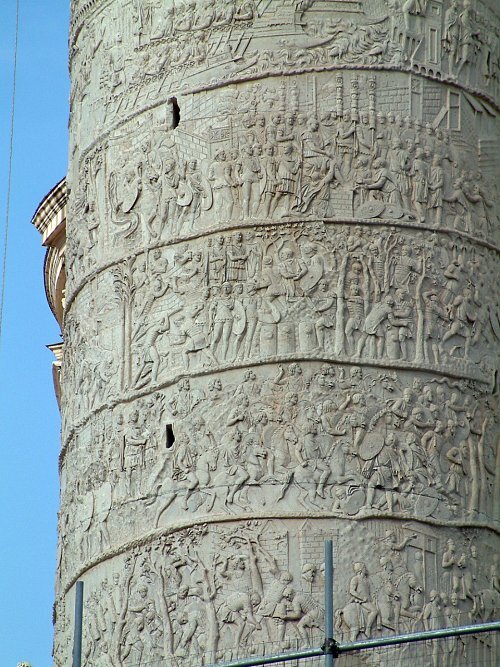
- The column looks very slender: its shaft hardly tapers and reaches toward the sky, making the multi-story building next to it appear noticeably shorter. Against the backdrop of modern buildings, it is clear that the monument served as a high-rise landmark.
- At the top is a bronze statue wearing a halo and holding a key—this is the Apostle Peter, who replaced the statue of Trajan in 1587. Below the statue is a square platform enclosed by a fence atop a capital featuring oval elements (an echinus); the capital’s form corresponds to the Tuscan order.
- From this distance, the relief transforms into a fine texture: individual scenes on the upper drums cannot be discerned. The column conveyed an overall impression of scale rather than allowing for the reading of each episode.
The Trajan’s Column is a marble column erected in Rome in 113 CE to commemorate the victories of Emperor Trajan in the Dacian Wars. A spiral relief wraps around its shaft, depicting episodes from the military campaigns.
Height and Monumentality The shaft of the column is approximately 29.8 meters high, with a pedestal rising to about 35 meters, and the statue of Trajan atop the column reaching roughly 38 meters. The column is constructed from blocks of Carrara marble, and an internal spiral staircase contains about 185 steps. An inscription on the pedestal states that the column illustrates the height of a hill that was cut down during the construction of the Forum. Interpretations vary: some see it as a narrative about the scale of the earthworks, while others view it as a reference to the hill’s elevation. Trajan’s ashes were kept within the pedestal. In 1587, the statue of Trajan was replaced with a statue of Saint Peter.
The Narrative Frieze The relief features approximately 23 wraps, spanning a length of about 190–200 meters, with about 2,500 figures. Trajan is depicted roughly 60 times. The frieze widens from the bottom to the top, and the narrative flows continuously without divisions; scenes transition into one another through landscapes, crossings, and the construction of encampments. The relief is shallow and was likely polychromed, but traces of paint and metalwork prevent a precise reconstruction of its original appearance. The plot covers two Dacian Wars (101–102 and 105–106 CE), from the crossing of the Danube to the death of Decebalus.
Placement in the Trajan’s Forum Ensemble The column stands in a narrow courtyard between the Greek and Latin Libraries, behind the Ulpian Basilica. Later, a temple to the deified Trajan was built behind it. Apollodorus of Damascus is thought to have designed the entire complex. A prevailing hypothesis suggests that the relief was viewed up close and possibly from the upper galleries of the libraries. In this scenario, the ensemble guided the viewer sequentially from a public space toward a commemoration of victory, with the column serving as the thematic center.
Monumental Scale and Scope of Events The two wars are condensed into a frieze of about 200 meters, making the depiction schematic: armies are shown as dozens of figures, and cities are generalized, while time and distances are compressed. Nevertheless, the army’s operations are detailed—for example, roads, bridges, and camps. The upper wraps are difficult to discern from below, suggesting the relief functioned more as an embodiment of Roman might and order than as a literal chronicle, inspiring awe through sheer scale.
The Crimean Wars from Written Sources
Start of the battle
Fresco Analysis
- A dense group of armored and helmeted warriors. Above them are banners bearing disks and a crown. This is Roman infantry: formation, unit insignia. The figures stand closely together, creating the impression of a large, organized army.
- Trajan near the camp. A figure in a cuirass, next to him a man in a cloak, behind them is the stone camp wall with gates. This is a scene of receiving spoils. The heads of slain Dacians are visible near the wall, and, judging by the adjacent figures, the warriors are also bringing them. Trajan stands calmly and gestures little: he is receiving the result, not obtaining it, so the image of a thoughtful commander is preserved even in this brutal scene. The severed heads emphasize that the enemy has already been defeated and that the army is receiving proof of victory.
- Cavalry enters the fray. The riders charge forward, the horses depicted in swift motion. To the right are fighters in helmets and neck wraps, carrying round shields, with defeated enemies lying beneath their hooves.
- The scene is read from left to right: the army, the emperor by the camp, and then the battle. This sequence emphasizes that the action proceeds in the order dictated by command: composure and authority on the left, and dynamism at the edge of the narrative strip. The Dacians are barely visible here: they are merely victims or trophies, whereas the Roman army is presented as a cohesive and victorious force.
Trajan’s Wars with the Dacians
Fresco Analysis
- Winged Victory in long robes, her hair gathered in a knot. She stands next to a round shield edged with a laurel wreath, writing upon it. The shield rests on a small pedestal.
- Enemy armor—oval shields with vegetal ornamentation, helmets, chainmail—are mounted vertically on the left and right. Weapons are piled at the bottom. Such arrangements were placed at places of victory in the Roman tradition. The figures on the left and right, clad in armor, are interpreted as trophies rather than as living warriors.
- Victory is positioned at the center, symmetrically framed by the trophies, and this is the only scene devoid of people or action. The verticals of the poles and the drapery folds, the wide wings, and the calm profile create a solemn pause. This is precisely why she is considered the demarcation between two wars.
- Victory is depicted as something finished and secured: it is inscribed on the shield and surrounded by captured spoils. The source of victory here is not battle, but the will of the goddess—thus, the victory appears consecrated.
The Dacian Wars (101–102 and 105–106 CE) were one of the most significant events in the Roman Empire during the reign of Emperor Trajan. The primary causes of the conflict were Rome’s desire to strengthen its position on the Danube, expand its territory, and establish control over the rich resources of Dacia. The main opponent of the Romans was the Dacian king Decebalus, who sought to maintain the independence of his state. Dion Cassius details the military campaign in his «Roman History, ” describing Trajan’s expeditions, the battles of the Roman army, and Decebalus’s defeat. Pliny the Younger also mentions the emperor’s victories in his „Panegyric, ” but his work is more aimed at glorifying Trajan, as it was written before the Dacian Wars began. Contemporary research by V. Yu. Danilova, M. Rubtsov, and Yu. K. Kolosovskaya examines the reasons for the wars, the characteristics of the Roman army, and the importance of the Danube region to Rome. V. Bartash’s work, „Dacia in Flame, ” also offers an understanding of this era, though it should be noted that it is a work of fiction rather than a scholarly source. As a result of the two military campaigns, Rome achieved victory over Dacia, and in 106 CE, its territory was incorporated into the Roman Empire. This allowed Trajan to solidify the frontiers on the Danube and expand his influence in the region.
Relief Description and Image
Rites Scene
Fresco Analysis
- A figure with a covered head stands by a small altar. Next to her, a person is bowing toward her—perhaps a participant in a rite. Banner holders are visible in the background. The altar is inside the camp walls: this is a closed, «sacred» space of the army.
- A bull, a ram, and a sow form a combination of purification rites. The army is ritually cleansed before a campaign. An assistant with a hammer raises it above the bull, depicting the moment before sacrifice. On the right, participants wearing wreaths look toward the altar.
- A warrior leans over a basket, while other figures are chopping trees in the upper left. This is the everyday work of the camp, presented alongside the ritual. The group of people on the left might be Dacian envoys.
- The scene is arranged vertically: power and ritual at the top, a procession below, and heavy labor at the bottom. This illustrates that the army and imperial authority act in concert: Trajan appears as a pious commander, and the war begins with purification—meaning it is done correctly and lawfully.