Navigation Menu
01 — Concept 02 — Copywriting in the Advertisements of Vladimir Mayakovsky and Alexander Rodchenko, 1923–1926 03 — Copywriting in the Advertisements of David Ogilvy — Copywriting for Rolls-Royce and Mercedes-Benz, 1958–1962 — Application of David Ogilvy’s copywriting techniques in advertisements for other products from the late 1940s to the late 1960s 04 — Copywriting in the Advertisements of William Bernbach for Volkswagen Beetle, 1959 — Copywriting in the Advertisements of William Bernbach for the car rental company Avis, 1963 05 — Copywriting in the Advertisements of David Abbott for Volvo — David Abbott and his advertising agency Abbott Mead Vickers BBDO: application of copywriting techniques using advertisements for The Economist magazine, 1986–1999 06 — Copywriting in Advertisements for Land Rover, 1971–1999 07 — Conclusion 08 — References
01 — Concept
Copywriting is a significant component of the advertising world, aimed not only at capturing the attention of the target audience but also at persuading them to purchase a product or service. The main objective of this visual research is to identify the various techniques and approaches used when writing copy or headlines. The foundation for this study is built upon iconic global works and projects by various authors and brands. The diversity of the advertised products and services allows for a more comprehensive view of the functions of textual messaging in practice. Through the examples presented in this work, I will study the specifics of copywriting and, in some cases, compare them against each other.
The primary parameter for searching visual material is the diversity of how the chosen subject of study is presented. Furthermore, another guiding principle for selecting the illustrative series is the desire to analyze the iconic works of great copywriters and advertisers. The material primarily considered includes advertisements published in newspapers and posters. It is important to note that the selected visual content places a greater emphasis on the text itself or its relationship with the images. Because many of the examples provided are international, the captions beneath the illustrations will include a Russian translation.
For the most practical analysis of the material being studied, it is necessary to establish a research structure. The main chapters focus specifically on particular copywriters and advertisers. Some of these chapters include subchapters that demonstrate the application of these same techniques depending on the type of product. Four chapters are dedicated directly to the work of famous advertisers, and the fifth chapter is entirely devoted to one specific campaign. This structure will allow for a more detailed coverage of various aspects of copywriting and enable us to draw conclusions about its characteristics across different contexts or projects.
To conduct this visual study, I also examined various textual sources. The main principle guiding their selection was the content of the information—not only concerning the features of language and style in copywriting and text composition approaches, but also regarding the diverse objectives and tasks of advertising campaigns and the history of their creation. Furthermore, to provide a complete context, materials concerning automotive companies were also considered, as they form a significant portion of this research. The primary textual sources consist of books and online articles. However, the central foundation is «Ogilvy on Advertising» and «The Advertising Man’s Revelations,» written by David Ogilvy, whose works are also reviewed in this study.
02 — Copywriting in Advertising by Vladimir Mayakovsky and Alexander Rodchenko, 1923–1926
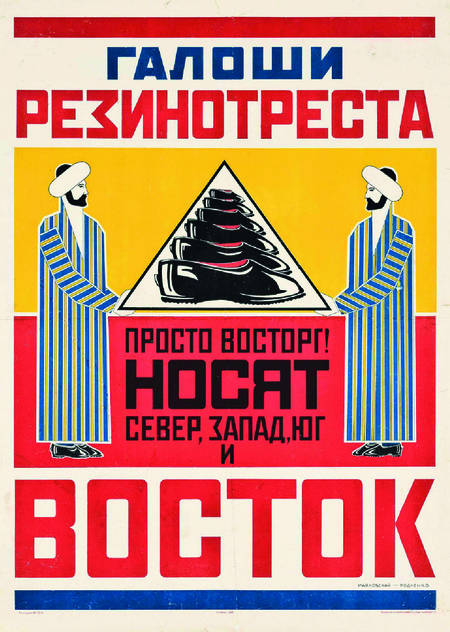
Mayakovsky and Rodchenko collaborated to create commercial advertising. The former handled copywriting, while the latter created the illustrations.
Wellington Boots Advertisement
Boot Cover Advertisement
Bread Advertisement
In his promotional message, Mayakovsky primarily employs rhyme. This technique helps the text be more easily absorbed and remembered.
Breastfeeding nipple advertising
GUM Advertisement
GUM Advertisement
Composition and illustration play a vital role in the posters of Mayakovsky and Rodchenko: they enhance the text and make the advertising more dynamic.
GUM Advertisement
Beer Advertisement
Pencil Advertisement
03 — Copywriting in Advertising by David Ogilvy
Copywriting in Advertising for Rolls-Royce and Mercedes-Benz, 1958–1962
«At 60 miles per hour, the loudest sound in the new Rolls-Royce is the ticking of the clock.»
«You renounce things when you buy a Mercedes-Benz 230S—things like noise, rust, and shoddy workmanship.»
The first thing that immediately catches the eye is the use of quotation marks. Ogilvy believed that imitating direct speech or a quote increases the viewer’s attention to the text. The second point is the use of contradiction in the headline, similar to the advertisement for Mercedes-Benz.
Applying David Ogilvy’s copywriting techniques in advertising for other products from the late 1940s to the late 1960s
Advertising campaign for Schweppes // «You can see the lemon in Schweppes Bitter Lemon. That’s because Schweppes uses whole, fresh lemons—the juice, the pulp, the rind, all of it.»
Advertising campaign for Schweppes // «This is a rebellion—how can you mix Gin & Tonic without Schweppes?!»
Advertising campaign for rum // Translation for the ad copy on the left: «Everyone knows we were in Puerto Rico when we uncork the rum»
In this case, the advertising for the same product is presented differently: the first option uses a headline in quotation marks, while the second mimics a dialogue. The first version is more successful due to its conciseness and sharpness.