Contents
1. Concept 2. Research 2.1 Cats in Medieval Society 2.2 Features of the Medieval Art Language 2.3 Marginalia and Animal Anthropomorphism 2.4 The Symbolic Meaning of Cats 2.5 The Cat as Part of the Real World 2.6 The Cat as an Independent Subject of Observation 3. Conclusion 4. Bibliography and Sources
Concept
Images of medieval cats have become popular in recent years due to the internet. In many miniatures, the animals appear unusual: they have disproportionate bodies, strange facial expressions, nearly human faces, and unnatural poses. Sometimes it seems as if the artist was attempting to draw a human but remembered at the last moment that they were depicting a cat. However, behind this outer comedy lies an interesting historical and cultural problem. Why did artists of different eras depict animals in this manner? What role did cats play? This topic was chosen because it allows for an exploration of art history from an unconventional angle—through the relationship between humans and animals and the shifting artistic perception of the world around us. For my research, I selected works of European art created from the 12th to the 18th century. I focused primarily on medieval manuscripts, book miniatures, and marginalia, as these are where the most unusual depictions of cats can be found.
The material selection is determined by several factors:
- Manuscript illustrations allow for the study not only of the physical appearance of cats but also of their role in daily and religious life.
- Works from different eras offer insight into the evolution of artistic techniques.
- Depictions of animals in domestic, religious, and satirical scenes allow us to understand how societal attitudes toward cats have changed.
Key Question:
Why do cats on medieval illustrations often appear as if they have human traits, and what role do they actually play?
Hypothesis:
The unusual appearance of medieval cats is attributable not so much to a lack of artistic skill as it is to the specific nature of medieval artistic thought. The depiction of an animal could be subservient to symbolic content, religious allegory, humor, or decorative function. Furthermore, artists employed conventional visual devices that did not always necessitate anatomical accuracy. It is presumed that as naturalism developed in art, the portrayals of cats became more realistic, though anthropomorphic and symbolic images continued to exist.
The Cat in Medieval Society
To understand why medieval artists depicted cats in that specific way, one must first examine the role these animals played in people’s lives. Contrary to the common notion of the Middle Ages as a time of universal persecution of cats, the perception of them was complex and varied. Cats were simultaneously viewed as beneficial domestic pets, companions, symbols of cunning, and beings connected to superstitions. They protected food stores, books, and fabrics from rodents. Furthermore, cats were kept for more than just practical utility—they became cherished household pets. Researcher Madeline S. Killack notes that the depictions of cats in medieval manuscripts allow us to gauge their important place in the daily lives of people. However, the attitude toward them could shift depending on cultural and religious beliefs [1].
Example Artwork:
«The Last Supper» — Piero Lorenzetti, 1320.
The image features animals situated within a domestic setting. Such details help convey the everyday atmosphere and illustrate that the animals were a familiar part of human life. Here, it is important to view the cat not merely as an artistic symbol, but as a reflection of the medieval person’s real-world experience. Thus, medieval artists depicted cats not exclusively as symbols, but also as pets familiar to them. Their depictions could reflect the actual habits and behavior of these companion animals.
Characteristics of Medieval Artistic Language
One of the main reasons for the unusual appearance of medieval cats is the difference between the artistic goals of that era and modern concepts of realism. Medieval art did not always aim for an exact reproduction of the external world. Religious meaning, the recognizability of the narrative, symbolism, and decorative expressiveness could be more important. Bestiaries—illustrated collections of animal descriptions—played a particularly important role, incorporating real and fantastic creatures into moral and religious narratives. Thus, an artist could consciously simplify or alter an animal’s anatomy if it helped better convey its role in the composition.
Example work:
«Adam gives names to the animals» — Aberdin’s Bestiaries, 12th century.
In medieval bestiaries, animal depictions served as a form of visual commentary on the accompanying text. Their purpose was not necessarily to accurately reproduce anatomy, but rather to convey the content and meaning of the described creature. This explains why some animals appear unfamiliar to the modern viewer. Consequently, a lack of photographic accuracy does not signify a lack of artistic skill. Medieval masters operated within a different system of artistic values.
Marginalia and Anthropomorphism of Animals
Marginalia hold a special place in medieval art—they were small illustrations and drawings placed in the margins of manuscripts. These could depict fantastic creatures, everyday scenes, animals, jokes, and satirical narratives. Sometimes, what appeared in the margins was entirely unrelated to the main text. In such illustrations, the typical behavior of animals might be reinterpreted: cats would participate in human activities, replicate human social dynamics, and become characters in fantastical stories. Bestowing human qualities upon animals like this is called anthropomorphism.
Example Artwork:
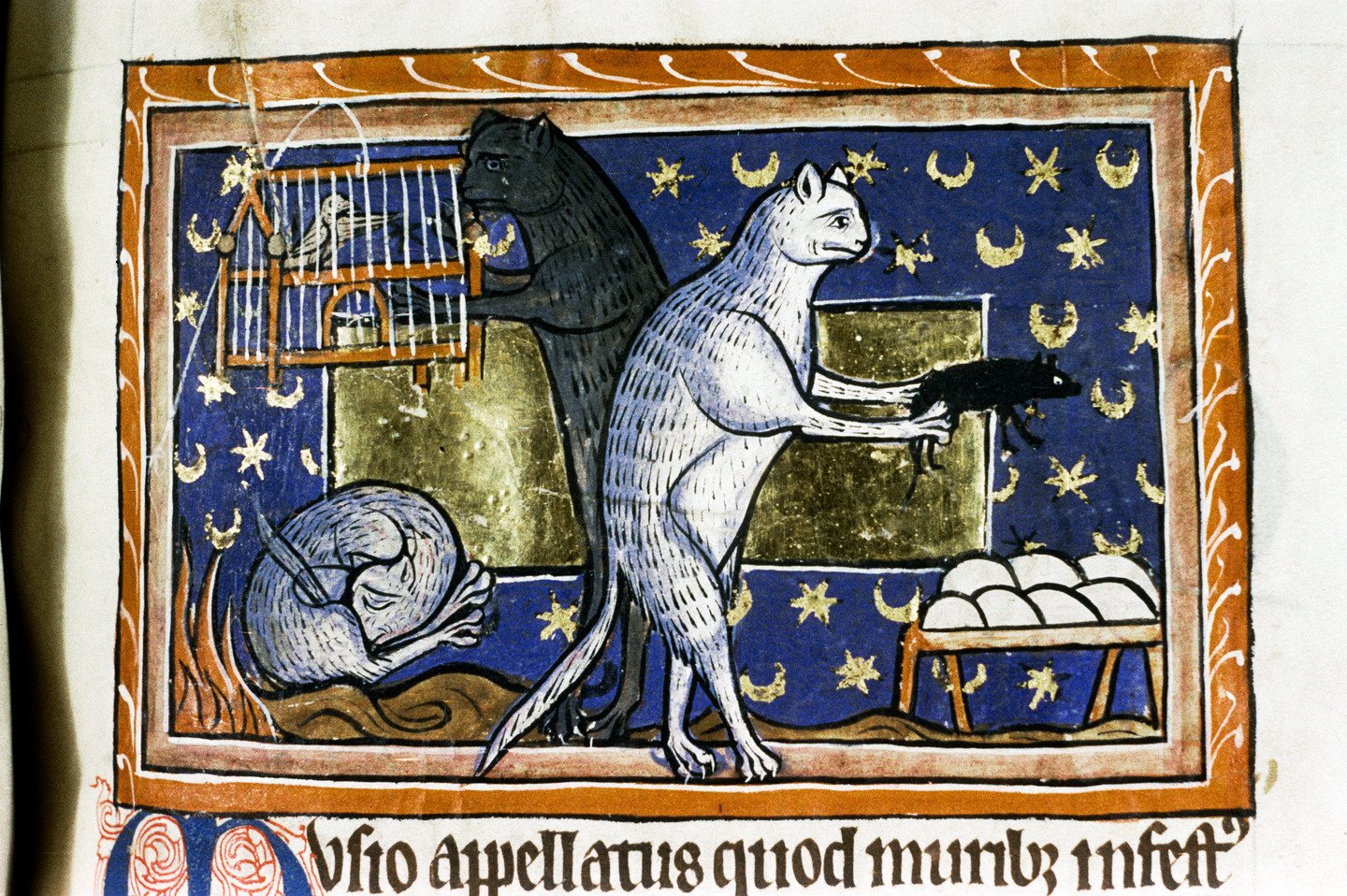
British Library Harley 3244 f. 49v (England, 13th Century)
The page features a cat hunting mice. In medieval bestiaries, animals were described not so much from a biological perspective as through allegories and moral lessons (based on the works of Isidore of Seville and the «Physiologist»). The cat is presented as a natural hunter of rodents.
Artwork Example:
«King of Cats, ” Scheibler’s Armorial, circa 1450.