Concept
The image of space became one of the defining visual myths of the twentieth century. Rising above a diversity of themes, the subject of exploring the universe developed synchronously on both sides of the «Iron Curtain,» merging scientific breakthrough, political propaganda, and philosophical inquiry. However, over a hundred years, the artistic language through which art speaks of space has undergone a radical transformation—shifting from the pathos of collective conquest of the unknown and belief in boundless progress to irony, fatigue with «grand projects,» and the search for personal sanctuary.
The selection of this theme is driven by the fact that the evolution of the cosmic motif most clearly demonstrates how Soviet and, subsequently, Russian art engaged in dialogue with the global artistic process—initially diverging ideologically, but converging on shared visual and semantic strategies by the turn of the 21st century.
Material and Source Selection Principles
The material selection principle is based on a comparative method. The research focuses on key works of painting, graphics, photography, and installation from the 1910s through the early 2000s. The primary selection criterion was not the literal illustration of a «cosmic theme, ” but rather the presence of a strong spatial metaphor in the work—a detachment from the earth, the overcoming of boundaries, emptiness, or artificially created infinity. The works are grouped into visual pairs and resonances, where the pieces by Soviet and Russian artists are contrasted with the works of their international contemporaries.
The principle for selecting and analyzing textual sources involves combining theoretical works on the history of the Russian avant-garde, Soviet unofficial art, and global contemporary art with exhibition catalogs from major museums and the artists' own writings.
Key Research Question and Hypothesis
The key research question is: how and why has the visual representation of space in 20th and 21st-century art transitioned from a symbol of collective technological utopia to a metaphor for personal escapism, irony, and alienation?
Research Hypothesis: In the first and mid-twentieth centuries, Soviet and Western art approached the idea of infinity differently—from Suprematist cosmicism and heroic Socialist Realism in the USSR to metaphysical emptiness and the transcendence of the canvas in European Modernism. However, the crisis of utopian consciousness in the last third of the century led to a convergence of visual codes: in the late Soviet underground, space became a means of mental escape from closed-off everyday life, while in global and Russian art at the turn of the 20th and 21st centuries, it transformed into a tool for the ironic deconstruction of progress.
The Principle of Categorization
The principle of rubrication is structured chronologically and thematically, reflecting three sequential stages in the transformation of the cosmic myth in the 20th century and at the turn of the century. The first section is dedicated to the birth of utopia and the aesthetics of boundlessness (1910s–1960s). The second section analyzes the «crack in the myth» and the turn toward personal escapism and irony in the 1970s–1980s. The third section summarizes the epoch, tracing the collapse of cosmic utopia, the nostalgic archive, and the intimate space for contemplation in the late 1980s—early 2000s.
Section 1. Utopia and Anarchy (1910s–1960s)
In the first half of the 20th century, space entered art not as an astronomical landscape, but as a radical reinterpretation of the canvas’s very space. The Russian avant-garde rejected the horizon line, earthly gravity, and conventional perspective, transforming the canvas into a model of the infinite universe.
By the beginning of the space age in the 1950s and 1960s, this philosophical impulse bifurcates. In Soviet art, space acquires flesh, muscle, and the pathos of collective achievement, while in Western modernism, it continues the line of metaphysical liberation—through the breakthrough of the picture plane and immersion in pure color.
Horizon Breakthrough
In his work, «White on White,» Kazimir Malevich reduces painting to ultimate weightlessness: the slightly tilted square does not rest on a base but hovers in a limitless white environment.
Kazimir Malevich. «White on White.» 1918
His student, Ivan Kudryashov, deeply connected to the ideas of Russian cosmism and the works of Konstantin Tsiolkovsky, translates this non-objectivity into a sense of motion and light orbits—his compositions are structured around smooth tonal transitions and diagonal rays reminiscent of atmospheric luminescence.
Ivan Kudryashov. «Construction of Linear Motion.» 1925
Three decades later, the Italian Lucio Fontana pushes the yearning for infinity into a physical gesture. In the series «Spatial Concept. Waiting, ” he literally slices the monochrome canvas with a blade—the black slit ceases to be an image of depth and becomes a real entrance into the space beyond the painting.
Lucio Fontana. «Spatial Concept. Waiting.» 1960
Leap into the Void
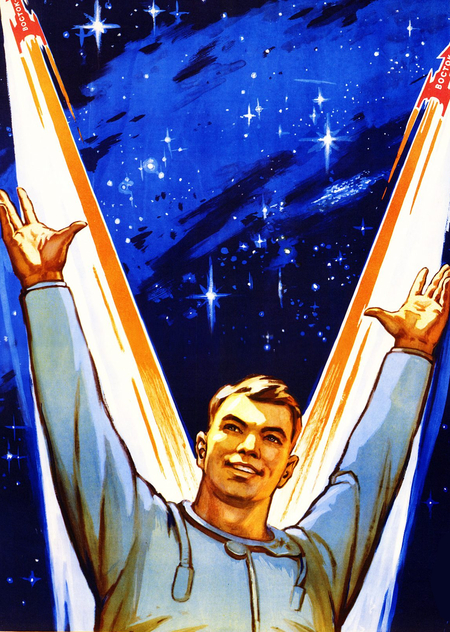
Following the launch of the first satellite and Yuri Gagarin’s flight, Soviet visual culture became imbued with heroic dynamism. In Alexander Deineka’s monumental composition, «Conquerors of Space,» the human figures are stretched across powerful diagonals—representing an athletic, collective exertion where humanity equals the element itself.
Alexander Deineka. «Conquerors of Space.» 1961
In parallel, Andrey Sokolov is creating a canon of Soviet «space painting”—featuring precise outlines of spacecraft, the stark light of distant stars, and the romantic pathos of the pioneer.
Andrey Sokolov. «Space Station of the Future.» 1980
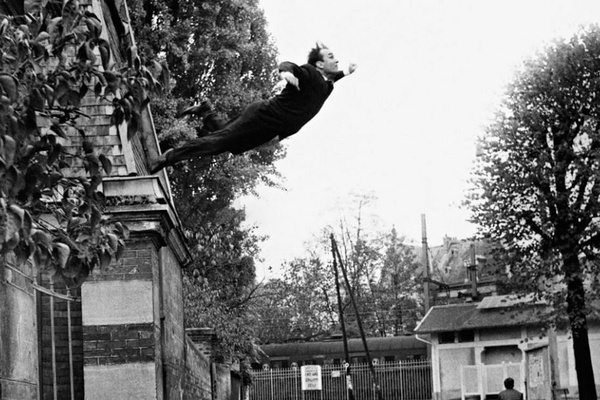
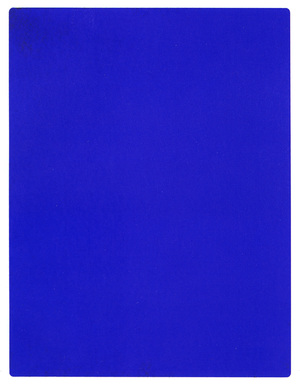
In the West, during the same years, Yves Klein offers the exact opposite optical perspective. In his famous photomontage, «Leap into the Void, ” the artist does not conquer the sky through technique, but rather steps off a ledge into the air alone, trusting in weightlessness.
His deep, absorbing blue monochromes replace the narrative of flight with the pure experience of infinity.
Ив Кляйн. «Прыжок в пустоту». 1960
Ив Кляйн. «Синий монохром». 1961
Section 2. The Crack in the Myth (1970s–1980s)
By the 1970s, the euphoria of the space race gave way to fatigue. The Moon landing had occurred, but the promised utopia failed to transform everyday life. At this juncture, the image of space dramatically shifted function—it transitioned from a state project to a domain of personal escapism and alienated contemplation. In the USSR, artists in the unofficial sphere juxtaposed the sublime dream of the stars against the claustrophobia of communal living and state propaganda rhetoric. In the West, space imagery was absorbed by Pop Art and conceptual graphic design, shedding its romantic aura to become either a reproducible media image or a meditative, cold void.
Catapult from the Communal Apartment