Крылатые божественные и сверхъестественные существа в искусстве от Древнего Египта до XIV века
Concept
Research Content
1. Concept 2. Winged Imagery in Ancient Egyptian Art 3. Winged Creatures in Mesopotamian Art 4. Winged Figures in Ancient Greek and Roman Art 5. Winged Imagery in Early Christian and Byzantine Art (3rd–6th Centuries) 6. Winged Imagery in Medieval Christian Art (7th–14th Centuries) 7. Conclusion
Introduction
In the art of various eras and cultures, figures of winged creatures appear, connected to mythological and religious concepts. Among these are deities, personifications of different phenomena, guardians, and messengers of higher powers. Wings are a characteristic part of their appearance and are linked to the role or significance of the character within a specific culture. My research centers on the holistic artistic image of these characters: their external appearance, attributes, actions, and their mythological or religious role and meaning within the context of a specific work. Wings are examined as a common feature of the material under study, but not in isolation. Their meaning is revealed alongside other characteristics of the image and the purpose of the work. In this study, I will investigate the diversity of winged beings from various cultures, ranging from Ancient Egypt to the 14th century, and compare them. This will allow me to identify similarities in their functions and artistic depiction, as well as differences in the beliefs associated with them. I will also pay special attention to potential instances of artistic continuity, where previously established modes of representation are employed in a new cultural and religious context.
Topic Selection
I chose this topic because I was interested in tracing how the general visual motif—wings—functions across different mythological and religious contexts.
Principle of Visual Material Selection
The study includes winged divine and supernatural figures whose forms incorporate human features. The primary group consists of anthropomorphic beings, and individual hybrid creatures that combine human and animal traits are also examined. The main selection criterion is the significant role of wings in the character’s depiction: they may be connected to the figure’s function, status, or meaning within mythological and religious tradition. The work analyzes the complete image—wings are examined alongside the body, attributes, actions, and context of the depiction. Images of ordinary birds and animals are not included in the study because their wings are a natural anatomical feature. Sphinxes, griffins, and other fantastic creatures possess independent symbolism; however, studying them requires separate consideration of the iconography of mythological hybrids and monsters, so they are also excluded from this study. An exception is the winged sphinx of Ancient Egypt, which is included in the first chapter as an example of the combination of human, animal, and avian traits in a being associated with protection and royal authority. The work examines characters whose functions and image characteristics allow for a meaningful comparison across cultures. When selecting works, the accuracy of attribution and dating, the historical context, the purpose of the work, and the potential to uncover the character’s significance through its depiction are taken into account.
Principle of Selecting and Analyzing Textual Sources
The core of the research consists of museum catalogs, collection pages, and art historical publications dedicated to the iconography and meaning of the depicted images. When selecting sources, the accuracy of the information, the authority of the publication, and its connection to specific works were taken into account. The sources are used to refine the dating, origin, intended use, and mythical or religious role of the monuments and characters. The analysis of visual material includes examining the external appearance, attributes, actions, and context of the image. Comparing visual observations with the information from the sources helps to substantiate the interpretation of the image.
Principle of Research Categorization
The study is structured upon a cultural-historical principle and comprises five chapters dedicated to the art of Ancient Egypt, Mesopotamia, Ancient Greece and Rome, early Christian and Byzantine cultures, as well as Medieval Christian art. Within each chapter, the material is grouped by individual winged figures or creature types, allowing for their examination within the context of their respective cultures, followed by a comparative analysis of the functions, depiction methods, and significance of these winged characters. The chronological sequence enables a tracing of potential instances of artistic continuity and the reinterpretation of imagery as one tradition transitions into another.
Key research question
The central question of my research is how the depictions of winged divine and supernatural beings differ across various eras and cultures, and how their artistic portrayal relates to the character’s mythological or religious role.
Research Hypothesis
My hypothesis is that the presence of wings in art from the Ancient world through the 14th century is not a universal symbol with a fixed meaning. Its significance emerges in combination with the character’s mythological role, their attributes, actions, and the work’s purpose; consequently, outwardly similar winged figures perform diverse functions—they might protect, escort the deceased, announce victory, or convey divine will.
Research Objective
Analyze the archetypal imagery of divine and supernatural beings across various eras and cultures, identify similarities and differences among them, determine the specific characteristics of their depiction, and understand how the artistic portrayal of these characters relates to their mythological role or the intended meaning of the work.
Winged Imagery in the Art of Ancient Egypt
In the art of Ancient Egypt, wings appeared on both goddesses with human forms and on creatures combining human and animal features. Such imagery was connected to various concepts—ranging from protecting the deceased and posthumous rebirth to royal power. In this chapter, I will examine the winged figures of Isis, Nut, and the Sphinx. Despite their external similarities, their meaning depended on which character was depicted and in what context the image was used.
Isida
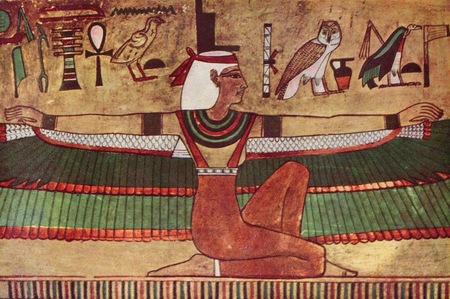
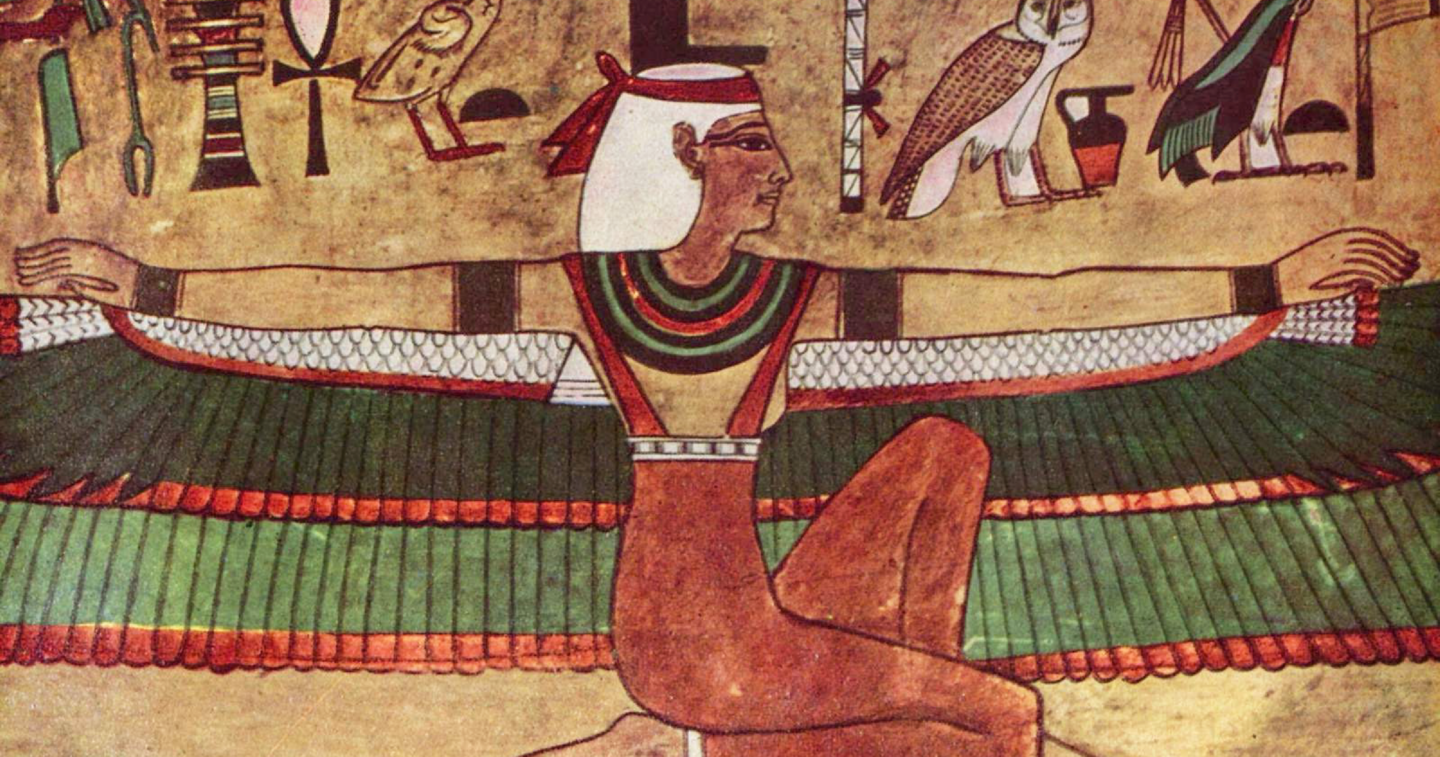
Isis—a goddess associated with magic, motherhood, and protection. According to the myth of Osiris, she protected her deceased husband and contributed to his resurrection. Because of this, Isis held an important place in Egyptian concepts of the afterlife.Isis. Painted relief from the tomb of Set I in the Valley of the Kings. 12th century BCE.
Isis on the sarcophagus of Ramesses III, 12th century BCE.
The goddess is depicted in the images with wide-spread wings extending away from her body. In funerary art, this gesture is associated with protecting the deceased. Images of winged Isis were placed on sarcophagi and other burial objects, invoking her patronage.
Chickpea
Nut—the goddess of the sky, which the Egyptians envisioned as her body stretching over the earth. According to mythological beliefs, every evening she would embrace the sun to bring it forth again in the morning. This cycle connected Nut with the renewal of life and posthumous rebirth.
Pectoral depicting the sky goddess Nut, Tutankhamun’s tomb, 14th century BCE.
Images of Nut, like Isis, were frequently placed in tombs. The goddess could be depicted as a celestial vault covered in stars or with outstretched wings. On the object shown, her wings are spread out on both sides of her figure. In this context, they are associated with patronage of the deceased, and the image of Nut herself relates to concepts of the heavens and rebirth.