Concept
Mahjong is a traditional Chinese board game that has become an integral part of Chinese life and culture over time. At first glance, it seems quite simple: players assemble combinations from the game tiles. However, upon closer inspection of the game set, one can see that its elements hide an entire system of symbols connected to nature, time, directions, and conceptions of the world’s structure. Mahjong is interesting not only for its rules but also for how it unites people, becomes a part of family gatherings, and is passed down from generation to generation.
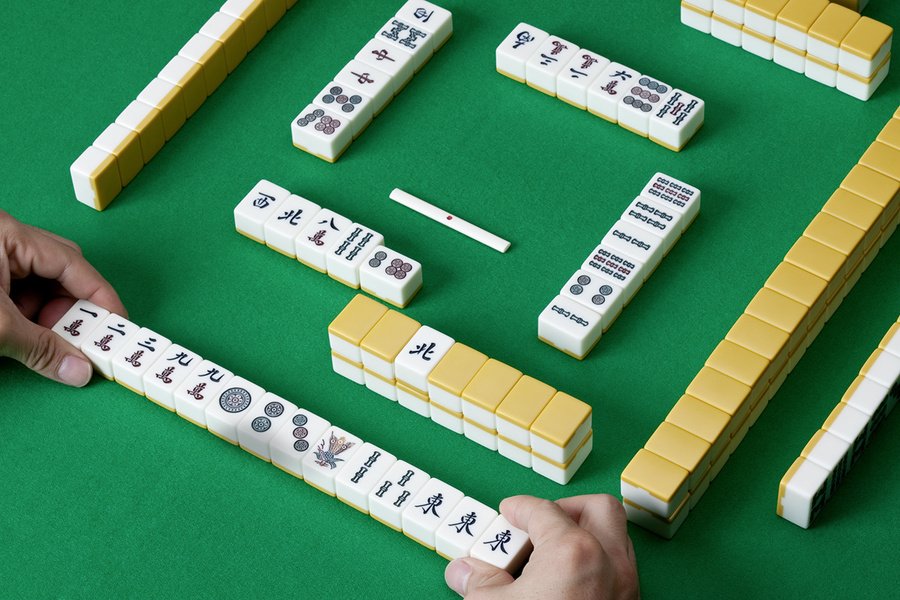
Mahjong.
Mahjong has spread far beyond China today. It appears in cinema, art, and the daily lives of various countries while retaining the recognizable characteristics of the traditional game. Over time, new rule variations and set designs have emerged, but many of the original elements remain intact. I am interested in understanding precisely what connects Mahjong to Chinese culture and how that connection is manifested within the game itself.
Game Dice
The central question of this research is how Mahjong reflects Chinese culture and how traditions are preserved and transmitted through the game. I propose that the significance of Mahjong lies not just in its popularity. Symbols, rules, and traditions play a vital role, linking the game to the history and culture of China. Therefore, I examine Mahjong not merely as a pastime, but as a cultural phenomenon where visual imagery, history, and everyday life intertwine.
In this work, I will investigate the origins of the game, tracing its potential lineage to earlier Chinese games and examining why it spread beyond China to other countries over time. I will also separately analyze the structure of the game set to understand why specific images were chosen for the bones—how the suits relate to the old monetary system, what the winds and dragons symbolize, and why flowers and seasons appear among the supplementary symbols. Furthermore, it is important to explore how Mahjong became integrated into Chinese daily life, why it is played by families and friends, and what role it plays in intergenerational communication. In the concluding section, I will examine how the game has evolved outside of China and why contemporary artists and designers continue to utilize its iconography. My research will draw upon academic publications, historical sources, images of antique and modern game sets, and materials concerning Chinese culture.
An event dedicated to Mahjong.
Ultimately, I want to show that behind a familiar board game lies far more than just a set of rules: mahjong can tell the story of China’s history, traditions, and daily life.
Navigation
- The history of the origin and spread of mahjong.
- The mechanics of the game.
- The symbolism of mahjong.
- Mahjong in Chinese culture.
- The image of mahjong in contemporary art and beyond China.
- Mahjong as a social phenomenon.
- Conclusion.
The History of Mahjong’s Origin and Spread
The exact place and time of mahjong’s emergence are unknown. It is believed that the game originated in China in the second half of the 19th century. It is associated with older Chinese games. One of the possible predecessors to mahjong is mədiao, but there is still no definitive version of the game’s origins—only speculation.
Cards from the game Madyao.
Originally, Mahjong spread throughout the southern regions of China. Gradually, the game became popular in other parts of the country. People played it at home, in tea houses, and in public spaces, gathering with friends, relatives, and neighbors.
Traditional Mahjong in China.
In the early 20th century, Mahjong began to spread beyond China. In 1920, the American Joseph Park Babcock published an English-language instruction guide for the game, which made it easier for foreign players to learn the rules. During the 1920s, Mahjong gained significant popularity in the United States and Europe.
As the game spread to different countries, local variations in rules and set designs emerged. Mahjong, for instance, gradually went beyond China and became popular in many countries. Yet, even there, it maintained a connection to its culture—a connection traceable in the patterns on the tiles, the suit names, and the traditions of play.
Game Mechanics: Rules, Game Dice, and Major Suits
Mahjong is designed for four players. Before starting the game, all tiles are shuffled and laid out in a common wall—a long structure made of rows of tiles. Players take new tiles in turn and discard the unnecessary ones. The goal is to collect a winning combination before the others. In the classic variant, this consists of four sets and one pair of identical tiles. Sets can be formed from three consecutive numbers of the same suit or from three identical tiles. The game also features a kong—a group of four identical tiles.
Wall of Bones.
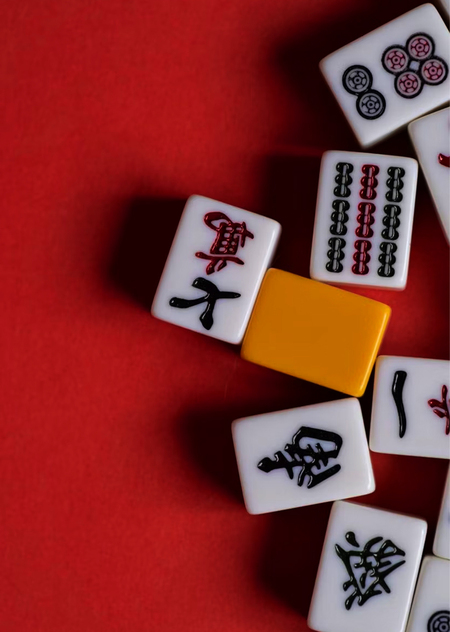
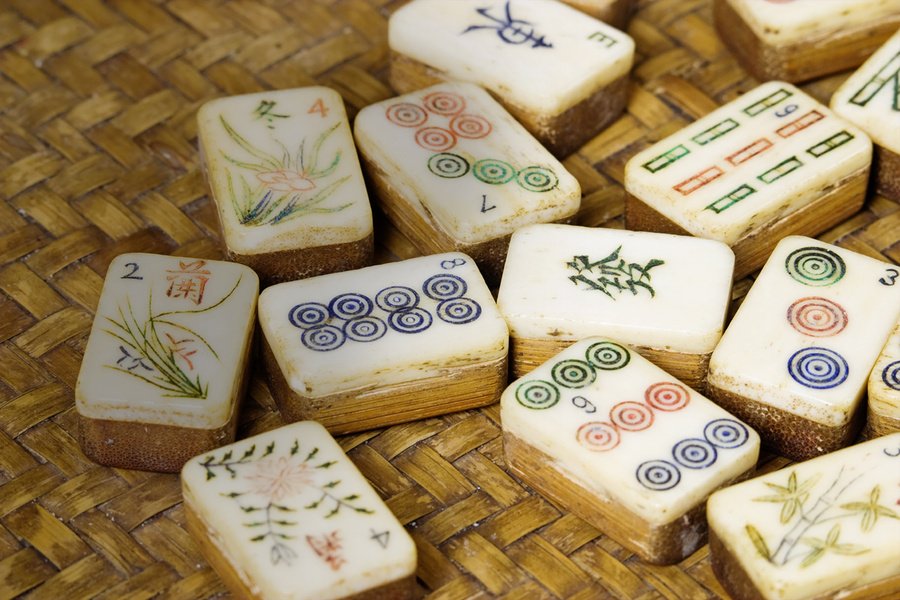
Traditional Chinese Mahjong uses 136 primary tiles. These are divided into three suit categories: dots, bamboo, and characters. Each suit contains tiles numbered one through nine. In addition, the set includes honor tiles: four winds and three dragons. All these tiles are represented in four copies.
Game Bones.
Some sets also include eight extra bones—four featuring colors and four featuring seasons. These are not part of the standard 136-bone set and are not used to form typical winning combinations, but they do award bonus points.
Mahjong Symbolism
Three main suits are connected to the ancient Chinese monetary system. The circles resemble copper coins, and the bamboo sticks represent the strings on which the coins were strung. The third suit, symbols, is associated with large sums of money. This explanation allows one to see a reference to old methods of storing and counting money in the images on the bones.
The winds—east, south, west, and north—designate the cardinal directions. In Chinese culture, they held significant importance and were incorporated into concepts of the world’s order. The dragon also occupies a special place in Chinese culture and is frequently associated with notions of power and prosperity.
There are various interpretations regarding the symbolism of Mahjong. According to one theory, the game set can be seen as a model of the world, featuring the interaction of three fundamental elements: heaven, earth, and humanity. In this system, seasons are linked to heaven, the winds to the cardinal directions, and the flowers to humanity and the development of life. The three dragons also correspond to these elements: white symbolizes heaven, green symbolizes earth, and red symbolizes humanity. However, this is only one possible interpretation—there is no single universally accepted explanation for the symbolism of all the game tiles.
Main Types of Bones.
The supplementary bones depict plums, orchids, chrysanthemums, and bamboo—plants known in Chinese art as the «Four Noble Plants.» Each is associated with specific qualities. For instance, the plum symbolizes resilience, as it blooms even in cold weather. The other four bones are dedicated to spring, summer, autumn, and winter, reflecting the change of seasons.