[1] Project Idea
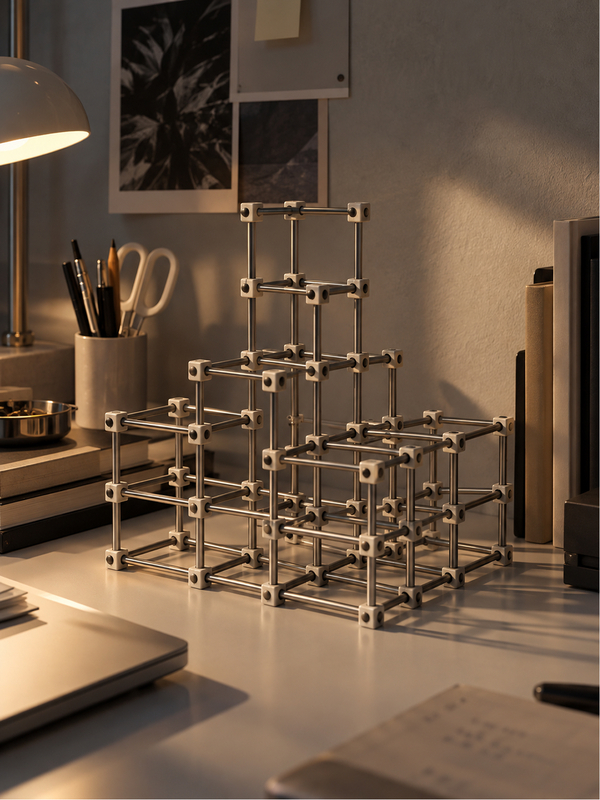
MAGLINK — a modular system for creating small interior decor items and desk accessories. It consists of metal rods and magnetic connectors, which can be assembled into cubic frames of various sizes and combined into new structures.
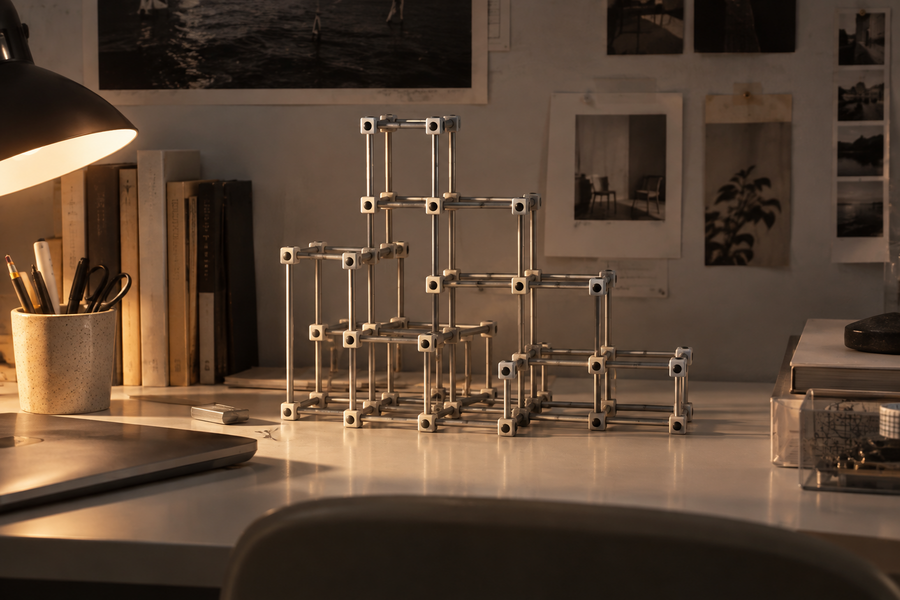
The project concept is to create an object whose form is not fixed forever. From a single set, users can construct an organizer, a jewelry stand, a tactile anti-stress toy, or an interior sculpture, and then disassemble the structure to reuse the parts. Instead of several separate items, the user receives one system that can be adapted to their needs. The geometry of the cube forms the basis for free construction, while the metallic surface accentuates the graphic nature and visual lightness of the objects.
[2] Main object
The central focus of this project is a desk organizer for a workspace. It is assembled from metal framework modules and is designed to hold pens, pencils, cards, and other small supplies.Its open design allows the contents of the compartments to be visible, and the ability to change its configuration helps adapt the organizer to various usage scenarios.Unlike items with fixed sections, MAGLINK can be reconfigured without needing to purchase a new piece. Additional removable elements can extend its functionality while maintaining the core principle of modularity.
[3] Module System
The system consists of metallic ribs of various sizes and connection nodes incorporating magnetic elements. The preliminary version explores three module sizes, allowing for the assembly of structures with differing heights and widths.
The connections must facilitate quick assembly and disassembly without complex tools. The geometry of the nodes is designed to allow components to be reused multiple times in different configurations.
The final dimensions, the structure of the connections, and the magnet parameters will be determined after the 3D model development and testing of a prototype node.
[4] Other uses
Stress-relief game. The modules can be connected and disconnected to create new geometric forms. The tactile interaction with the metal elements transforms construction into a brief creative pause.
Jewelry stand. An open structure is assembled from ribs to hold necklaces, bracelets, and earrings. The vertical and horizontal elements serve as holders.
Interior sculpture. The modules are combined into asymmetrical compositions that can be placed on a table or shelf. In this scenario, the structure is primarily used as a decorative object.
These variations demonstrate the potential of a single system. They do not require the development of separate module sets but may require additional holders and stability checks.
[5] Material and Construction
The primary material is metal with a polished or satin finish. As a preliminary solution, steel rods and connecting assemblies with embedded magnets are being considered.
3D printing can be utilized to create connectors during the prototyping phase. The metallic components are intended to be cut to size, have their edges finished, and undergo final surface treatment.
The magnetic assembly design must ensure precise part positioning, connection stability, and secure retention of the magnets. The material, connector dimensions, magnet type, and fastening method must be determined before preparing the final production files.
[6] dimensions and packaging
Format and Dimensions — Module size: 40 × 40 × 40 mm. — Configuration: 8 cubic modules arranged in 4 columns and 2 rows. — CAD assembly dimensions: approximately 172 × 82 × 46 mm. — Maximum submission size: 280 × 180 × 70 mm.
Materials and Finishing — Frame: AISI 304 stainless steel. — Connecting nodes: PETG, manufactured via 3D printing. — Magnetic elements: Neodymium magnets. — Metal finishing: Polished surface. — Color of plastic parts: Neutral, such as milky white or graphite.
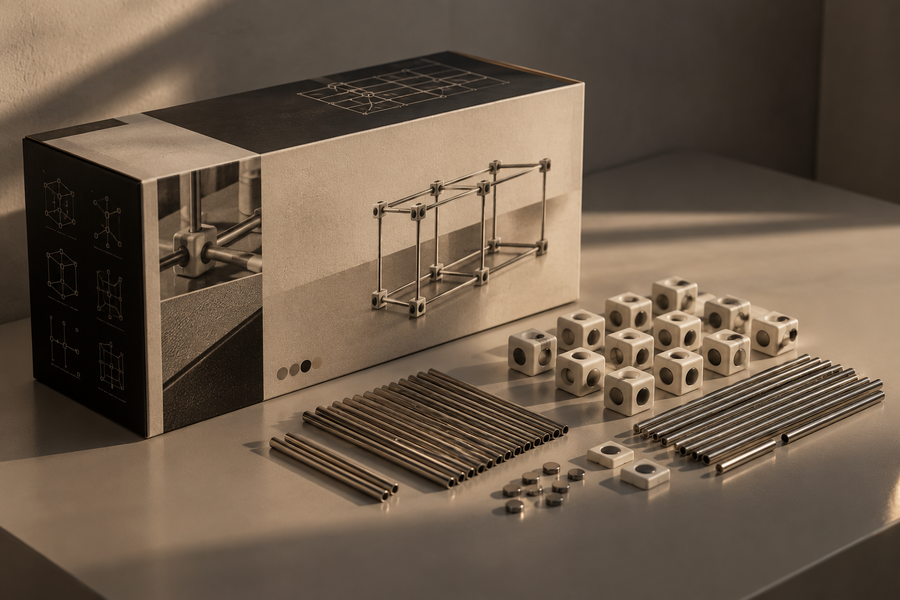
Kit Contents — 96 metal rods. — 64 corner connecting nodes. — 40 magnetic connecting clips. — 80 neodymium magnets. — 192 steel inserts. — Protective dividers for packaging.
Construction and Assembly Rods connect via corner nodes to form cubic frames. The magnetic clips allow individual modules to be combined and the organizer’s configuration to be changed without permanent adhesive bonding.
Packaging The entire kit is designed to fit inside a box with internal dimensions of 300 × 200 × 80 mm. The parts layout diagram is prepared.