On ancient tombstones, I was interested not only in the people but also in the small figures beside them. A dog at the feet, a bird in a palm, or a goose to the side take up little space. Yet, without them, some scenes would look completely different—there would be no reason for a lean, a outstretched hand, or a reciprocal gesture. I wanted to understand what role these animals played within the image. Not just what they might signify, but how they helped construct the composition itself.
My question is: how does the depiction of an animal alter human perception on Greek funerary monuments? I hypothesize that the animal often helps to reveal the human through action or relationship: a child offers a bird to a dog, an adult figure holds it near them, and the animal responds with a gesture. However, this assumption cannot be applied uniformly to all works. Sometimes the bird is positioned separately and is almost inconspicuous. Other times the dog is shown not in contact with the person, but alongside them. I want to find these cases and test where my hypothesis breaks down.
The primary material consists of ancient Greek funerary reliefs and painted monuments from the 5th–6th centuries BCE, drawn from museum collections. Most of the examples pertain to classical Attica from the 4th century BCE. The study also incorporates monuments from the Hellenistic period to examine whether specific techniques persisted beyond this circle. Each image in this study represents a distinct monument. Within the body of the work, I do not consider re-framing a new image to constitute a new piece.
I observe the positioning of animals relative to humans, the scale of figures, the direction of their movements, the placement of birds, and the use of negative space between them. It is also important how far a figure projects from the stone—high and low relief catch light in different ways. I call a vertical stone slab erected in memory of the deceased a stele. A monument resembling a small temple is called a diagonal monument: side supports and an upper beam or pediment frame the scene.
The work is divided based on the nature of the coexistence between humans and animals. I begin by examining a bird next to a single figure, then a child playing with a dog, and subsequently compare these dogs with the more placid companions of adults. Following this, I move to scenes featuring multiple people and to images that are poorly preserved or offer ambiguous answers. This segmentation prevents the construction of an artificial narrative progression from simple to complex.
For dates, materials, and titles, I draw upon the collections of the Metropolitan Museum of Art, the Louvre, and the Getty Museum. The Getty’s catalog of Greek funerary sculpture is invaluable for seeing how researchers document preservation and compare monuments. I do not automatically accept museum interpretations as the sole explanation—for instance, a bird might be both a pet and an offering. My own conclusions are based on the visible relationships between the figures. A single photograph cannot prove the deceased’s personal history, the patron’s intent, or even whether the depicted pet existed in life.
Содержание
Bird Nearby
Game at Arm’s Reach
Adult’s Companion
Bird Among People
When an Image Doesn’t Answer
Conclusions
Tombstones marked burial sites and preserved the memory of the deceased. On the stone surface, inscriptions and images could be combined. Anyone viewing the monument saw not a living scene, but an image created for memory. [2]
In these images, the figures rarely fill the entire frame. The empty space between the hand and the dog, or around the bird, helps to register the direction of the gesture. Therefore, I suggest viewing the monument as a whole before focusing on its individual parts.
In museum photography, monuments are often separated from their original setting and relit. Existing chips, lost paint, and modern backdrops influence what we see. Whenever possible, I note such limitations in the comments.
Bird nearby
The bird can easily be mistaken for a small addition to a portrait. Here, it is crucial to observe precisely where it is located—near the face, on the palm, or away from the figure. This changes the distance from which we read the scene.
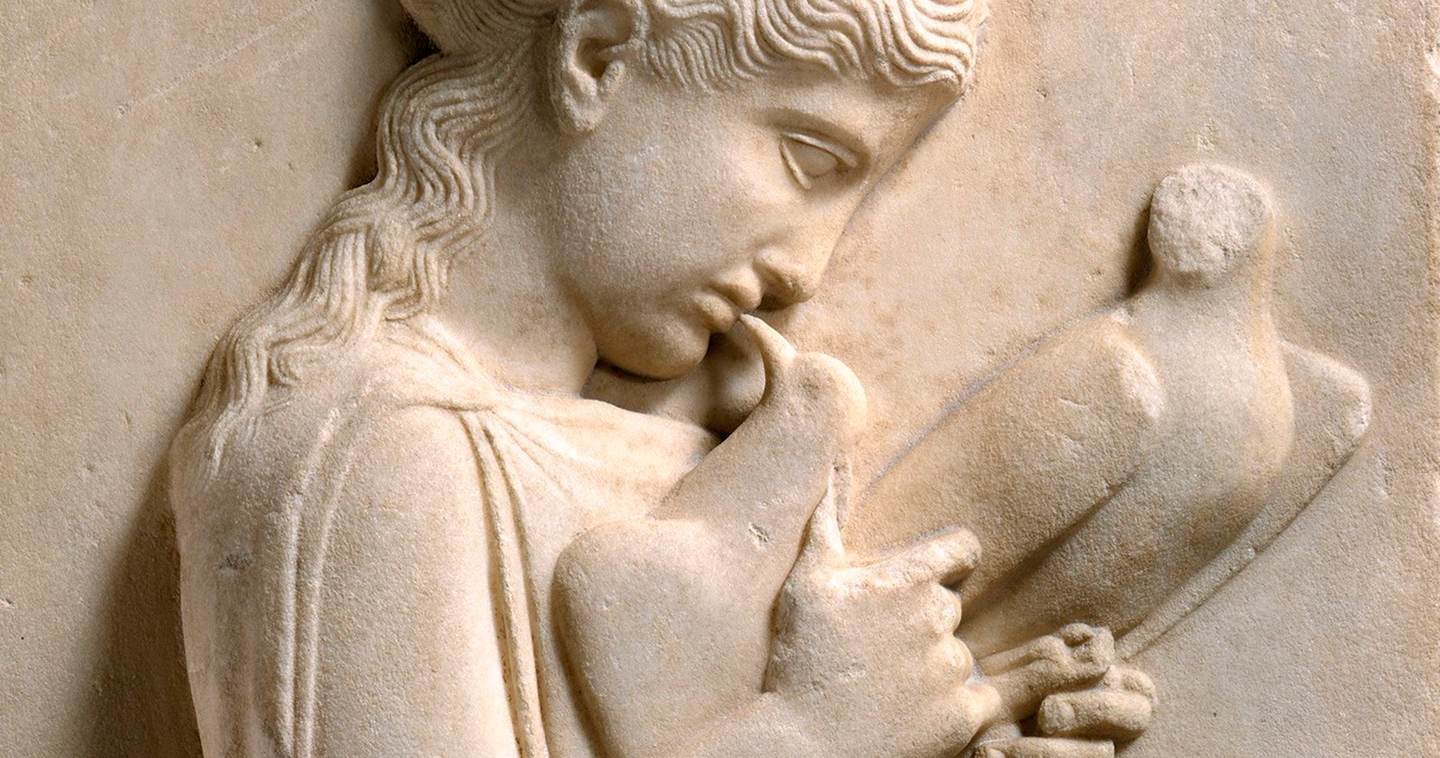
Unknown artist. «Tomb Stele of a Girl with Doves.» c. 450–440 BCE. Marble, relief. Metropolitan Museum of Art, New York.
A girl holds one pigeon near her face, while the second perches on her extended fingers. The birds are positioned at varying heights: one is almost touching her lips, and the other is visible further away. The movement of her hands unites both points into a single scene.
If the birds are obscured, a serene figure in long garments remains. With them, the pose becomes more defined: the girl is not simply standing, but gently cradling living beings. However, labeling this gesture as a farewell can only be an interpretation, not an established fact.
Artist unknown. «Mithion Funerary Stele.» circa 400 BCE. Marble, relief. Getty Museum, Los Angeles.
The Mittion bird is positioned lower, at arm’s length. A void exists between the face and the animal, causing the connection to be perceived differently than in the relief of the girl with two doves. Here, attention is distributed between the bird and the figure’s long silhouette.
Getty offers two possible explanations: the bird might have been a pet or an offering. Its size next to a person alone doesn’t allow us to choose between them. This is a critical limitation for my hypothesis: proximity in composition does not equate to proven closeness in life. [1]
Author unknown. «Tomb of a Girl with Figurine and Bird.» circa 360 BCE. Marble, relief sculpture. Getty Museum, Los Angeles.
In this stele, a young woman looks at a small figure in her hands, while a long-necked bird stands below and to the left. Unlike the pigeons in the Metro Museum’s depictions of girls, the bird does not capture the human’s central focus. It adds another participant, but it doesn’t fully explain the girl’s gesture.
The Getty Catalog cautiously identifies the bird as a probable goose. The object’s meaning is also not undisputed: it is suggested to be understood as an offering rather than necessarily a toy. For comparison, the visible placement of these forms is more important to me than the definitive name of each item. [2]
Unknown artist. «Tomb of Apollonia.» circa 100 BCE. Marble, relief, traces of painting. Getty Museum, Los Angeles.
On the Hellenistic monument of Apollonia, the bird is raised on a support, appearing next to the child’s hand. It is not resting in the palm, as in the Mittion. The distance between the human and the bird is simultaneously noticeable and overcome by the touch.
Game at arm’s length
Now the bird becomes part of the scene with the dog. One participant holds it, while another reaches for it. I am comparing not only the recognizable narrative but also how weight and movement are distributed differently.
Unknown artist. «Tomb Stele of Moschion with a Dog.» c. 375 BCE. Marble, relief. The Getty Museum, Los Angeles.
Moshion lowers his hand from the bird to the dog. The dog is standing on its hind legs, its body angled upward. The boy’s hand and the dog’s posture form a short diagonal—it is upon this line that the movements of the human and the animal converge.
Most of the plate remains open space around the figures. The dog doesn’t merely fill an empty corner by the feet; its rise compels the viewer to look back at the hand and the bird. The viewer traces this cluster with their gaze several times.