Navigation
1) Concept
2) Face Directed Toward the Viewer
3) Anatomy of the Monstrous Image
4) How Medusa’s Face Changes
5) Material and Scale
6) Medusa in Space
7) Has the Terrifying Medusa Disappeared?
8) Scientific Perspectives and Independent Analysis
9) Conclusion
10) Bibliography and Sources
Concept
The depiction of the Gorgon Medusa holds a special place in ancient Greek and Roman art. Her image appears on a wide variety of objects—from temple ornaments to coins and mosaics—and the recognizable features of the Gorgon remained consistent for many centuries. Over time, her appearance changed significantly, yet certain artistic characteristics remained stable. These changes are most often interpreted as a gradual transformation from a terrifying monster into a beautiful woman. Furthermore, the relationship between Medusa’s appearance, the type of object on which she is depicted, and the nuances of her gaze deserves separate attention. This is what I explore in my research.
The research is fundamentally based on images of the Gorgon found on architectural elements, ceramic vessels, coins, ornaments, weaponry, and mosaics. The chronological scope covers the 6th century BCE through the 2nd century CE, and the geography encompasses various artistic traditions of the Greek and Roman worlds. This selection allows for tracking the evolution of Medusa’s image over time and comparing the methods of her depiction across different media.
The research is based on comparative and iconographic analysis. First, the characteristics of the Gorgon’s face and gaze are examined, followed by changes in her appearance across different historical periods, the influence of material and size of objects, and the placement of images in architecture and interior design. The main sources include ancient works of art, museum catalogs, and scholarly publications.
Key research question: How did the face, gaze, and recognizable features of the Gorgon change, and to what extent did these changes depend on the historical period, artistic tradition, and the medium of the representation?
It is hypothesized that the transformation of Medusa from a grotesque monster to a more human figure was not a singular or irreversible process. This is because images from different eras and artistic traditions did not always follow a single sequence of changes; even in later works, features characteristic of early frightening figures could be found.
- Face turned toward the viewer
1.1 Archaic Antefix
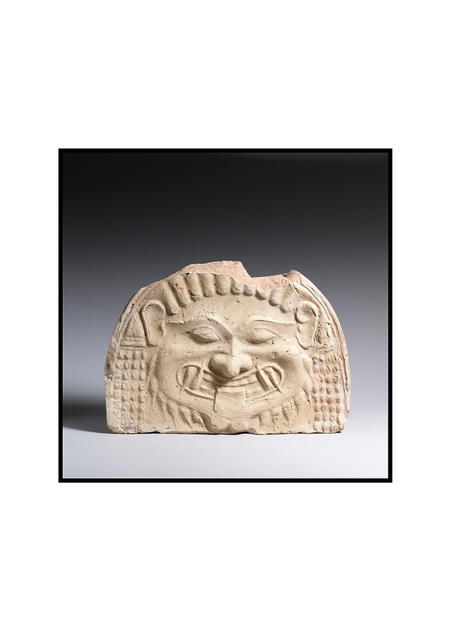
The Greek terracotta antefix The Met 10.210.44 dates to approximately 580–570 BCE and measures about 17 × 24 cm. The antefix covered the edge of a roofing tile, so the image was part of the architectural molding. The card does not specify which building it was removed from or where it was found; therefore, the mounting height and viewing angle cannot be determined. However, the object’s type itself indicates that the mask was created for quick external recognition rather than for narrative representation.
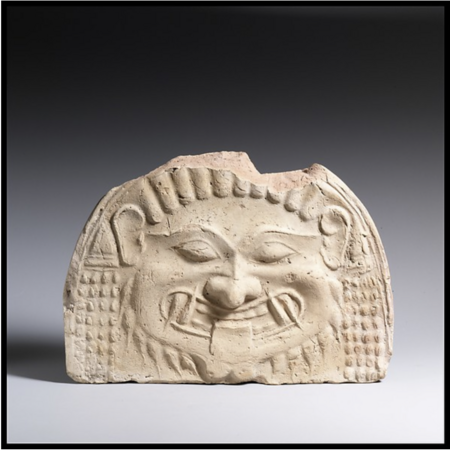
Fig. 1. Terracotta antefix with gorgoneion, Greek, c. 580–570 BCE, 17 × 24 cm. The Met, 10.210.44. https://www.metmuseum.org/art/collection/search/248331
The face dominates nearly the entire frame and is structured around a central axis. Large eyes, an open mouth, and visible teeth create a distinct pattern. Frontal faces are relatively rare in Greek vase painting; the Gorgoneion stands out among figures in profile. The museum suggests this mask was intended to ward off evil.
1.2 Circular Field and Eye Position
Attic terracotta figurine, circa 570 BCE (The Met 31.11.4), transfers the same facial type onto a small, round object. Inscriptions link it to the potter Ergotimos and the vase painter Clitius. The eyes, nose, and mouth are gathered toward the center, while the hair forms a frame. This demonstrates the enduring stability of the compositional formula across different media.
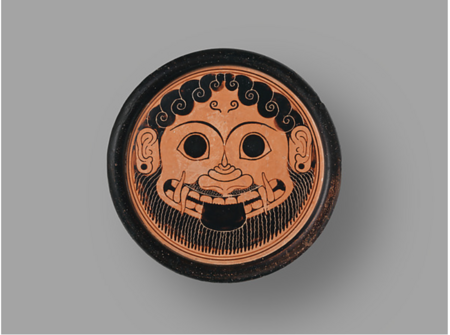
Fig. 2. Terracotta stand with gorgoneion, Attic, c. 570 BCE, diameter of about 9 cm. The Met, 31.11.4. https://www.metmuseum.org/art/collection/search/253342
For a theme concerning gaze, the difference in distances is important. Architectural relief is typically viewed from a distance and from below, whereas a small pedestal is viewed up close and when the object is turned. However, identical frontality does not yield the same feeling, because the size and the possibility of holding or walking around the object change the viewer’s position. Therefore, the face must be considered together with the carrier.
1.3 Independent Entity and Frontal Sign
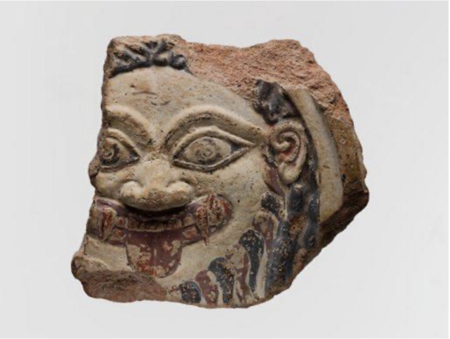
Fig. 3. Terracotta antefix with a Medusa head. Etruria, 6th century BCE; terracotta with polychromy; 14 × 14.9 cm. The Met, 27.122.14. Card: https://www.metmuseum.org/art/collection/search/252929
On the antefix, the large eyes, sharp snarl, and preserved white, black, and red pigments intensify the facial contrast.
The Met notes that such details allowed for the recognition of recurring masks below. This example serves the same function as Greek roof antefixes—that is, it primarily performs a practical function—but it also demonstrates that the same motif existed in various regional variations.
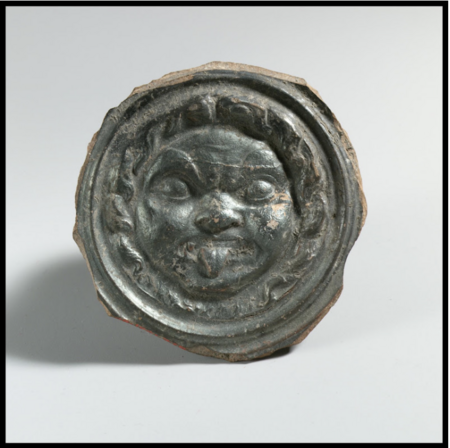
Fig. 4. Tondo from a flask with the head of the Gorgon. Southern Italy, Campania, 3rd century BCE; terracotta; diameter 7.3 cm. The Met, 06.1021.276. Card: https://www.metmuseum.org/art/collection/search/247442
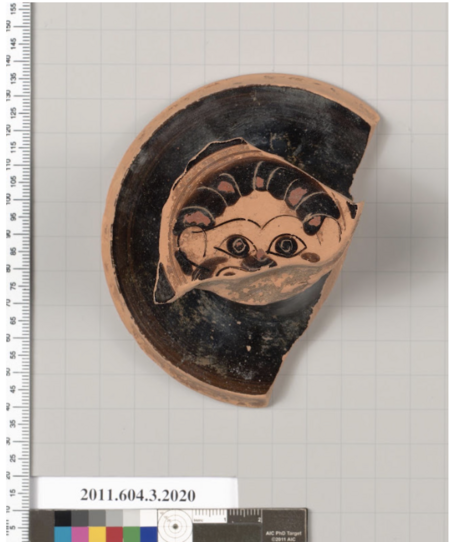
Fig. 5. Fragment of an Attic cup with a Gorgoneion. Attic, third quarter of the 6th century BCE; terracotta. The Met, 2011.604.3.2020. Card: https://www.metmuseum.org/art/collection/search/755836
The fragment retains a large, frontal mask featuring rounded eyes and an open mouth. The image allowed for a view of the face inside the vessel, but because the object reached us only as a fragment, the original composition and method of use cannot be fully reconstructed.
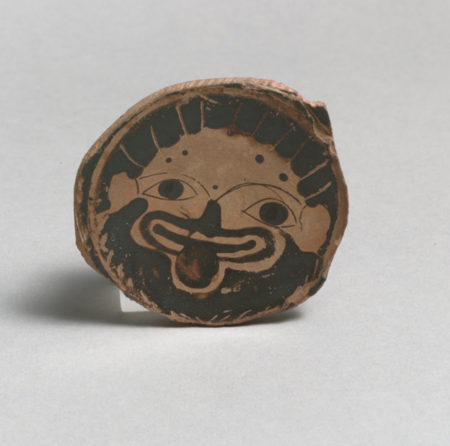
Fig. 6. Fragment of an Attic kylix featuring the head of the Gorgon. Attic, second half of the 6th century BCE; terracotta; height 6 cm. The Met, 98.8.40. Card: https://www.metmuseum.org/art/collection/search/246752
Although part of the image is missing, the fragment shows large eyes and a wide grimace. Comparing it to the previous kylix, it is visible that the frontal face appears not only on a single vessel but is repeated on smaller ones. However, the two fragments do not reveal how frequently this motif appears throughout all Attic ceramics.
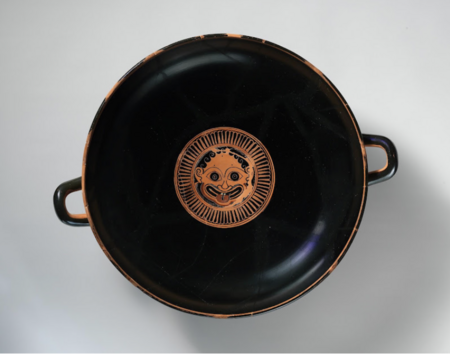
Fig. 7. Attic bowl of the «eye» type with a Gorgoneion. Attic, c. 530 BCE; terracotta; height 15.9 cm, diameter 38.1 cm. The Met, 14.136. Card: https://www.metmuseum.org/art/collection/search/248906
The internal medallion of the cup features a frontal head with emphasized eyes, fangs, and a protruding tongue. The circular shape makes the face particularly defined and easily recognizable. One might surmise that as the cup was drunk from, the image gradually became visible, but the card does not specify the exact context in which the cup was used.
- Anatomy of the Monstrous Image
Archaic gorgoneion depict a human face combined with an exaggeratedly wide mouth, protruding tongue, and fangs. Various additions—such as snakes, wings, or beards—were sometimes applied to these figures. A beard might coexist with curled hair and earrings, suggesting gender traits within the Greek visual tradition. This amalgamation amplified the image’s strangeness, but it is insufficient to label every bearded mask as a male character; context is crucial for identification.