Concept
«Battleship”—a familiar school game—is typically perceived as a simple, almost primitive children’s pastime played on lined paper. However, beneath its surface simplicity lies an interesting history and a complex strategic structure. The player does not see the opponent’s fleet, does not control ships in real time, and does not react to maneuvers. They operate in a field of pure probability and deduction.
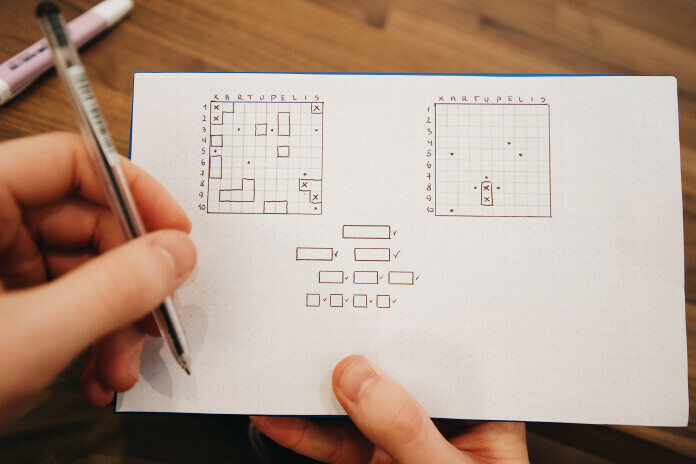
Modern Battleship game on a sheet of paper
The game «Battleship» can be understood as the reduction of naval warfare to its informational core. Like in actual naval battles, it seems like a simple game, but in reality, it is a battle for knowledge: where the opponent is, where they are moving, where their weak points are. «Battleship» strips away everything except this struggle, transforming war into a pure game of wits.
Our hypothesis is that «Battleship» is a paradigmatic example of an agonistic game (in Roger Caillois' terminology), where the competition unfolds not in the space of physical action, but in the space of information. Victory is achieved not through superiority in strength or speed, but through mastery of uncertainty.
This hypothesis requires testing through three analyses: historical (how play diverged from real warfare), mechanical (how rules create space for informational competition), and philosophical (how Kaiju classification helps us understand the nature of pleasure in play).
The Game Process
Thus, the chapters will correspond to three parts of the analysis. The first chapter will examine the origins of «Sea Battle, ” documentary mentions from the early 20th century, the game’s commercialization, electronic and computer adaptations, and contemporary digital forms. The second chapter will analyze the fundamental structure and key mechanics of the game, reviewing strategies as well as algorithms. The third chapter will analyze the agonistic nature of the game based on Kaiya’s classification.
Chapter 1. History: From Military Drill to Grid Notebook
The exact origin of «Sea Battle» remains unestablished. There are two main versions. The first, folkloric version, attributes the invention of the game to Pyotr Kondratyev, a Ural bargeman from the second half of the 19th century, who, unable to participate in real naval battles, devised a paper simulation of them. The second version connects the game to World War I: Russian officers, according to testimonies, played a similar game on hand-drawn grids, secretly placing ships and «firing» coordinates.
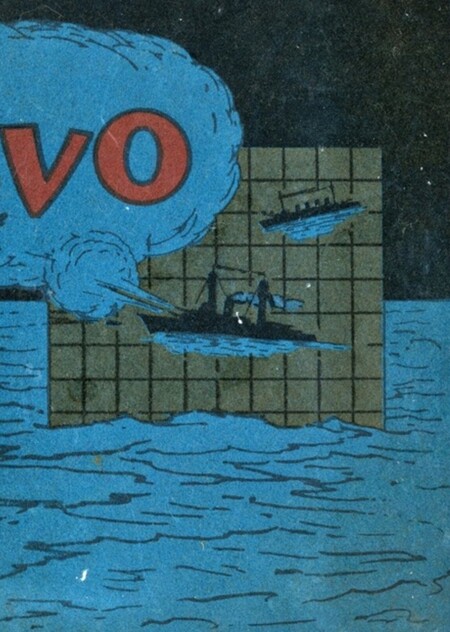
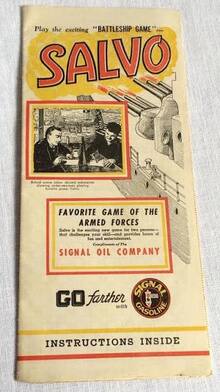
The Salvo game box, released in 1931
The documented mention dates back to 1907: the Russian poet Ryurik Ivnev refers to the game in his diary. This suggests that by the turn of the 20th century, «Battleship» already existed in oral tradition.
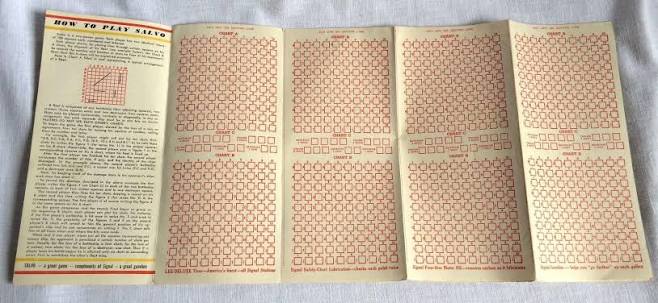
Play area
The first commercial version, Salvo, was released by Starex in the United States in 1931. These were notepads with pre-printed grids, which simplified game preparation. In 1943, Milton Bradley released Broadsides: The Game of Naval Strategy, also in a paper notepad format [1].
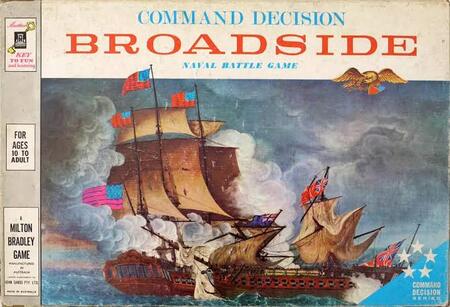
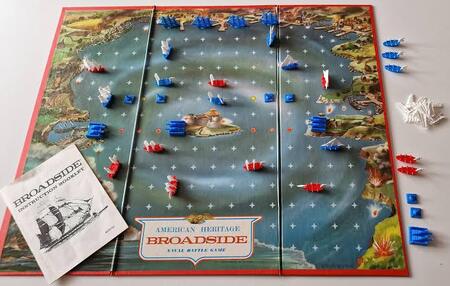
The game Broadsides, released in 1943
Broadsides Ship Enrollment
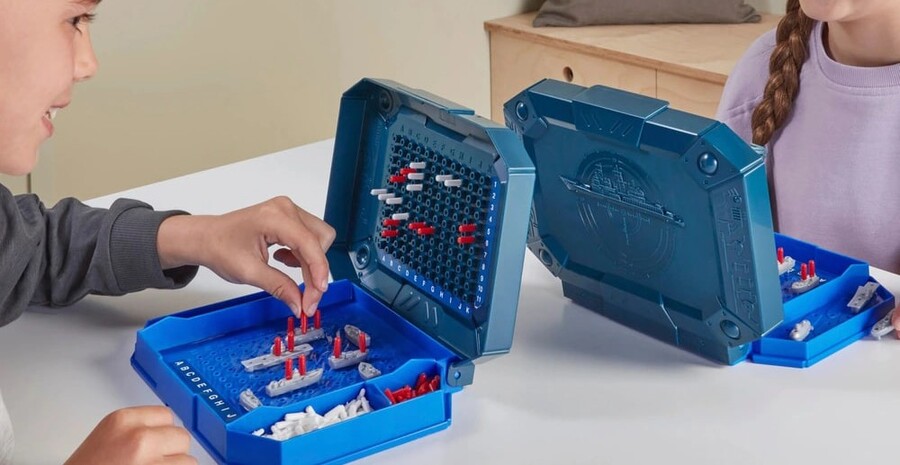
The turning point arrived in 1967 when Milton Bradley released the plastic version featuring grids, pegs, and miniature ships called Battleship. The design proposed by Ed Hutchins included a folding lid that concealed the player’s fleet from the opponent. This version became the canonical standard: it sold over 100 million copies and remains the benchmark for board game «Battleship» today [2].
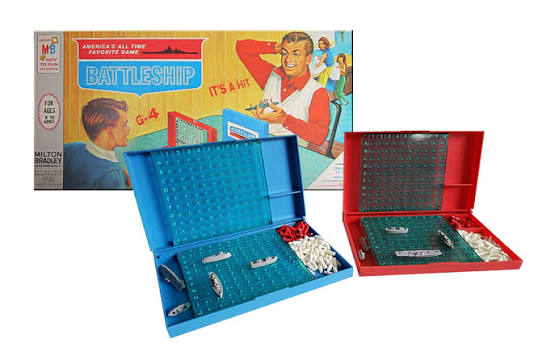

Battleship, released in 1967
In 1977, the electronic version—Electronic Battleship—was released, one of the first microprocessor toys capable of reproducing sound. In 1979, the game was ported to the Z80 Compucolor computer, one of the first computer adaptations of the tabletop game. Since then, Battleship has existed in countless digital variations, including mobile applications and online platforms.
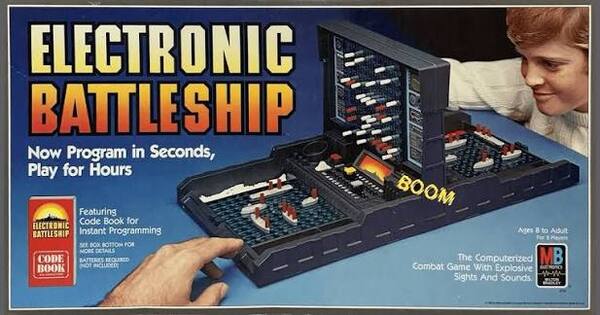
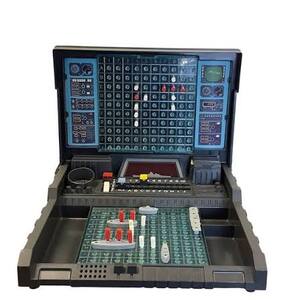
Electronic Battleship (1977)
In the USSR, there was a tangible, physical version of the game. In 1984, the Kharkiv factory released a plastic «Battleship» game featuring mechanical cannons and metal projectiles. Players shot balls across the field to sink the opponent’s ships—a cruiser, a destroyer, and a hunter. The game could last for hours. This version is interesting because the physical action (shooting a ball) was combined with tactical placement, whereas the classic paper version completely abstracts the act of firing into simply naming a coordinate.
Soviet-made «Battleship»
Soviet-made «Battleship»
Chapter 2. Game Mechanics
The classic «Battleship» unfolds on two 10×10 grids. Each player places a fleet of 10 ships: one four-decked (battleship), two three-decked (cruisers), three two-decked (destroyers), and four one-decked (patrol boats). Ships cannot touch each other, even at the corners—a rule that significantly restricts the space of possible configurations and forms the basis for deductive strategy. A turn consists of calling out a coordinate. The response has three levels: «miss,» «hit» (a strike on a multi-decked ship without sinking it), and «sink» (sinking the ship). Upon hitting, the player retains the right to take another turn.
Game Mechanics
The core feature of «Sea Battle» is the asymmetry of knowledge. Each player knows the location of their own fleet but not the location of the opponent’s. The entire game is a process of gradually eliminating this asymmetry through successive queries into the opponent’s field.
This distinguishes «Battleship» from many other games. In chess, both players see the full board—there is no uncertainty, and victory is achieved through pure calculation. In poker, uncertainty exists, but it relates to hidden cards and the psychology of betting. In «Battleship,» uncertainty is structural: it is embedded in the rules themselves and can only be resolved through rational deduction.
Mobile Game Interface for Sea Battle
The optimal strategy in «Sea Battle» can be formalized. I. I. Perelman described one of the winning strategies based on the concept of a «halo»: around each ship there is a zone where no other ships can exist. This allows surrounding cells to be excluded from the search once a ship has been detected [3].