CONCEPT
Nikolai Konstantinovich Rerikh was a renowned 20th-century painter, a descendant of someone from Scandinavia, and a leading peacemaker of the 20th century. Various researchers associate Rerikh with different movements: some classify him as Symbolist, while others believe Nikolai Konstantinovich’s painting should be more accurately categorized as Realism. Rerikh was a truly multifaceted individual: the creator of the Rerikh Pact, a brilliant archaeologist (despite lacking systematic formal education in the field), and a master of artistic detail.
Painting is an art form that interacts closely with other disciplines, such as literature and music. Rerikh was an artist whose work was profoundly intertwined with other art forms; he frequently designed musical productions. He was responsible for creating sketches for Ibsen’s play, «Peer Gynt,» and also provided visual interpretations for Borodin’s opera, «Prince Igor,» and Stravinsky’s ballet, «The Rite of Spring.»
It is also important to mention Nikolai Konstantinovich’s fascination with Richard Wagner, as he is the originator of the concept of the synthesis of arts, known as Gesamtkunstwerk. In other words, such a profound interaction between Rerikh and music could not have failed to influence his painting style, his artistic details, his choice of subjects, and his entire body of work. This is precisely why, in my research, I intend to examine how music found its embodiment in Rerikh’s painting and by what means the interweaving with this ephemeral art form arises.
The primary selection principle for materials will be the backstory of the painting—you must be able to pose a question about the artwork (e.g., is this painting related to a specific musical piece, was it painted in inspiration from music, or was it created for an event related to music?) and provide a definitive answer. In other words, the paintings must be connected to a musical theme in some way.
The selection of visual material will also be based on historical data (for example, paintings created a year after the staging of «The Rite of Spring»), because intertextuality is not always consciously recognized by the artist, yet it is nonetheless present in their work.
HYPOTHESIS
The hypothesis regarding Rerikh is as follows: music appears in his work on the imagistic level (characters or motifs from programmatic music find visual embodiment in Rerikh’s painting), the compositional level (the structure is somehow related to the rhythm and tempo of music), and the color level (a distinctive synesthesia). His works account for the nature of the music and many of its characteristics, embodied both in the color solutions and in the material and rhythm of the painting used. Rerikh partly copies the ideas of certain composers—that is, he does not limit himself solely to analyzing musical pieces, but also considers the specific characteristics of a particular author.
The principle of categorization is primarily based on musical works (for example, the «Sacred Spring» category, where Stravinsky’s specific piece and the embodiment of its ideas in Rerikh’s sketches are analyzed) and composers (the «Wagner’s music» category, where only the direct influence of Wagner’s music on Rerikh’s painting is analyzed).
The principle for selecting textual sources for analysis is primarily based on the reliability of the information provided by the source, while also taking into account the authority of the sources and their direct connection to visual arts.
RESEARCH CATEGORIES
- WAGNER MUSIC
- PER GUNT
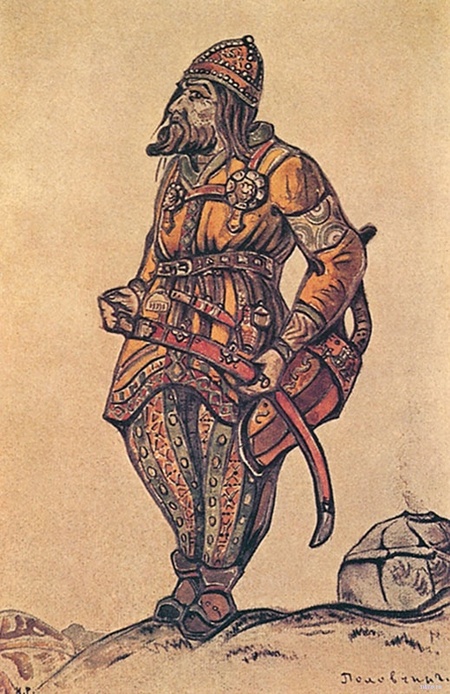
- PRINCE IGOR
- HOLY SPRING
Wagner’s Music
Wagner was a composer deeply admired by Scriabin. He cherished his music because it resonated with his inner world. Nikolai Konstantinovich, by his own volition, created sketches for Wagner’s «Valkyrie,» which, unfortunately, remain unrealized.
Tristan and Isolde
The emphasis in the sketch is primarily placed on the rocks, the gate, and the powerful, large steps of this fortress. Tristan, who is looking at the painting, does not immediately notice (he is not in the center of the painting and not in the foreground)—Tristan is standing on the steps. His colors blend with the landscape (blue + gray), and his shape mimics the rocks (he is slightly bent back, stooped).
The landscape is vivid and colorful, and Tristan seems lost against this backdrop of diversity with his rather subdued palette and imitation of natural forms. This approach to color, form, and composition creates the feeling of a unified «movement» within the painting.
Richard Wagner Theory
The 1850s were pivotal for Wagner: it was during this period that his core creative principles were finally established. He laid these out in his theoretical works, including «Art and Revolution» (1849), «The Work of Art of the Future» (1850), and «Opera and Drama» (1851).
«The Story of an Unproduced Masterpiece: Nikolai Rerikh’s Designs for Richard Wagner’s Opera ‘Tristan and Isolde’ at S. I. Zimin’s Private Opera, ” M. Gordeeva
Rerikh. A Biography by Valentina Pavlovna Knyazeva
An Encyclopedia for Kids by Avanta+ Art. Music. Theater. Cinema. Maria Aksyonova