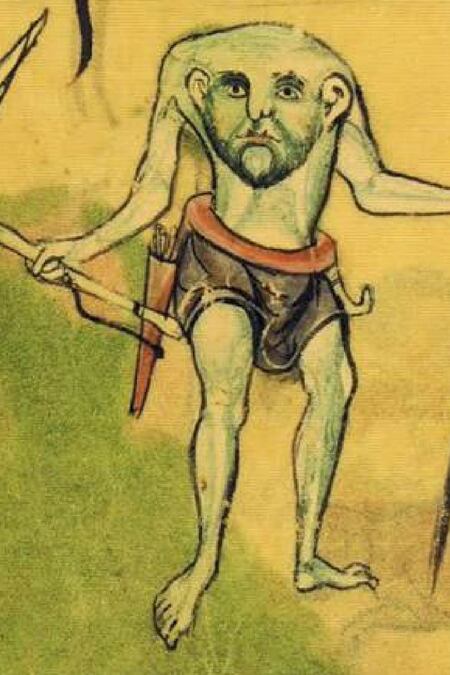
Unusual narratives and fantastic creatures in medieval manuscripts from the 13th–14th centuries
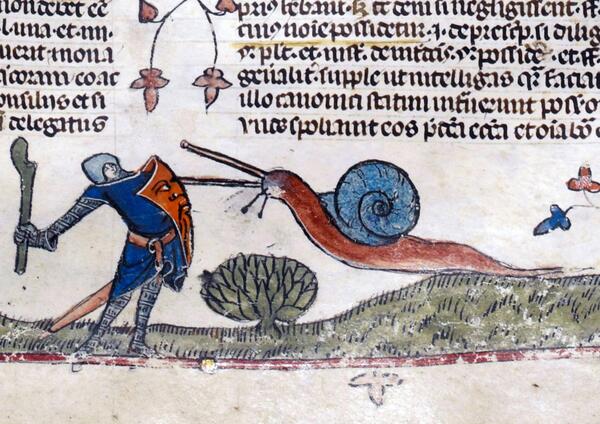
Visual Research Concept: Medieval manuscripts are typically associated with religious texts, austere illustrations, and intricate ornamentation. However, their margins often feature unusual subjects: rabbits with weapons, knights battling snails, and fantastic creatures combining traits of different animals.
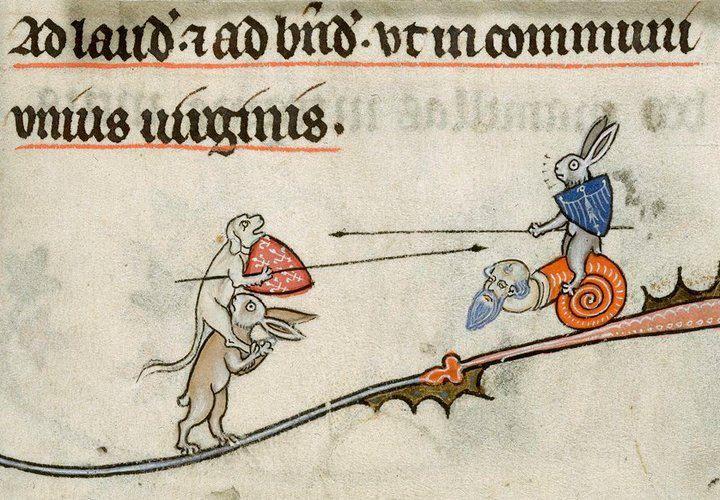
I have been interested in why such images appeared in serious manuscripts and what role they played in their decoration. Were they merely ornamentation, or could they have held additional meaning? In my research, I examine the marginalia from the 13th–14th centuries using the «Smithfield Decretals, ” the „Gorleston Psalter, ” and the „Lattrell Psalter“ as examples. My primary focus is on the themes, fantastic creatures, and artistic techniques used to create these images. I am also interested in how the drawings interacted with the text and integrated into the page composition. By comparing works from different manuscripts, I aim to determine which visual characteristics recur, how they differ, and how the artists utilized the space of the margins.
Chapter 1. Images Beyond Text
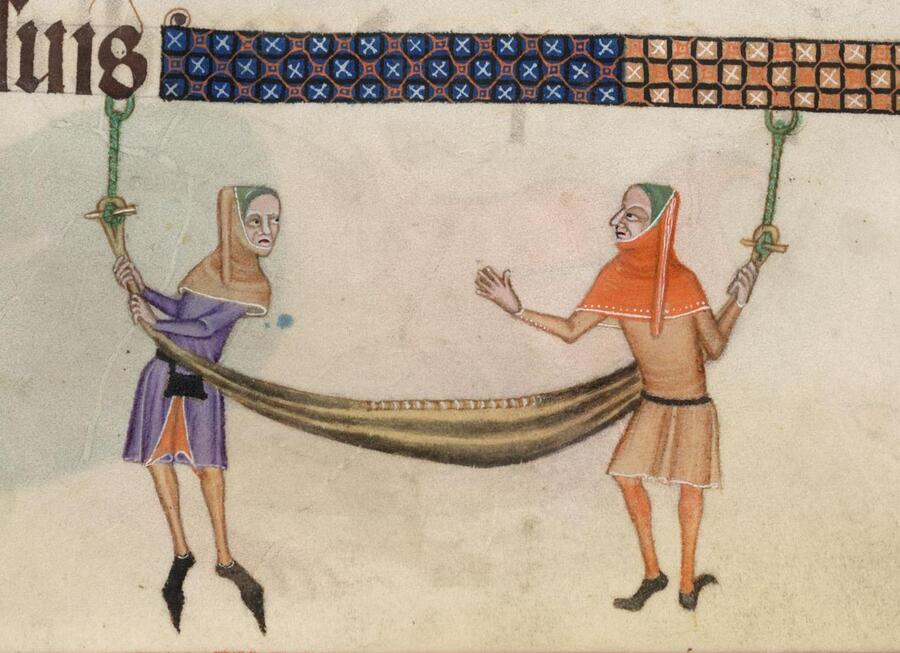
Page from a medieval manuscript. Unknown artist. Decorated page from the «Psalter of Lattrell.» England, circa 1325–1340. British Library, Add MS 42130, fol. 200r.
First Encounter with Marginalia
I used to think that everything in the Middle Ages adhered strictly to canonical rules. However, when I first saw marginalia, I was very surprised. I started to wonder: what was the purpose of including such images next to serious texts, such as prayers and church laws?
I became curious as to why medieval manuscripts featured armed animals attacking people, as well as fantastical creatures combining characteristics of different beasts.
Unknown artist. Page from the «Grolston Psalter.» England, 1310–1324. British Library, Add MS 49622, folio 107v.
Who Lives on the Margins?
Marginalia are drawings, notes, and decorations placed in the margins of handwritten pages. The name itself comes from the Latin word margo—meaning «edge.»
On the margins, you might find illustrations of plants, birds, animals, and strange creatures. Sometimes they relate to the main text, and other times they exist seemingly separate from it.
In art history, particularly whimsical illustrations are called drolleries. [1]
I was surprised that such unconventional drawings could appear in serious medieval books. They didn’t merely decorate the pages; they attracted attention—sometimes even more so than the text itself.
Initial adorned with figures
Unknown artist. Initial Q with figures. Italian breve, 1153. The Getty Museum.
How Drawings Went Beyond Letters
Initially, many characters existed within decorated capital letters. Artists wove animals, people, and plants into the initials.
Gradually, figures began to appear outside the letters. In Gothic manuscripts from the 13th–14th centuries, the margins of the pages transformed into space for small scenes. [1]
In these instances, the drawings were not always merely decorative. Sometimes they complemented the text’s content, while at other times they presented independent narratives unrelated to the main text.
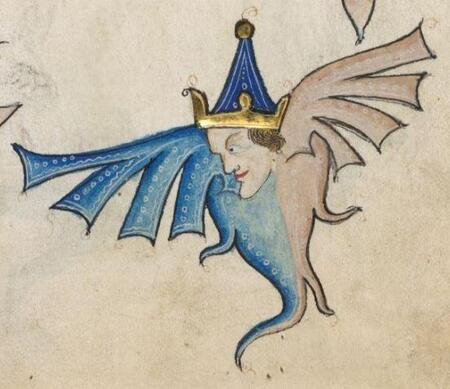
A Comparison of Unusual Themes in 14th-Century English Manuscripts: «Smithfield Decretals, ” f. 62r, 107r; „Lattrell Psalter, ” f. 181.
Three Unusual Narratives What Exactly Do I Want to Find Out?
I want to study the narratives themselves, as well as how artists created the effect of unusualness in images that still capture attention today. To do this, I will compare character behavior, their proportions, poses, and interaction with one another.
«Psalter of Lattrell.» England, c. 1325–1340. Add MS 42130, fol. 200r. Full page and fragment of the lower margin.
My Hypothesis
It seems to me that the illuminated manuscripts served as a space where artists could experiment more freely with imagery. Here, they could reverse the roles of humans and animals, depict a fantastic creature, or weave a short narrative. However, I do not believe that every such illustration was necessarily a joke. Some images might have told a specific story, others might have been linked to religious texts, and some might have served purely as decoration. [1]
To test this hypothesis, I selected several manuscripts created around the same period and decided to compare their themes and unusual characters.
Chapter 2. How Medieval Books Were Created and Decorated
A Book You Couldn’t Simply Print
The pages of medieval books were often made of parchment—specially treated animal skin. The text was handwritten, and the illustrations were created using paints and sometimes adorned with gold. [1]
Several master artisans might work on a single book: one would transcribe the text, another would create the illustrations, and a third would handle the binding.
Knowing the time and effort involved in creating such books makes examining marginalia even more fascinating. After all, even the most unusual image was meticulously crafted by the artist, who considered every detail.
«Gorlston Psalter, ” fol. 107v. Page composition and illustrations of musicians in the lower field.
How a Page is Structured
In a manuscript book, the majority of the page was typically allocated to text, but artists also utilized the surrounding space. The «Gorlston Psalter,» for example, demonstrates how the lower field could be transformed into a separate composition featuring several characters. The viewer’s attention is distributed among the text, illuminated letters, and illustrations. Furthermore, small images can capture the eye through movement, color, and recognizable figures. I find it interesting that the page is perceived as a single whole, even though its elements serve diverse functions.
«The Smithfield Decreta.» Ecclesiastical manuscript. France, c. 1300; marginal illustrations—England, 1340s. British Library, Royal MS 10 E IV.
«The Doctrinae Smithfield» is a collection of ecclesiastical legal decrees. The main text of the manuscript was created in southern France around 1300, and many of the marginal illustrations were added later in London. [3]
The manuscript features not only individual figures but also entire series of illustrations that tell stories about animals.
I found it interesting that the decoration appeared after the text itself. It suggests that the artists were working with an already existing book, creating an additional visual layer around its content.
The «Grolston Psalter» was created in England in the early 14th century. [4]
A psalter is a book of psalms used for prayer and religious services. However, the manuscript’s ornamentation is not limited to religious imagery.
Its margins feature musicians, animals, and unusual characters.
«Psalter of Lattrell.» England, circa 1325–1335. British Library, Add MS 42130, f. 181.
The Real and the Fantastic in One Book
The «Psalter of Lattrell» was created in England during the first half of the 14th century at the behest of landowner Geoffrey Lattrell. [5] In this manuscript, the combination of fantastic creatures and depictions of daily life is particularly fascinating. On folio 181, one can see a watermill, and on the side panel, a hybrid creature with human features and a winged, serpentine body. On one page, the artist juxtaposes a perfectly real object with a fantastic image. This proximity allows for a comparison between the methods of representing what exists and what is imagined.
Chapter 3. When Animals Change Roles
A hare shoots at a hunter. «Smithfield Decretaillies.» England, 1340s. Royal MS 10 E IV, f. 59v.
When the Prey Becomes the Hunter
In a typical scenario, a human hunts a rabbit. However, in this miniature, the animal takes up arms itself and attacks the human. The artist retains the recognizable appearance of the rabbit but imbues it with human actions. It is this shift in behavior that makes the image unconventional. I believe that what is important here is not only the animal’s figure but the situation itself. The viewer recognizes the familiar figures of the hunt, yet their roles turn out to be the opposite of what is expected.
Hunting scene with hares. «Smithfield Decreta.» England, 1340s. Royal MS 10 E IV, folio 59v–61v.