
NOKIA: FROM SMARTPHONES TO AI INFRASTRUCTURE: ANALYSIS OF BRAND COMMUNICATION STRATEGY (2025–2026)

nokia.com.
INTRODUCTION
Nokia is one of the most recognizable technology brands in the world, and at the same time a brand that today means something entirely different from what it did ten years ago. For the general public, Nokia is still associated with smartphones and legendary feature phones, but the real company in 2025–2026 is a global supplier of telecommunications infrastructure. The gap between the «image in the audience’s mind» and the «actual business» makes Nokia a particularly interesting object of analysis: the brand must simultaneously re-educate one audience while preserving the nostalgia of another. The company articulates its key positioning as «connectivity for the AI era.» With the arrival of new CEO Justin Hotard (who took office on April 1, 2025, having previously led the Data Center & AI division at Intel), the focus has shifted definitively toward networks for data centers, AI infrastructure, and 6G. Nokia positions itself not as a device manufacturer, but as the creator of a secure and resilient network foundation for telecommunications operators, cloud providers, and industry.
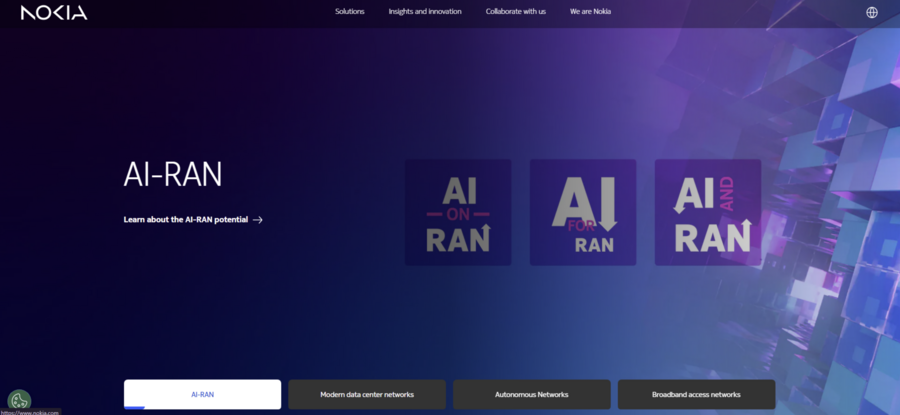
the AI-RAN page on nokia.com
The scale of the brand is confirmed by numbers. Revenue for 2025 was €19.9 billion (growth of approximately 3%), comparable operating profit was €2.0 billion, and R&D expenditure was €4.9 billion. In 2025, Nokia closed the acquisition of Infinera for €2.5 billion and entered into a strategic AI-RAN partnership with NVIDIA, which is investing $1 billion into the company. Orders from AI & Cloud segment clients reached €2.4 billion — this is the direction around which the new communications strategy is being built.
financial results table Nokia Financial Report Q4 2025 and full year 2025
Nokia’s audience today is primarily professional and B2B. The core consists of engineers, CTOs, telecommunications operator executives, government sector representatives, and industry professionals: they care about specifications, reliability, and long-term stability. In parallel, there is an indirect B2C audience — those who remember and value Nokia for its reliability. There are no direct sales of consumer devices: smartphones and feature phones are produced by licensee HMD Global, and communication with the mass consumer goes through partner channels, playing primarily an image-building role.
These two audiences are conveniently represented as core and periphery. At the core are B2B clients, with whom Nokia speaks the language of facts: here the central route of persuasion applies, along with the need for information. At the periphery is the broad public that remembers and loves the brand: here the peripheral route operates (heritage, recognition, emotion) along with the need to belong to a meaningful story. This split into two audience types defines all subsequent communication, and it is precisely this split that we will trace throughout our analysis.
COMMUNICATION CHANNELS
Nokia’s communications are organized in a differentiated manner: different platforms and tones for different audiences. The brand’s field is broadly divided into three layers: business (corporate blog, Newsroom, LinkedIn and X, financial releases), scientific-reputational (Bell Labs, white papers, conferences), and image/mass (YouTube, HMD partner channels). Already here we can see an important feature that we will return to in the analysis: almost all channels operate in broadcast mode — the brand speaks, and the audience listens.
1.8 million followers
In the business segment, Nokia relies on professional social networks (LinkedIn, X) and its own platforms — the corporate blog and Newsroom. Content is designed for a prepared reader: posts and articles contain specific figures, links to reports, architectural diagrams, and technology breakdowns. The tone is expert, without entertainment. The corporate blog is especially illustrative: it features long, well-argued pieces in which the brand fully controls the presentation.
article in Nokia’s blog about trusted agentic AI in IP networks
The Newsroom serves as the showcase for strategic news: press releases, announcements of deals, appointments, and contracts with operators. It is a tool for working with investors and business media. A separate layer consists of the CEO’s personal appearances: Hotard sets the strategic tone and connects technology initiatives with business results, reinforcing market confidence. Here, as in the blog, communication remains one-directional: these are announcements, not dialogue.
Newsroom feed (news about Indosat Ooredoo Hutchison, June 2026)
The strongest part of the strategy is scientific PR through Nokia Bell Labs. In 2025, the laboratory celebrated its 100th anniversary, and the jubilee became a platform for demonstrating expertise: white papers on 6G and quantum technologies, video interviews with researchers, reminders about Nobel and Turing Prize laureates. The brand capitalizes not on an immediate product, but on the very history of innovation.
«Nokia Bell Labs celebrates 100 years of innovation»
On X, the @Nokia and @NokiaBellLabs accounts handle operational news and coverage of industry conferences. Short format, fast pace: announcements, live coverage, reactions to industry news. This is a «here and now» channel that keeps the brand in the current conversation.
Nokia post on X about NSP agentic AI with video
For the general public, YouTube is used in an image-building and educational format: brand history, explanations of complex technologies, «Networks you can trust» videos. The consumer phone segment is handled by licensee HMD Global. Here it is not argument but recognition and emotion that do the work — what we will further analyze as the peripheral route.
Nokia YouTube channel, 415 thousand subscribers
THEORETICAL FRAMEWORK
For our analysis, we selected two theories from the course syllabus. The first is the Elaboration Likelihood Model (ELM): it explains how persuasion of different audiences works. The second is Uses and Gratifications Theory (U&G): it explains why audiences turn to brand content. The two perspectives complement each other: ELM looks from the perspective of the message sender, U&G from the perspective of the receiver. In our recommendations, we will additionally draw on dialogic theory to assess the quality of two-way communication.
The ELM describes two routes of persuasion. The central route involves deep analytical processing: a person reads carefully through facts, figures, and details and forms an opinion based on logic; it is activated when the audience has both the motivation and the ability to engage. The peripheral route works through external cues — authority, recognition, emotion, aesthetics — and is activated when the audience is not prepared to analyze. Attitudes formed via the central route are more durable; those formed via the peripheral route are more superficial, but are achieved more quickly. For Nokia this is the key pair of tools, because the brand works simultaneously with two very different audiences.
Uses and Gratifications Theory starts from the premise that audiences are not passive: people actively choose content to meet their own needs — for information, for control over uncertainty, for social belonging. Applied to a brand, this flips the question: not «what does Nokia want to say,» but «what does the audience want to receive and why do they stay?» This angle is especially useful for evaluating social media engagement — it explains which materials «hook» people and through which need.
ANALYSIS
For its business audience, Nokia consistently works via the central route. The website, blog, and reports publish technical specifications, data on 5G Standalone deployments, AI-native network architecture, and financial metrics. Engineers are willing to invest time in processing arguments, and investors analyze quarterly figures (revenue €19.9 billion, operating profit €2.0 billion). Persuasion is built on the logic of facts.
page «What is AI-RAN?» with breakdown and white paper
From an ELM perspective, this is a «textbook» central route: high motivation (procurement decisions worth millions of euros) meets high analytical capacity (professional education). The brand deliberately increases the weight of its arguments — providing verifiable figures, diagrams, white papers. Attitudes formed this way are resilient: a CTO convinced by data will not change their mind because of a mood shift.
For the general public, Nokia activates the peripheral route. The Bell Labs centenary (100 years), the company’s own 160th anniversary, timelines of innovations — the transistor, the laser, information theory — mentions of Nobel laureates all build the image of a technology leader without requiring the audience to understand the details. Image videos bet on recognition and emotional connection: «a legacy of innovation» functions as a quality signal.
Bell Labs heritage