I
Death and Power
All power is finite. Even the most mighty ruler is mortal. Their power is limited by time, circumstance, and the recognition of contemporaries and descendants. Through monuments, regalia, architecture, and ceremonies, power can present itself as an order whose existence does not depend on the life of a single ruler. Humans are constantly confronted not only by the action of power, but also by its image. Power exists within laws, institutions, and relationships, yet it becomes accessible to sensory perception through signs, spaces, rituals, and images.
Everything is fleeting and soon begins to resemble a myth before succumbing to complete oblivion. And I am talking about people who were once surrounded by a special aura. As for the rest, they are forgotten as soon as they pass away. What is eternal glory? — Mere vanity.
These words belong to the Roman Emperor—a man who possessed one of the greatest forms of political power of his time. Yet, he recognized that neither power nor public recognition could save a person from oblivion.
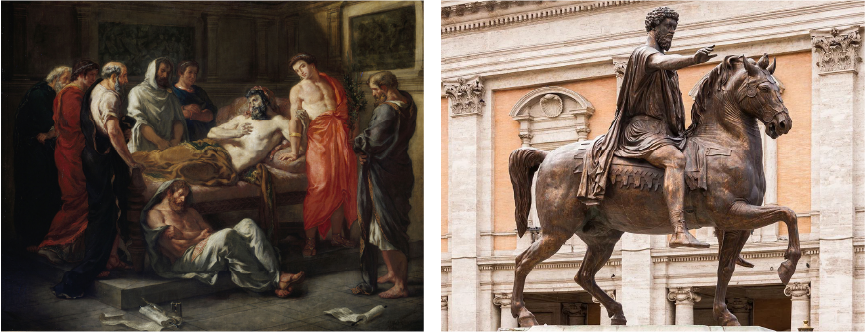
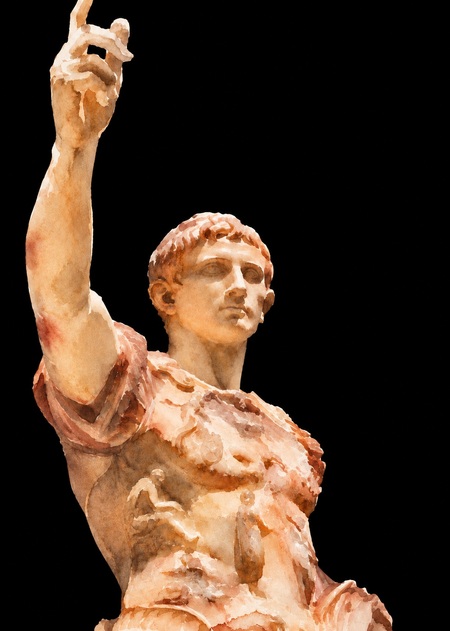
Eugène Delacroix | Last Words of Emperor Marcus Aurelius | 1844 Equestrian Statue of Marcus Aurelius | 176–180 AD
When Aeneas Delacroix Marcus Aurelius dies. His body loses strength, and power must pass to a successor. The emperor depicted in the bronze statue, in contrast, continues to hold a position of authority centuries later, expressed in the adlocutio pose.Power is expressed in images that evoke fear, inspire respect, and create an impression of grandeur. Through these images, people perceive not only a specific ruler but also an idea of order that surpasses the individual.In the book «Two Bodies of the King, ” Ernst Kantorovich examines the medieval concept of the dual nature of royal power. In the doctrine he studied, one can distinguish the Natural body of the king—mortal, subject to aging, illness, and weakness; and the Political body of the king—the symbolic embodiment of royal dignity and the continuity of the institution of power. From this arises the main research question:
How does power, embodied in a mortal human being, manifest as a transcendent and eternal force through an aesthetic image—one capable of evoking fear, reverence, and the sublime?
II
From Strength to Authority
Power can outlive its bearer. Rulers succeed one another, but the institutions, laws, and traditions they establish can continue to function. However, the very possibility of power transfer does not explain why people acknowledge someone’s right to rule.Subjugation can be secured through the threat of punishment, but power does not always require the direct application of force. People bow their heads to the sovereign, follow the judge’s decisions, and obey the commander’s orders. Sometimes these actions occur without coercion.Why does a person capable of resistance voluntarily give up the will to resist?
In his work, «The Concept of Power,» Alexander Kozhev suggests viewing power through the relationship between the agent and the object of their action. A similar approach can be found in Plato. In the first book of The Republic, Socrates, in a dialogue with Phrasimus, examines rule as a craft—one that, like medicine, is aimed not at the benefit of the practitioner but at the benefit of the person being served. In the case of a ruler, this is the benefit of the ruled.
However, Kozhev is less interested in the purpose of power than in the very condition of its existence. For him, it is fundamental that an authoritative action does not meet resistance from a person who is capable of resisting but consciously chooses not to.
Authority presupposes not the absence of the capacity to resist, but the voluntary renunciation of that capacity. The individual recognizes a certain superiority in another and permits that other’s intervention in their own actions.
Authority exists not only because of the qualities of the one in charge, but also through the recognition of those who are subject to them. Moreover, this recognition does not necessarily imply affection or moral approval. In this regard, power depends on those over whom it is exercised. A loss of recognition can dismantle authority even if the means of coercion and the enforcement of their will are maintained.
Authority and law do not always go hand in hand. The law allows for the compulsory execution of decisions even against a person’s will. Authority, however, implies the absence of resistance to the exercise of power itself. Therefore, legality and authority are not synonymous. A legitimate ruler can lose recognition, while an individual without an official position can possess significant authority.
If authority implies recognition, the question arises: what exactly do people recognize in those they obey?
Kozhev outlines four pure types of power: the Father, the Master, the Chieftain, and the Judge. Each possesses a distinct basis for superiority.
▸The Father’s power rests on lineage and precedence; ▸The Master’s rests on recognized superiority tied to risk and struggle; ▸The Chieftain’s rests on the ability to foresee and direct; ▸The Judge’s rests on impartiality and justice.
These types allow us to distinguish between methods of legitimizing submission, without reducing power to a single universal attribute.
Paternal authority is tied to origin: the father precedes the son and is the cause of his existence. In political life, this type of authority manifests through tradition and lineage. A ruler may hold power not because of personal merit, but due to belonging to a specific dynasty.
The power of Mr. Kozhev is connected to the Hegelian master-slave dialectic, which arises from the struggle for recognition. However, dominance cannot be reduced to mere physical force. Victory only becomes the basis for authority insofar as the victor’s superiority is acknowledged by the vanquished.This distinction is particularly evident in depictions of capitulation and triumph, where direct violence has ceased, but the relationship of superiority persists.
The leader’s authority stems from the ability to see beyond others, anticipate events, and suggest a direction for collective action.A leader enjoys authority because others recognize their capacity to guide them. Consequently, their power is directed toward the future that is yet to be realized.
The power of the Judge does not lie in recognizing justice and impartiality. The Judge holds authority as long as the decision is perceived as independent of personal interests. From this arises the characteristic symbolism of justice, which substitutes the specific individual.
The Four Types of Kozhev are analytical models. In reality, these types often coexist within a single individual. A monarch can be a dynastic heir, a military victor, a people’s leader, and the supreme judge. Their authority is supported by several bases for recognition. However, these bases can contradict each other, meaning that the outward unity of a powerful image may conceal an internal heterogeneity of authority.
Kojev considers heredity, appointment, and election as mechanisms for transmitting pre-existing authority to its next bearer. Political ceremonies take on particular significance here, representing the transition of one person to another as a continuation of the established order. However, the ritual itself does not guarantee recognition. It formalizes the transfer of power but does not replace the conditions upon which its authority depends. These images of power connect a person’s finite life to the history of an institution that claims a more enduring existence.