Navigation
- Concept
- Chapter I. The Judge and the Map of the World: The Structure of the Underworld
- Chapter II. Man Before Judgment: Sin, Punishment, and Salvation
- Chapter III. How an Image Addresses the Viewer
- Conclusion
- Bibliography
- Image Sources
Visual Research Concept
Обоснование темы, принципы отбора, проблема и гипотеза
Concept The Last Judgment belongs to the few scenes where medieval art speaks of death directly and in detail. Christ judges the living and the dead; the righteous ascend to heaven, and the sinners fall into hell. This scheme is repeated from monument to monument, yet the images that embody it change noticeably. This study compares three monuments from the 12th–14th centuries: the Tympanum of Saint-Lazare Cathedral in Autun (c. 1130–1145), the central portal of the west façade of Notre-Dame Cathedral in Amiens (first half of the 13th century), and Giotto’s fresco, «The Last Judgment, ” in the Scrovegni Chapel in Padua (1303–1305). The subject matter is important because it was located at the entrance to the church or on a wall visible to everyone who entered. It connected theology, moral teaching, and the experience of the believer. By examining how the Last Judgment is depicted, one can discern the religious and moral meanings the image offered the viewer before they crossed the threshold.
Rationale for Topic Selection Medieval art is often characterized by broad definitions—"symbolic,» «flat,» «religious.» The three selected artifacts challenge these definitions. Ottonian art exemplifies Romanesque sculpture, where the body is subordinate to ornament and meaning. Amiens showcases Gothic sculpture, where figures gain volume and the composition is organized into successive tiers. Padua represents monumental painting, where figures occupy real space. Within a single subject matter, one can observe the evolution of expressive means.Criteria for Material Selection For comparison, one artifact was chosen from each century: the 12th, 13th, and 14th. All three were created for sacred Christian spaces and are intended for the worshipper entering the church. They belong to distinct artistic traditions: Burgundian Romanesque sculpture, French Gothic, and Italian fresco painting. Within each artifact, individual fragments are examined to reveal the entire concept: the figure of the Judge, groups of the righteous and sinners, framing elements, and details naming the master or patron.Problem and Hypothesis The key question is: How did the balance between fear and hope in the visual representation of the Last Judgment change over two centuries, and what artistic means were employed to express this shift? Hypothesis: This work is based on the premise that the transition from Romanesque sculpture to Gothic art, and subsequently to Giotto’s fresco, shifts the image of the Last Judgment from a schema that needs decoding to a scene that the viewer experiences. Punishment becomes more corporeal and specific, and the possibility of salvation acquires distinct figures and a place within the composition. Fear does not disappear, however; it changes its audience—from the universal to the individual viewer.
Chapter I. Judge and World Map
Устройство загробного мира: Христос-Судия, рай, ад и воскресение
The framework of the Last Judgment remains largely unchanged: Christ in the center, the righteous on one side, the sinners on the other, and the resurrection of the dead below. The chapter’s question is how each monument fills this framework. What place does Christ occupy? How are heaven and hell distributed—are they bound by space or only by meaning?
Otyon: A center larger than a figure
The Last Judgment. Tympanum of the west portal of Saint-Lazare Cathedral in Autun, Burgundy, France. Second quarter of the 12th century (circa 1130–1140). Sculptor Gislebertus. Stone.
The tympanum is built around the mandorla—the almond-shaped aura surrounding Christ. It occupies nearly the entire height of the central section, dividing the composition through mass rather than line. The other figures are placed at the edges and are subordinated to it. This is how the hierarchy of Romanesque art functions: the significance of a figure is determined by its placement and size, not by realism. Christ is the most important figure here, and this is immediately apparent, visible from a distance, from beneath the portal arch.
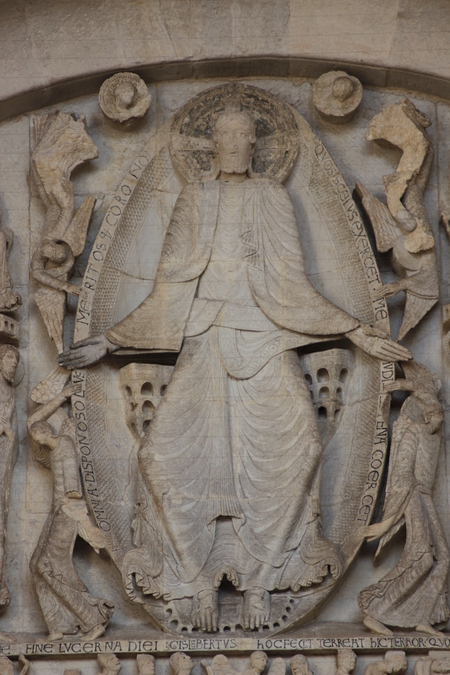
Tympan of Saint-Lazare Cathedral in Autun: Central section, Christ in Majesty. Second quarter of the 12th century (c. 1130–1145).
The body of Christ is elongated and scarcely resembles a body in the conventional sense. The elongation of figures in the Tintoretto work is so profound that it strips them of corporeality. A crucial detail for understanding the image: four angels support the mandorla, as if the divine light possesses weight. Here, light becomes matter. The sculptor conveys this through weight and support, rather than through radiance.
Amiens: Order, unfolded upwards
Portal of the Last Judgment on the west facade of Notre-Dame Cathedral in Amiens, Picardy, France. First half of the 13th century. General view.
The Amiens Portal constructs the afterlife differently. The tympanum integrates into the façade as part of a unified whole. Reading from bottom to top, one encounters the resurrection of the dead, the weighing of souls, the separation of the elect from the damned, Christ the Judge, and at the very apex, the apocalyptic Son of Man holding two swords emerging from his mouth. The verticality establishes a sequence: First, the resurrection takes place; then, the fate is decided; next, the judgment is pronounced; and finally, it is confirmed from above. The image transforms into a narrative that the viewer reads from bottom to top.
Tympanum of the central portal of Amiens Cathedral. First half of the 13th century.
At the center of the tympanum sits Christ the Judge. Christ’s wounds serve as a reminder of his sacrifice. Of particular note are the traces of medieval polychromy in the eye area: the preserved paint intensifies the expressiveness of the gaze. Beside him are Mary and Saint John. They stand near Christ, introducing the theme of intercession into the scene. Mary and John do not negate the judgment, but they show that the court has people capable of petitioning. Christ is highlighted not only by his size—he is integrated into the architectural system of the portal.
Padua: The Afterlife as a Space
Giotto di Bondone. «The Last Judgment.» Cappella Scrovegni (Arena) in Padua, Italy. 1304–1306. West wall, general view.
The fresco covers the western wall of the chapel above the entrance. The image is not divided into separate reliefs—it is a single scene. Christ in a mandorla is in the center, flanked by apostles, with angels saved and damned positioned below. The symmetry is almost geometric, allowing the viewer to immediately perceive the center and the edges. Furthermore, the space is not arbitrary: the scene recedes into depth and is perceived as a window rather than a schematic diagram.
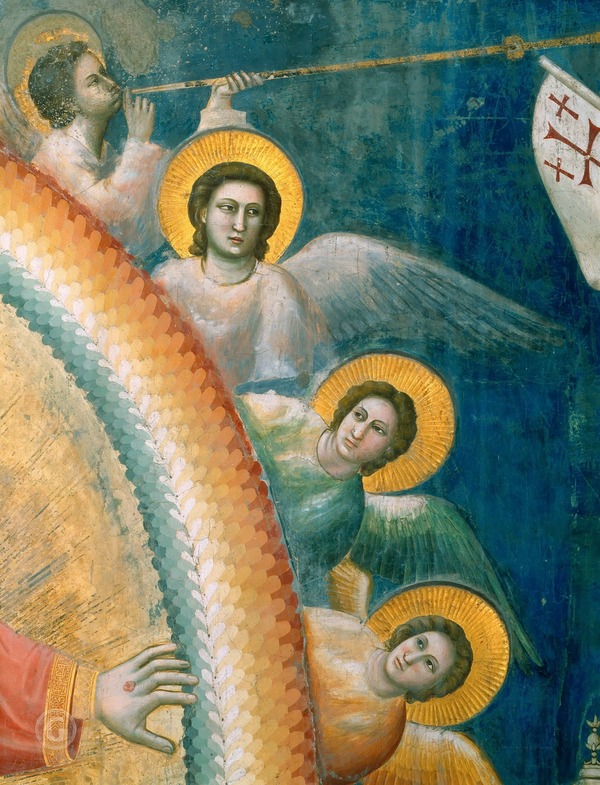
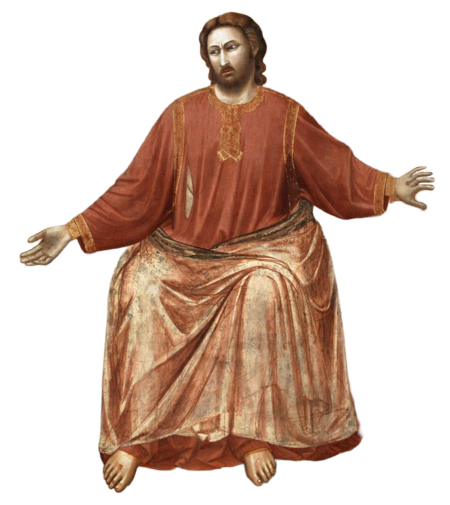
Giotto. «The Last Judgment.» Scrovegni Chapel, Padua. Fresco fragment. 1304–1306.
The Apostles are arranged in several rows; the figures stand at varying depths, partially overlapping one another. This is not strict linear perspective, but the space is already structured as a place where one can be. Christ is perceived as a human figure, rather than a symbol. Therefore, the spatial organization of the composition creates the impression of an unfolding event.
Chapter Conclusion
All three monuments depict the same afterlife order, yet they construct it differently. Otton establishes a hierarchy of meaning: Christ anchors the center, and the edges present a contrast—the space is logical. Amiens integrates the order into the verticality of the façade, guiding the viewer through a journey from resurrection to judgment. Padua translates the order into a spatial experience where heaven and hell occupy the wall, positioning the viewer before the scene. The afterlife moves from schema to place.
Chapter II. The Individual Before the Court
Грех, наказание и спасение: Как изображены праведники и грешники
Chapter Two shifts focus from structure to the individual. What is depicted in the righteous and the sinner is crucial—how the difference in fate and who is granted the opportunity for salvation is conveyed. The core material here involves bodies, poses, groups, and motifs that allow the viewer to recognize their own destiny.
Otyon: Salvation as a Narrow Pass
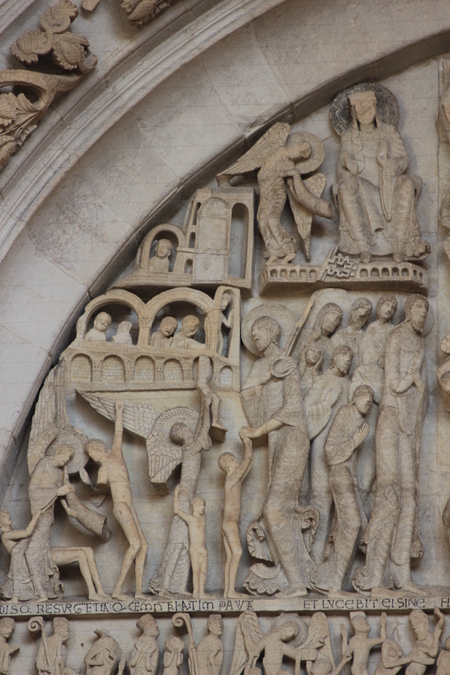
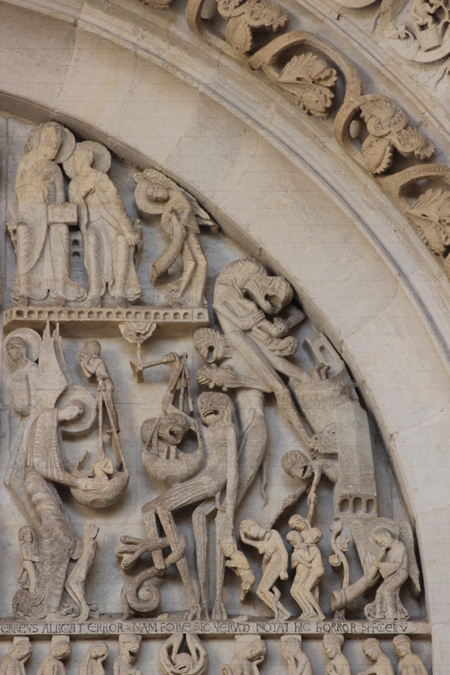
Tympan of Saint-Lazare Cathedral in Autun. A fragment with the chosen / a fragment with the condemned. Second quarter of the 12th century (c. 1130–1140).
Those condemned on one side are broken: Knees are bent, torsos are compressed, and the figures take on angular forms. There is no space behind them to retreat into. The figures are depicted as being squeezed, as if crushed into hell. Suffering is shown in detail because it needs to be made visible. Bliss is indicated differently—through the direction of movement.
The righteous are moving toward the heavenly Jerusalem, depicted as an arcade. Saint Peter, holding the keys, guards the entrance, while an angel assists the resurrected in squeezing inside. Salvation appears as an effort and a path that must be traveled. Paradise is not given freely: the entrance is open, but narrow, and angelic aid does not negate the condition.
Amiens: Participation as Affiliation