Navigation
[1] Concept [2] Trust through Authority [3] Trust through Cultural Proximity [4] Trust through Emotional Connection [5] Conclusion [6] Bibliography [7] Image Sources
Concept
At the turn of the 19th and 20th centuries in the Russian Empire, industry, trade, and mass production were rapidly developing. As competition grew, it became increasingly important for producers not only to capture buyers' attention but also to convince them of the quality and reliability of their goods. One of the main tools for this persuasion was advertising, which increasingly utilized diverse artistic imagery and symbols alongside product information.
I was interested to discover that pre-revolutionary advertisements sometimes featured imagery unrelated to the advertised product: state emblems, fairy-tale characters, and children. In my research, I aim to answer the question: how were the images mentioned above used to build trust in products within late 19th and early 20th-century Russian commercial advertising, and what visual techniques allowed them to perform this function?
The relevance of this research lies in examining historical mechanisms of visual persuasion, many of which remain in modern advertising. By appealing to state symbols, cultural traditions, and family values, producers can build an emotional connection with consumers and create an impression of reliability. Analyzing pre-revolutionary advertising imagery helps us understand how such strategies were formed and the role that societal perceptions and values played in that process.
The visual material will consist of advertising posters, announcements, labels, and product packaging created in the Russian Empire, predominantly between 1890 and 1917.
When analyzing images, particular attention will be paid to composition, color schemes, and how the visual elements interact with the advertised product.
The research structure is divided into three main parts, each dedicated to a distinct method of visual persuasion.
The first section examines the appeal to authority through the use of state emblems, awards, medals, and imperial iconography. It analyzes how these elements were integrated into advertising compositions to create associations with official recognition and high product quality.The second section is dedicated to fairy-tale and folklore imagery. Using examples from advertising visuals, it explores how familiar characters, folk motifs, and stylistic adaptations of traditional art could foster a sense of cultural intimacy between the producer and the consumer.The third section analyzes the use of children’s imagery. Special attention is paid to facial expressions, gestures, clothing, and the characters' interaction with the product, as well as how advertising, through the depiction of children, engaged the viewer’s emotions and ideas about family, care, and security.
When selecting textual materials, I will draw upon scientific publications on the history of Russian advertising, studies of visual culture and consumer society, as well as works on the history and theory of advertising.
The primary selection criteria will be the credibility of the sources, their relevance to the topic, and the ability to use the information contained within them for the correct interpretation of advertising imagery.
Trust through authority
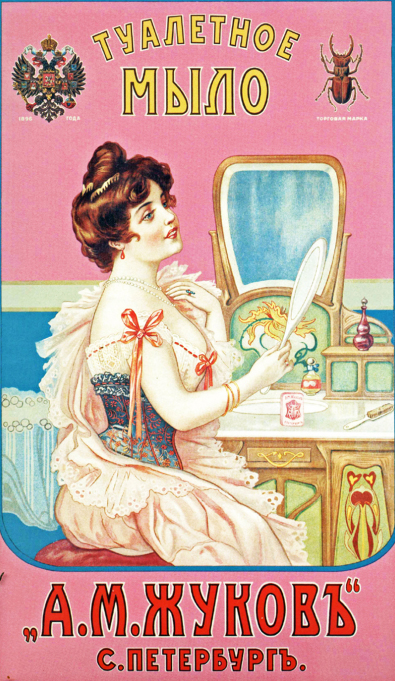
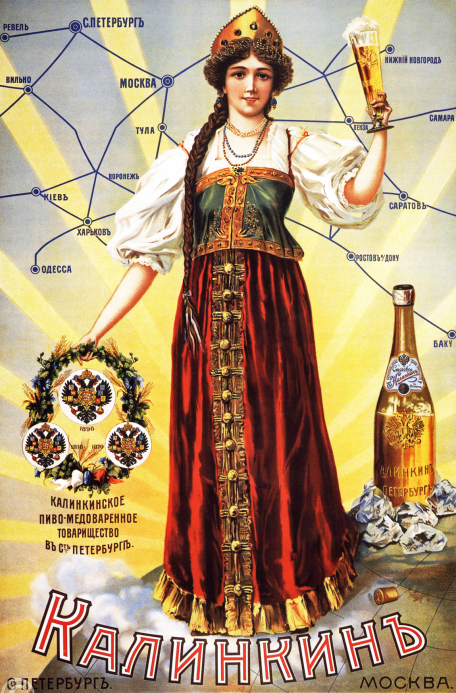
Advertising poster, «A.M. Zhukov. Toilet Soap.» 1904 // advertising poster, «Kalinkin Beer and Mead Company.» 1890s
Vladimir Amosovich Taburin, Advertising Poster «Tobacco from Kolobov and Bobrov’s Factory, ” 1890s
Advertising poster for the «Maltsov Factories Locomobiles,» circa 1900
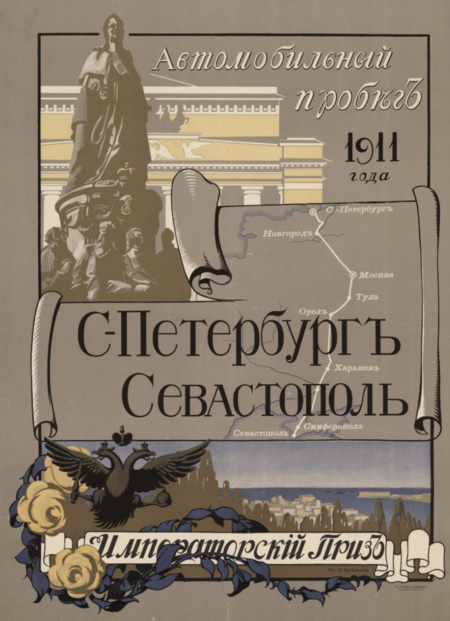
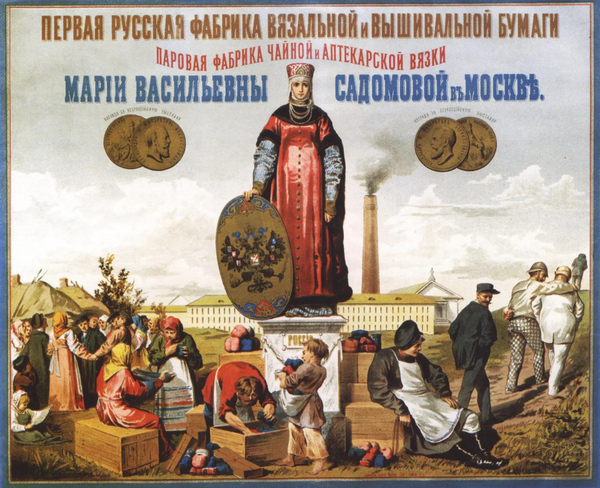
Advertising poster, «Automobile Mileage 1911 St. Petersburg–Sevastopol,» 1911 // P. Ostashov, advertising poster «The First Factory for Knitted and Embroidered Paper,» 1884
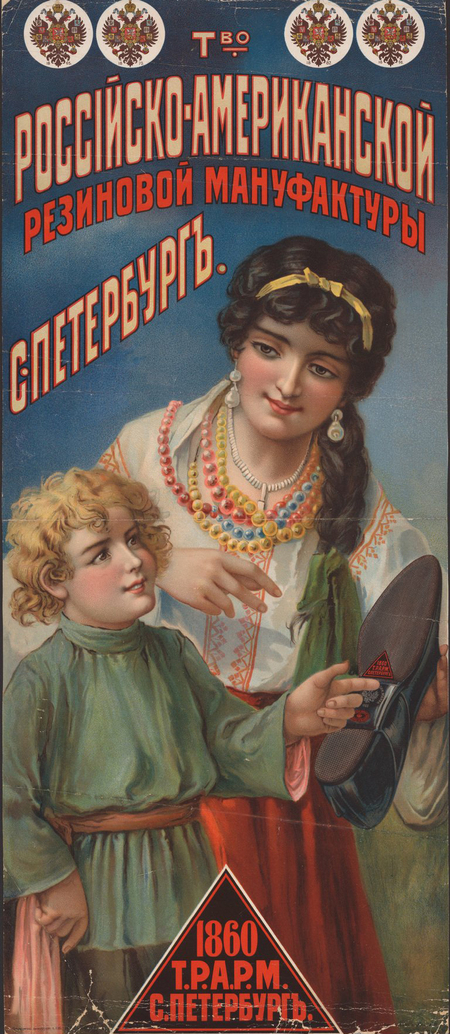
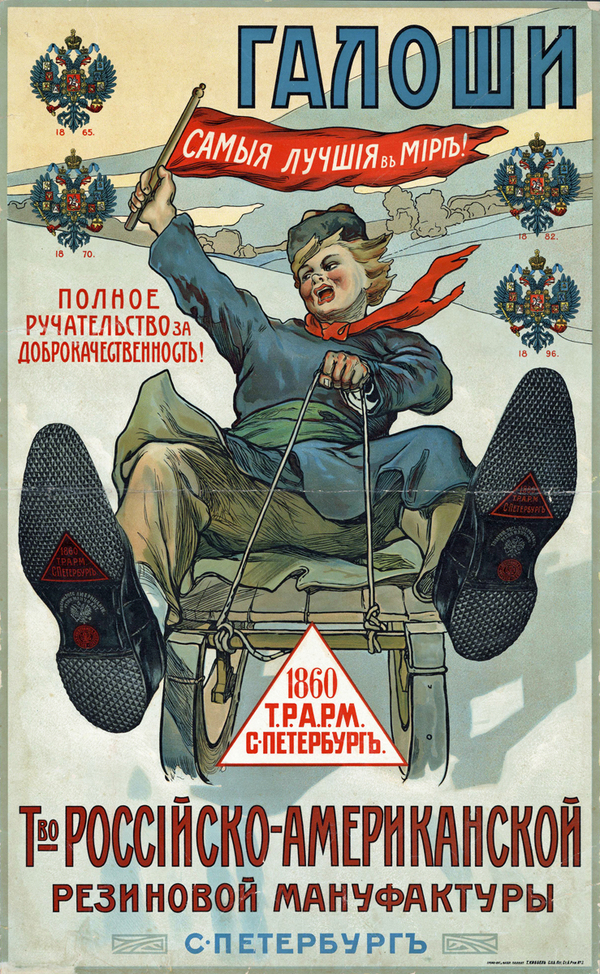
Advertising poster for the «Russian-American Rubber Manufactory,» 1904 // advertising poster for «Triangle» rubber boots. 1910s
1
https://reklama.school/pre-revolutionary/1-3 (Accessed: November 15, 2026)
https://reklama.school/pre-revolutionary/1-3 (Accessed: November 15, 2026)
https://reklama.school/pre-revolutionary/1-4 (Accessed: November 15, 2026)
https://reklama.school/pre-revolutionary/1-4 (Accessed: November 15, 2026)
https://viewer.rusneb.ru/ru/000199_000009_010080362?page=1&rotate=0&theme=white&inversion=off (Accessed: November 15, 2026)
https://arthive.com/ru/artists/9893~Plakaty_SSSR/works/280561~Pervaja_fabrika_vjazal'noj_i_vyshival’noj_bumagi (Accessed: November 15, 2026)
https://rusneb.ru/catalog/000199_000009_010067276/ (Accessed: November 15, 2026)
https://reklama.school/pre-revolutionary/1-5 (Accessed: November 15, 2026)