Navigation
1 Concept 2 What is Manueline? 3 Characteristics of the Style 4 Artistic Distinctiveness 5 Famous Monuments 6 Conclusion 7 Sources
Concept
The Manueline style (Portuguese: Manuelino) is a distinctive Portuguese architectural style, representing a unique Portuguese variant of Renaissance architecture from the 15th–16th centuries. It fuses late Flamboyant Gothic elements, Renaissance features, Moorish-Mudéjar heritage, and iconography related to the Age of Great Discoveries. The style is named in honor of King Manuel I the Happy (1495–1521). This period marked the zenith of Portugal’s geopolitical power as a leading maritime force and active colonial expansion. Successful competition with Genoa and Spain for naval dominance spurred a powerful economic and cultural ascent, which materialized in large-scale architectural construction.
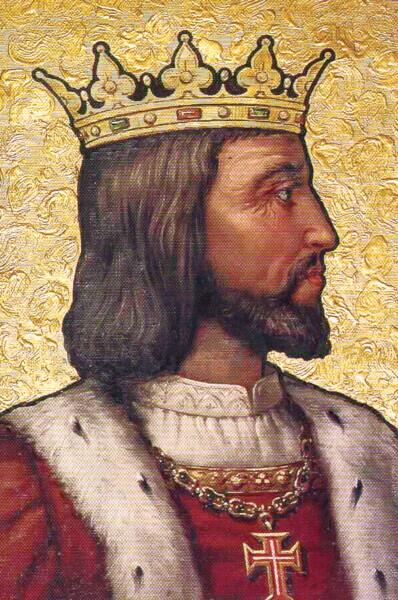
Portrait of Manuel I from the Sintra Palace Gallery
Manueline architecture conveys a sense of monumentality. The powerful, solid volumes of the buildings contrast with Moorish turrets, twisted columns, and portals and windows adorned with dense, intricate carving. T. Kaptereva noted that a characteristic feature of Manueline style is the contrast between the calm, strictly balanced masses of the building and its whimsical silhouette. With its non-European excess and dense ornamentation, Manueline decor sometimes evokes the art of India—a path the Portuguese charted in 1498.
The Symbol of Lisbon—Belém Tower, located at the mouth of the Tagus River, built between 1515–1520 by architect Francisco de Arruda.
I chose this topic because Manueline style is a rare instance where architectural decoration directly transforms a country’s historical experience into an artistic language. Usually, the Manueline style is discussed through monumental examples, but its unique character is best revealed through its motifs—the armillary sphere, ropes and anchor chains, shells and seaweed, botanical forms, the cross of the Order of Christ, and exotic elements from newly discovered lands. It is the ornament itself that demonstrates how maritime expansion, colonial wealth, and contact with unfamiliar cultures translate into visual imagery.
Characteristic ornament featuring the Cross of Christ (top) and poppy boxes (bottom).
For this reason, the work follows a structure moving from the general to the specific, and then to a synthesis: first, the concept of Manueline style and its historical and cultural context is defined; next, the characteristics of the style and its motifs, along with their symbolism, are analyzed; following this, the material is illustrated using well-known monuments—the Belém Tower, the Jerónimos Monastery, and the Christ Monastery in Tomar—culminating in the conclusion and bibliography. This progression allows us not merely to list decorative elements, but to transition from defining the style to analyzing its ornamental language and demonstrating how these features function in actual architecture.
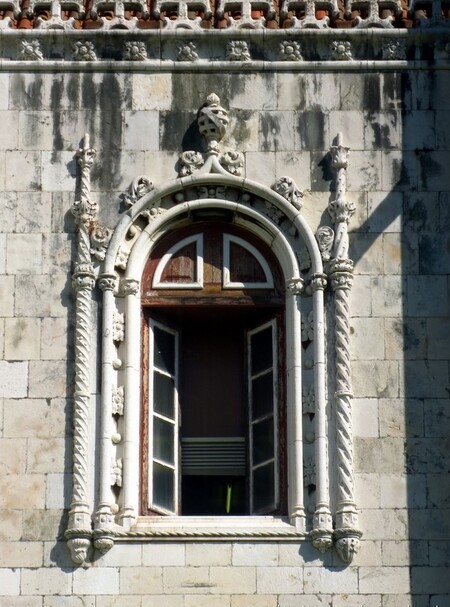
Royal Monastery Window in Tomar
The key question of the work can be formulated as follows: How do Manueline ornamental motifs shape the artistic uniqueness of the style, and how do they reflect the historical experience and cultural perceptions of Portugal during the Age of Great Discoveries? The answer is tied to the hypothesis that ornament in Manueline serves not only a decorative but also a semantically formative role; the combination of maritime, botanical, Christian, and exotic motifs creates a visual language that expresses the nation’s maritime power, religious ideology, and perception of an expanding world. By analyzing these motifs, it can be shown that Manueline is a cohesive artistic phenomenon, and its «excess» and decorative dynamism are systematically linked to the historical ascent of Portugal and its role in the Age of Discovery.
What is Manueline style?
Manueline is a distinct Portuguese architectural style that developed in the late 15th to early 16th century. It blends late Flamboyant Gothic, Renaissance features, Moorish-Mudéjar heritage, and motifs associated with the Age of Discovery. The style is named after King Manuel I, the Fortunate, during whose reign Portugal reached the zenith of its maritime power.
The Belém Tower is adorned with Crosses of the Order of Christ on its battlements and wrapped with carved «marine ropes.»
Mannerism combines Gothic elements, Moorish forms, Renaissance techniques, and exotic motifs. Some researchers suggest the influence of Indian art was also present. Essentially, this style conveys what a European felt upon first encountering a new, previously unknown world and unfamiliar lands. The closest parallel is Spanish Plateresque, particularly in its early stages. There, building ornamentation was also structured around a flat wall densely packed with details. However, the Portuguese variation proved richer and more dynamic: it features more imagery and leans more noticeably toward decoration and opulence.
Marine nodes on watchtowers
Tatiana Kaptereva, in her book «The Art of Portugal,» defines the Manueline style thus: «The tendency to evaluate Manueline art as a variation of late Gothic, which encountered the influence of Eastern and Renaissance forms within Portugal, confines its interpretation to the narrow scope of a stylistic phase. However, this art—which originated at the crest of a fundamental shift in national history—represents a more complex, dynamic unity between the departing old ways and what was forming in the life and culture of the people. While growing out of late Gothic, it simultaneously asserted something qualitatively new, belonging to the phenomena of the Renaissance era. The interaction of various artistic trends—sometimes in opposition, sometimes in mixture and fusion—lent this art, despite its distinct stylistic coherence, the capacity for dissimilar and original creative solutions.»
Jeronymus Monastery, Fragment
The name «Manueline» only appeared in the 19th century. The style was named after King Manuel I of Portugal, who was nicknamed the Fortunate: he ruled from 1495 to 1521, the most vibrant period in the country’s history. Following the first maritime expeditions of the 15th century, organized by Prince Henry the Navigator, the Age of Great Discoveries began. Portuguese possessions stretched from Brazil to India; colonial gold and spices enriched the nation, and construction flourished everywhere—on a massive scale and with unprecedented speed for that era. The spirit of ocean voyages fueled Portuguese art. Manueline is the style of victors, of brave pioneers who mastered the maritime element and reached previously unknown shores. New continents, their unfamiliar cultures, and strange flora brought astonishing motifs into architecture.
Style Characteristics
The dominant characteristic of Mannerism is the abundance of forms and a strong naturalist-symbolic interpretation of original and traditional themes. These motifs appear in buildings, tombs, or even in artworks. The window, in both religious and secular buildings, is one of the architectural elements where this style can be best observed.
Among the most common motifs in Manueline architecture is the armillary sphere, which John II gifted to his cousin and son-in-law, the future King Manuel I. Later, this sphere came to symbolize the divine preordination of his reign. This also includes the Cross of the Order of Christ. Alongside these motifs, there are naturalistic details—corals, seaweed, artichokes, and depictions of various animals—as well as fantastic imagery: the Ouroboros (a serpent eating its own tail, a symbol of the Universe where beginning and end meet), mermaids, gargoyles, dragons, and animals with open jaws consuming their own bodies.
Botanical Motifs in Portuguese Gothic. Church portal in Silves, Algarve Province. 1470
Maritime and naval themes are another characteristic feature of Manueline style. Initially, architects, and subsequently furniture designers, began incorporating decorative elements such as ropes, cables, anchors, as well as seashells, sea creatures, pearls, and seaweed.
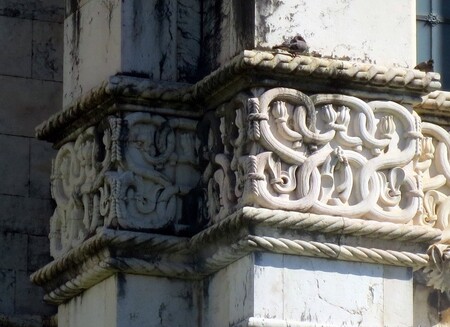
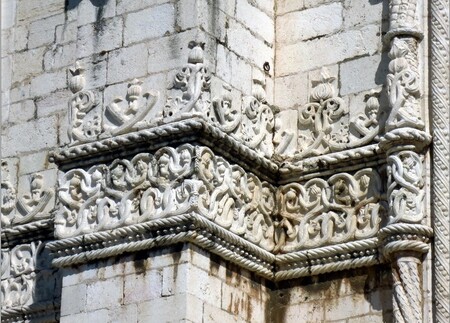
In the complex Manueline stone carvings, several groups of motifs are consistently featured:
— Nautical elements: armillary spheres (a navigational instrument and personal emblem of Manuel I, as well as a symbol of the cosmos), spheres, anchors, anchor chains, ropes, and cables;
— Maritime imagery: shells, pearls, and seaweed;
— Vegetal motifs: laurel branches, oak leaves and acorns, poppy pods, corn cobs, and thistles;
— Christian symbols: the Cross of the Order of Christ (the former Templar military-religious order, which played a vital role in funding the first expeditions); this cross adorned the sails of Portuguese ships;
— Motifs from newly discovered lands (for example, the pattern in the Cloister of the Jerónimos Monastery in Batalha, where Islamic filigree work influenced by Indian architecture can be seen);
— Columns carved to resemble twisted ropes;
— Semicircular arches instead of Gothic pointed arches in doorways and windows, sometimes composed of three or more convex curves.
These types of constructions are typically characterized by multiple columns, octagonal capitals, asymmetrical design, conical terminations, slanted dentils, and richly decorated portals featuring niches or canopies.