
From Sound to Image: Psychoacoustics and Visual Language in Animation
Contents
01 | Introduction: Relevance and Significance of the Work
02 | Case Studies 1–2: Sonic Aesthetics and Nostalgia in Studio Ghibli Films
03 | Case Studies 3–4: Comparative Analysis of Musical-Visual Emotion in Attack on Titan
04 | Conclusion: Summary of Results and Findings
01
Introduction—When Sound Shapes Image
In contemporary animation, sound and image do not merely complement each other—they exist in an indivisible unity, enhancing and extending one another. Music has long transcended the role of mere background; it has become an independent instrument that shapes our emotional state and directly influences the perception of space, time, and meaning on screen.In the realm of visual design, this raises a crucial question: how do acoustic phenomena—from harmonious chords to chaotic noise—find their graphic manifestation? How do they determine the color palette, the character of the lines, and the rhythm of the edit, becoming visible?This study is dedicated to analyzing psychoacoustic patterns through their visual expression. It is grounded in I. A. Aldoshina’s theory regarding critical auditory bands and the mechanisms of spectro-temporal sound analysis on the basilar membrane. As examples, we examine two poles of Japanese animation culture: the works of Studio Ghibli (composer Joe Hisaishi) and the series Attack on Titan (composers Hiroyuki Sawano and Linked Horizon).
The Sound of Serenity — Ghibli and the Visual Language of Harmony
The soundscape of Studio Ghibli films is built upon the principles of acoustic consonance, classical harmony, and natural «pink noise”—the sound of wind, rustling leaves, and lapping water. According to research by I. A. Aldoshina, when the frequency intervals between sonic components exceed the width of the critical band (which is only 24 on the basilar membrane), the auditory system perceives the sound as harmonious, stable, and safe. Such frequencies evoke a sense of security, deep relaxation, and warm nostalgia.
The visual language perfectly mirrors the soundscape: soft watercolor textures, smooth organic lines, diffused natural lighting, and a pastel color palette with low contrast. Together, the image and sound create a unified space of comfort in which the viewer feels protected.
The Sound of Tension — «Attack on Titan» and the Power of Dissonance
In contrast, the soundtrack to «Attack on Titan"—specifically the composition «Shinzou wo Sasageyo!"—relies on acoustic dissonance, sharp marching rhythms, expressive brass instrumentation, and masking low frequencies.
In psychoacoustics, dissonance arises when frequency components fall within 5% to 50% of the critical band width, reaching maximum discomfort at 25%. Such sounds activate the sympathetic nervous system, triggering a «fight-or-flight» response and establishing a persistent state of anxiety and internal tension.
The graphic equivalent of this state is harsh geometry, sharp contours, abrupt chiaroscuro, dynamic montage, and saturated, aggressive colors: deep red, black, and contrasting gold. Every visual technique intensifies the sense of danger, speed, and inevitable collision.
In Conclusion
Comparing these two approaches shows the main takeaway: sound is not merely heard—it shapes what we see and feel.
When acoustic harmony transitions into soft, pictorial forms, and acoustic conflict resolves into sharp, tense imagery, it becomes clear: music and visual art are a single language addressed to our consciousness through two channels of perception.
The main research question is: How can the objective patterns of psychoacoustics (I. A. Aldoshina’s critical band theory) be visualized using media design graphic elements?
Hypothesis
Synchronizing visual parameters (contrast, form, rhythm, and dynamics) with psychoacoustic zones of consonance and dissonance allows for the objectification of the auditory code’s perception and intensifies the viewer’s emotional response.
02
«Ghibli: Resonance and Nostalgia»
Sound architecture in Joe Hisaishi’s work functions not merely as musical accompaniment but as a creator of an emotional space that interacts organically and cohesively with the visual language of Studio Ghibli. The prominence of piano and acoustic string instruments in his compositions becomes a key element that shapes an atmosphere of memory and nostalgic longing for the past.
From a media design perspective, the sounds of acoustic instruments possess a proper periodic wave structure and are rich in natural overtones (Aldoshina, 1999, p. 6). Because of this, the auditory system processes the sound signals most naturally and comfortably (Aldoshina, 1999, p. 8). Combined with the carefully selected chords and harmonies of the piano, the sound avoids beating—a phenomenon that creates discomfort and interferes with critical bands of auditory perception (Aldoshina, 1999, pp. 20–21). Consequently, the listener’s nervous system instantly transitions into a state of calm and security.
When the soundscape is free from internal tension, it becomes the ideal environment for perceiving visual imagery: watercolor tones, natural light, and soft lines. This is not simply about creating entertaining content—it is intentional sensory design, which excludes aggressive frequencies, helping the listener reconnect with sincere, pure feelings deep within the soul.
Case Study 1 — Spirited Away
Гармония фортепиано и визуальная память (Nostalgia)
Visual Metaphors of Nature in Studio Ghibli Animation. A still from the video «Studio Ghibli Nature Loop | Studio Ghibli | HBO Max» (official Max channel, 2020, [Timestamp 12:57]).
The piano parts of Joe Hisaishi’s composition, «One Summer’s Day,» rely on pure intervals—octaves, fifths—which fall outside the range of critical listening bands. The non-linear relationship between sound frequency and perceived pitch (the mel scale) evokes a sense of nostalgia and emotional security in the viewer. The visual language of the shots is built upon the use of the horizon line, pastel blue tones, and minimalist composition, emphasizing the acoustic spatial quality of the sound.
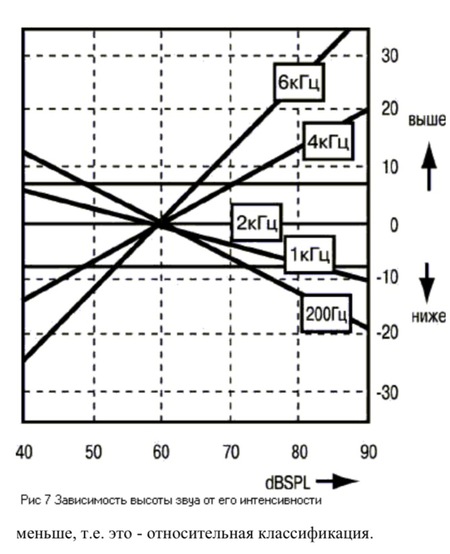
I. A. Aldoshina, «Fundamentals of Psychoacoustics, ” Figure 5, 1999.
The opening piano chord in the composition for the film «Spirited Away» doesn’t merely begin the narrative—it immerses the listener in the depths of memory and nostalgia for the past, owing to the perfect interplay between aesthetic principles of media design and the laws of sound perception.
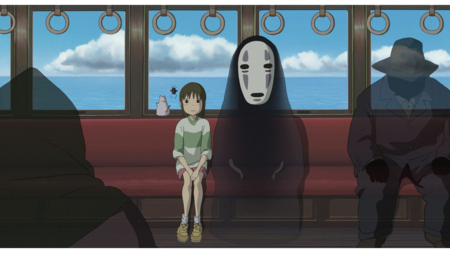
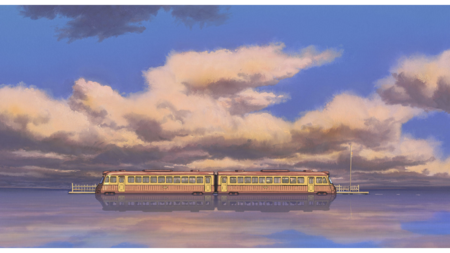
«Spirited Away» (directed by Hayao Miyazaki, 2001)
From the perspective of sonic architecture and brain function, evoking a nostalgic mood is achieved through the use of piano chords in the low and mid-frequency ranges—areas that are most natural and subtly perceived by humans. Research confirms that the relationship between the physical frequency of a sound (Hz) and the subjectively perceived pitch (Mel) is nonlinear (Aldoshina, 1999, p. 4). Within the range of fundamental musical frequencies, pitch perception changes smoothly and proportionally, without exceeding the zone below 5000 Hz—where the ratio begins to sharply distort (Aldoshina, 1999, p. 4, 8).
The visual metaphor of nature in Studio Ghibli animation. Frame from the video «Studio Ghibli Nature Loop | Studio Ghibli | HBO Max» (official Max channel, 2020, [Timestamp 13:26]).
This physiological state of the auditory system, exposed to soft, unstressed sound, allows the central nervous system to form a sensation of safety and calm (Aldoshina, 1999, pp. 13–14). This perfectly corresponds to the film’s color palette—shades of blue, natural greens, and the light of warm sunshine filling the frames.
Case Study 2
Акустический консонанс и розовый шум (Studio Ghibli)
1. «Howl’s Moving Castle» (directed by Hayao Miyazaki, 2004)/ 2. «My Neighbor Totoro» (directed by Hayao Miyazaki, 1988)
«My Neighbor Totoro»