In this study, I set out to delve into the realm of contemporary art, specifically focusing on works not recognized by any established contemporary art institution. The reflections began while examining Andrea Fraser’s diagram—one interpretation of how one might view the «world of art» from the perspective of its structure. The researcher offers a fairly clear delineation of institutions and their respective characteristics, prompting the question: «But what lies beyond these arbitrarily drawn boundaries?» It is here, naturally, that the concept of art that falls outside the criteria of any of the proposed categories arises.
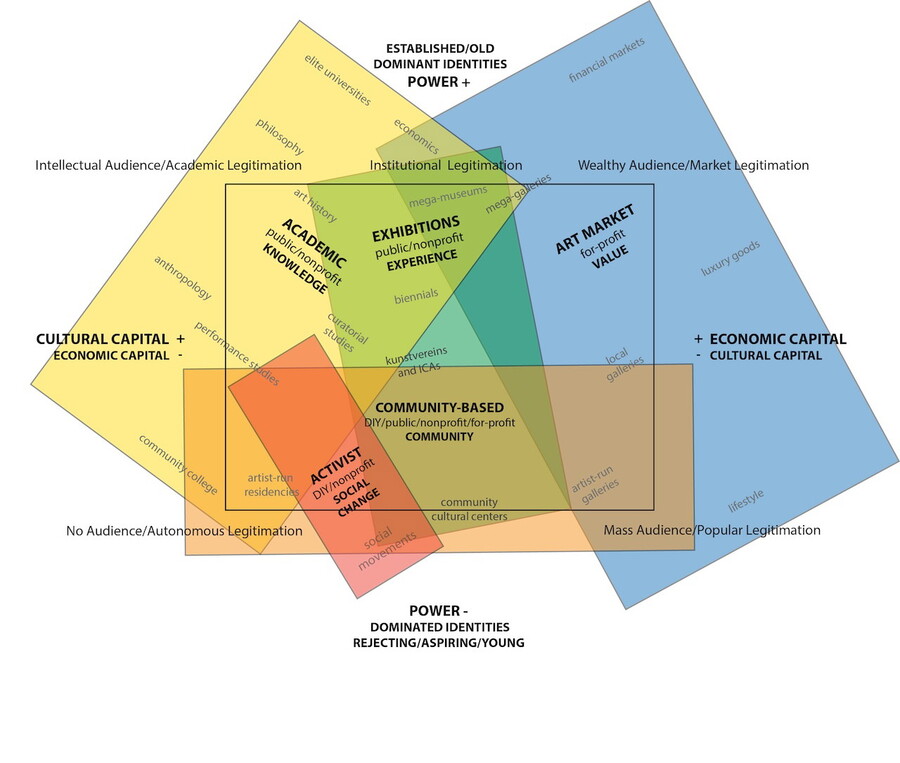
Andrea Fraser / «The Field of Contemporary Art: A Diagram» / 2024
Thus, my hypothesis is that works rejected by every community—be it a museum, a private gallery, or the art market—cannot truly be dismissed as peripheral or outside the main discourse of contemporary art. This supposition arises from the very existence of such works and their subsequent rejection for various reasons, which already signals their specific role and influence.
The central question guiding my research is:
What is the nature of outsider art and what role does it play in the contemporary world?
Next, it is necessary to define the subject of the research more precisely—rejected works. By this term, I mean both works that were denied exhibition and exhibitions that were approved but subsequently canceled, as well as works that were initially included in an exhibit but later removed. Furthermore, this includes cases where the process of legitimization generates dispute between the artist and the institution’s representative, which can escalate from a private conflict into an event with public resonance.
Thus, this research focuses on completed, exhibition-ready works that prove to be, to put it plainly, «inconvenient» for display in public spaces. Based on this definition, the following structure for the visual research is formed:
1. Introduction. Historical Context.
2. Before the Opening. Works not shown to the public.
3. After the Opening. Works removed from the active exhibition.
4. Artist’s Request. Works taken down at the artist’s own request.
5. Contested Situation. Society objects, but no removal takes place.
The study of this phenomenon focuses primarily on the circumstances of rejection and its consequences. The research examines the reasons why works are not selected for exhibition, how such decisions are made, what factors influence a work’s fate, and what happens to it after exclusion. Consequently, material selection considers the presence of detailed documentation regarding the specific situation, as well as information on both the official reasons for refusal and the subsequent fate of the work. Official statements from institutions, artists' comments, academic research, and press publications are used to immerse the study in its context. Visual material is selected based on the principle of providing the most detailed depiction of the works themselves and the exhibition space, should one have existed.