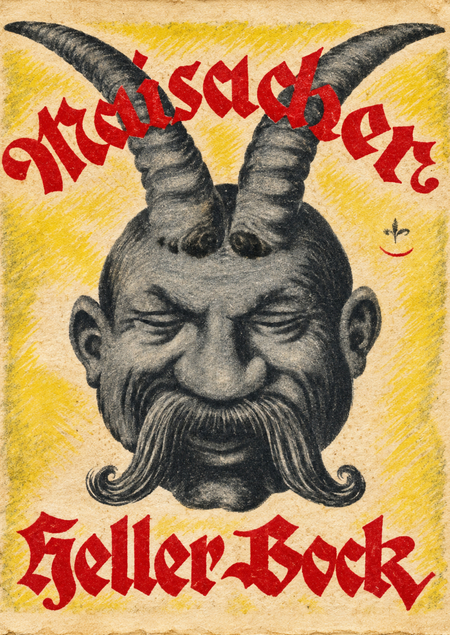
The visual research examines how the concepts of regional culture are conveyed through character imagery on Bavarian beer labels from 1948–1973, and how their graphic representation evolved during this period.
Concept
The character on a beer label can convey information about the beverage even before the name is read. The clothing, objects held, and familiar gestures connect the character to a specific environment. In this study, I am interested in what meanings arise from such details and how they help present the origin and character of the brand. To answer this question, I am examining characters on Bavarian beer labels from 1948–1973.
Topic Selection
The choice of Bavaria is connected to the special significance of brewing within the local culture and the use of regional imagery in product design. Robert Shea Terrell shows that in the post-war years, advertising campaigns emphasized the link between beer consumption and Bavarian culture [1, pp. 135–138].On the labels, this connection is expressed through character imagery, names, crests, and specific attributes. It is important for me to examine which of these elements evoke the local history and which primarily distinguish a particular brand or type of beverage.
Material Selection Principle
The visual material is primarily composed of labels from Bavarian breweries released within the selected period. The main selection criterion is the presence of a character that plays a significant role in the design. Both human figures and animals with recognizable traits or symbolic meaning are considered.
Historical works on brewing and advertising in Bavaria, along with materials about local traditions and the origin of the characters, are also used for research. Advertising posters, postcards, and photographs serve as supplementary materials to explain the cultural and historical context.
Principle of Categorization
The research begins with a section on the role of beer and advertising in post-war Bavaria.It then examines four character groups: monks and religious figures, the Munich child, female archetypes, and animals. For each group, I study the origin, significance, and characteristics of their depiction. Special attention is paid to clothing, gestures, objects, and inscriptions that help to understand the meaning of the image.
Navigation
(1) Bavarian Beer in Post-War Consumer Culture
(2) Character Types on Bavarian Beer Labels
[2.1] The Monk Archetype
[2.2] The Munich Child
[2.3] The Female Figure
[2.4] Animal Figurative Representation
Key Research Question and Hypothesis
What significance do the characters on Bavarian beer labels from 1948–1973 hold, and through what details are they connected to the local culture of the beverage?
The characters on Bavarian beer labels do more than just decorate the packaging; they help convey the history and origin of the drink.
(1) Bavarian Beer in Postwar Consumer Culture
«American Soldiers by the Hofbräuhaus Building in Munich.» May 1945. Unknown Artist
After World War II, Bavarian brewing found itself in a difficult position. Many production facilities were damaged, and shortages of grain and other resources limited beer output. For example, the Augustiner-Bräu brewery in Munich lost about 60% of its production capacity due to bombings.
Until September 1948, the production of standard-strength beer was prohibited because, amid food shortages, grain was primarily used for food production.
Even after the restrictions were lifted, breweries began gradually returning to former production volumes, although raw material supply problems persisted for several more years.
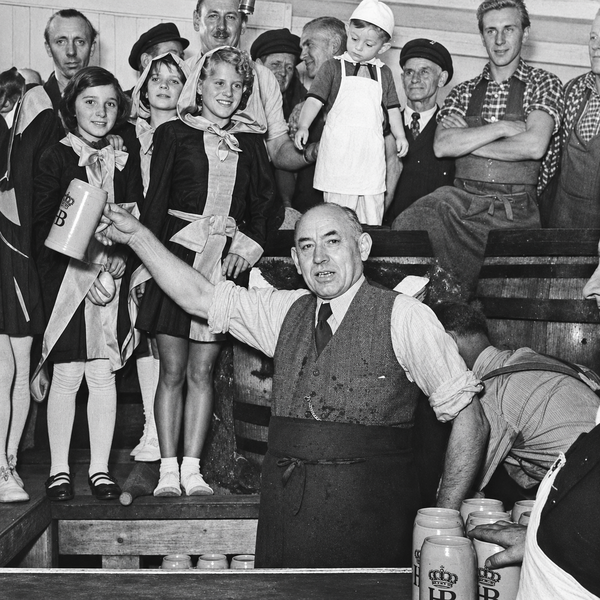
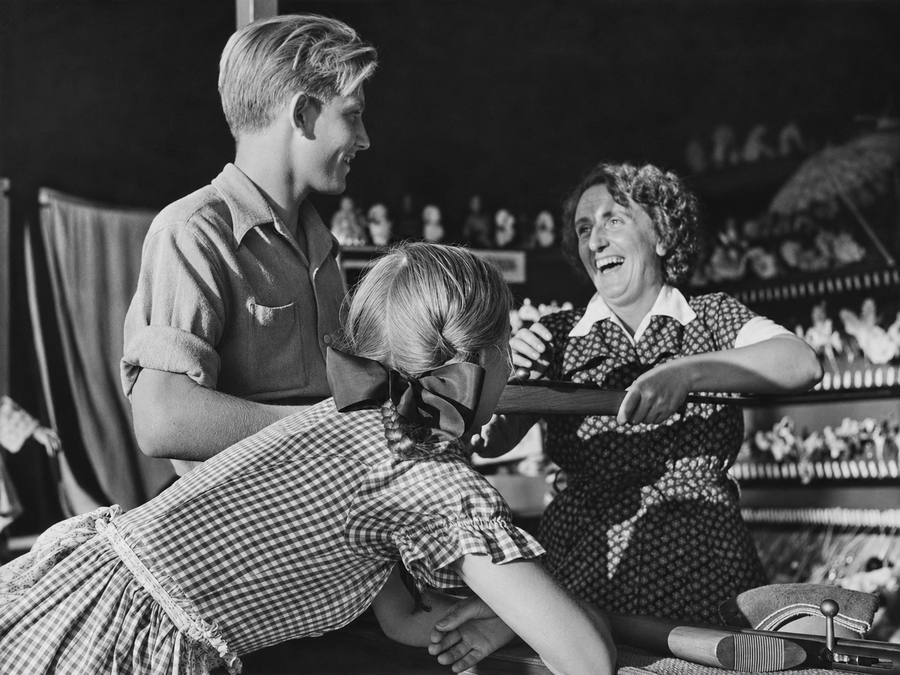
1. «Thomas Wimmer at the Oktoberfest Opening.» 1950. By Rudi Dix 2. «Oktoberfest in Munich.» 1950. By Herbert List
By the early 1950s, the situation began to improve. Tax reductions and the recovery of production allowed brewers to increase their output. Simultaneously, new beer varieties started appearing on the market. For instance, in 1950, Augustiner-Bräu introduced the strong beer Maximator, and in 1953, Wiesn-Edelstoff, intended for Oktoberfest.
The production recovery was accompanied by the return of city festivals. In 1949, after the wartime break, Oktoberfest was held again, and in 1950, the Mayor of Munich, Thomas Wimmer, officially inaugurated the celebration for the first time by pouring beer from the first barrel. Brewing once again held a significant place in civic life and local culture.
«Löwenbräu Munich.» 1955. Magazine advertisement. Löwenbräu Brewery, Munich.
In the 1950s and 1960s, not only did production volumes change, but so did consumer habits. Beer was increasingly purchased in bottles for home consumption rather than just ordered at pubs.In 1951, bottled beer surpassed draught beer in sales volume for the first time, capturing 52% of the Bavarian market. By 1957, its share reached 67%, and by the early 1960s, it was approximately 75% across West Germany [1, pp. 154–155].The proliferation of bottled beer increased the importance of the label. The consumer needed to distinguish products from various breweries and recognize a familiar brand among others.
1. «Francisaner. Munich Export Beer.» 1961. 2. «Munich Child. Malt Beer.» 1960s
The design addressed several objectives. The label communicated information about the product, helped distinguish it from competitors, or indicated the beer’s origin. Some producers incorporated characters connected to the brewery’s history, while others appealed to more general traditional symbols.
For instance, in the first case, the image of a monk is linked to the brewery’s history. In the second, the Münchner Kindl is used—a traditional symbol of the city depicted in black monastic robes with gold detailing. This image traces back to the Munich city coat of arms and underscores the beer’s local provenance.
«They Drink Beer in Bavaria.» 1952. By Max Blechacher
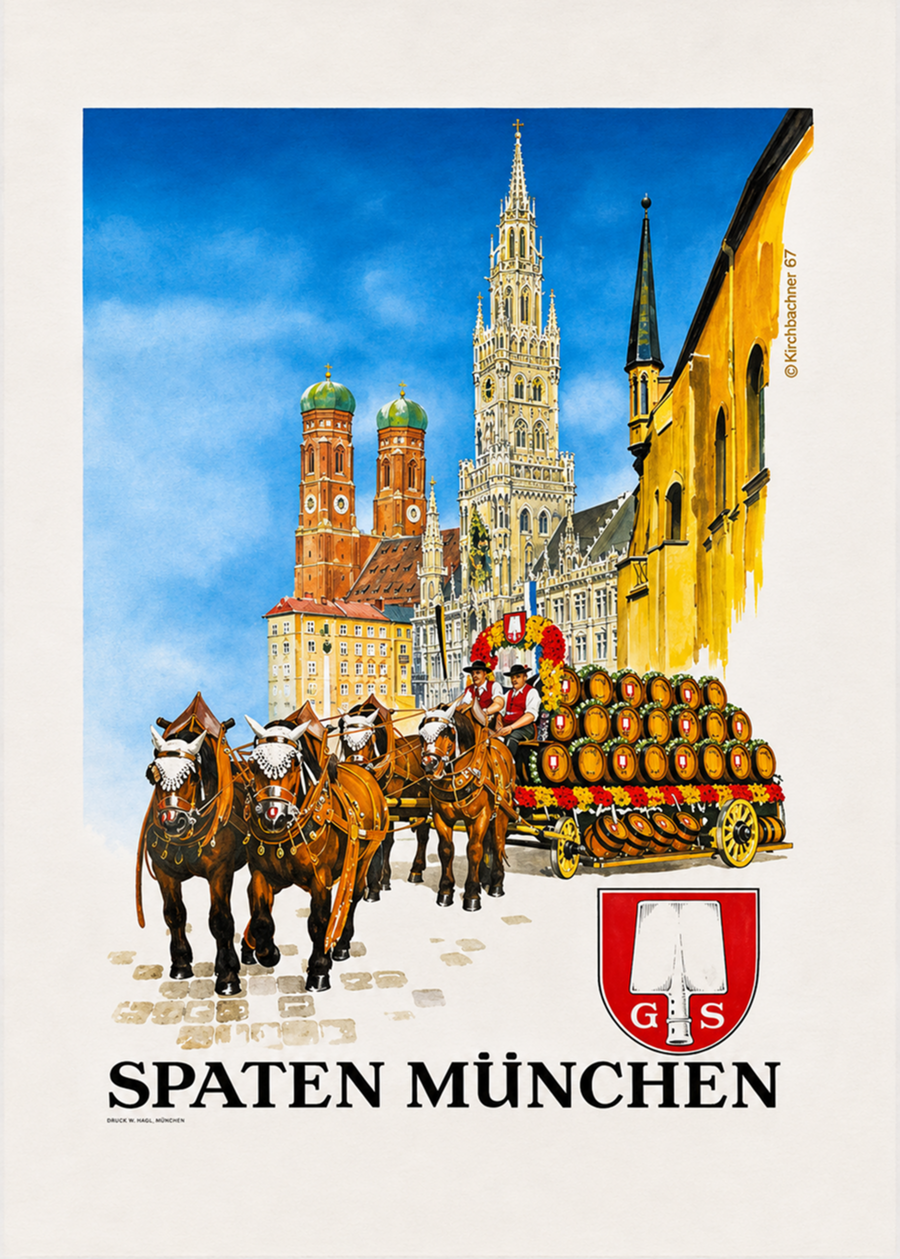
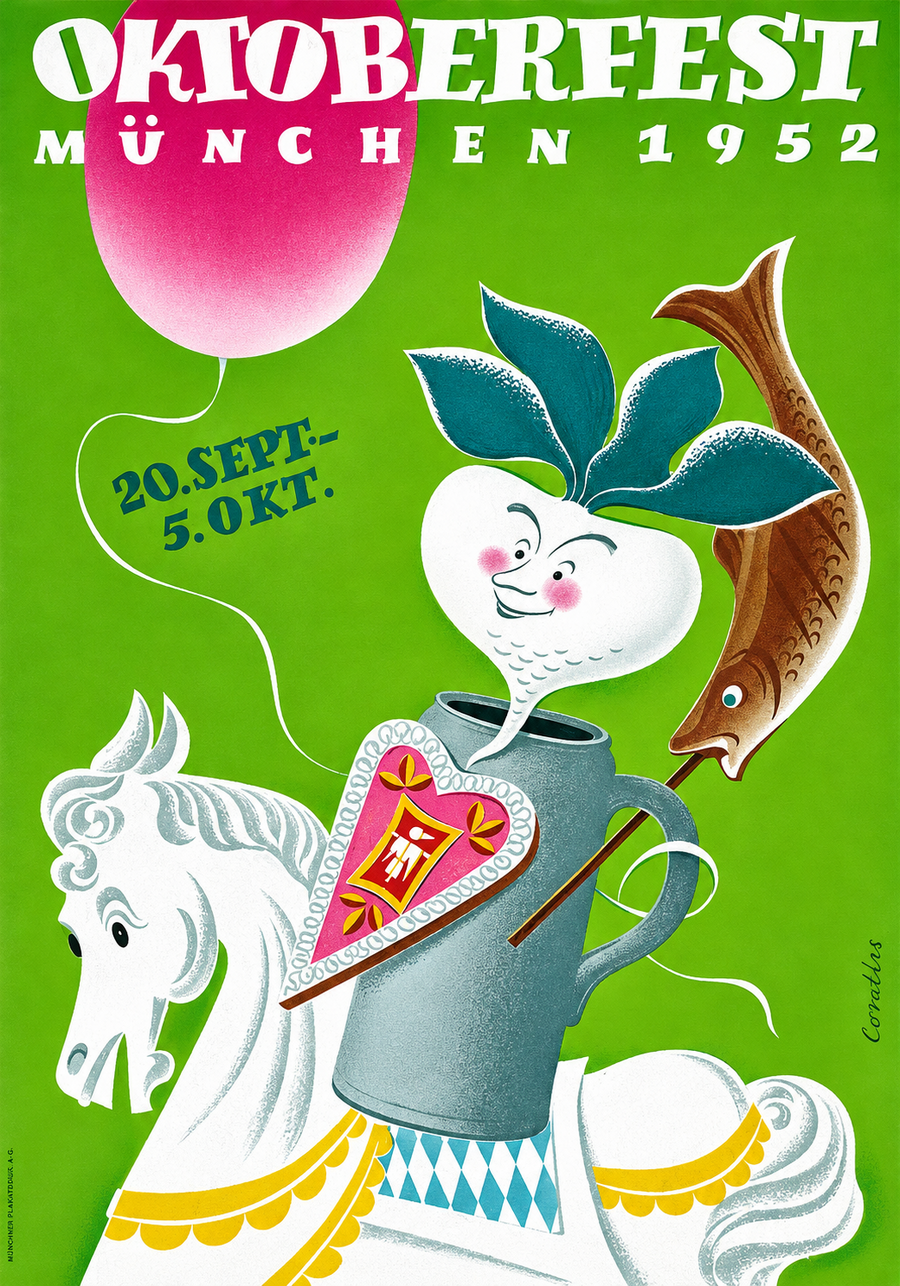
1. «Spaten. Munich.» 1967. Artist E. Tashner 2. «Oktoberfest. Munich.» 1952. Artist Eugène M. Gordy
In the early 1950s, German brewers began to utilize joint advertising more actively. An example was the campaign «In Bayern trinkt man Bier» («In Bavaria, one drinks beer»), developed by Munich graphic designer Max Bletschacher in 1952. The Bavarian Brewers Association released 60,000 posters distributed among manufacturers. In 1953, a large banner bearing the same slogan was displayed at Munich Central Station [1, pp. 135–138].
This type of advertising linked beer consumption with the image of Bavaria. Regional origin became part of the product’s identity, which was also evident in the design of individual brands: breweries referenced local landmarks, coats of arms, traditional costumes, and recognizable characters.
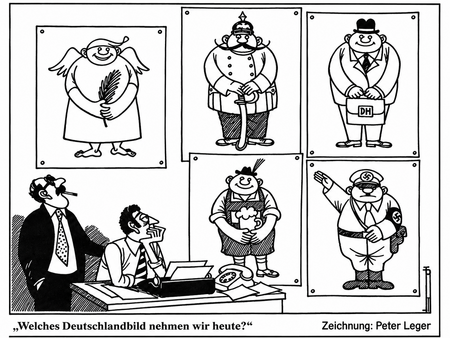
Over time, the Bavarian in traditional attire holding a mug of beer became one of the recognizable archetypes not just of Bavaria, but of Germany as a whole. This is clearly evident in Peter Leger’s caricature, «Which image of Germany will we choose today?» published in 1987, where two journalists choose from five stereotypical characters representing different facets of German history and culture. Among them is the Bavarian with a beer mug, who stands alongside the Prussian military man, a financier, and other symbolic figures [1, pp. 1–2].
(2) Character Types on Bavarian Beer Labels
Bavarian beer labels feature both characters tied to the specific brewery’s history and imagery common in the regional culture. Among these, four main groups can be distinguished: the monk, the Munich child, the female figure, and the animal figure. However, the character’s meaning also depends on its depiction—the same figure can look different depending on the context. Therefore, here the character types are examined alongside their graphic representation.
The Monk’s Image
One of the main characters encountered in traditional Bavarian etiquette is the monk. His image is tied to the history of monastic brewing: for centuries, monks brewed beer both for personal consumption and for sale (the first documented mention of beer production by monks dates back to 1634; they would distribute surpluses to the poor or sell them).It played a special role during religious fasts, when dietary restrictions promoted the consumption of strong and high-calorie varieties. Historian Robert Shi Terrell notes that the emergence of strong fast beer and its consumption during Lent [1, p. 94] is directly linked to this tradition.