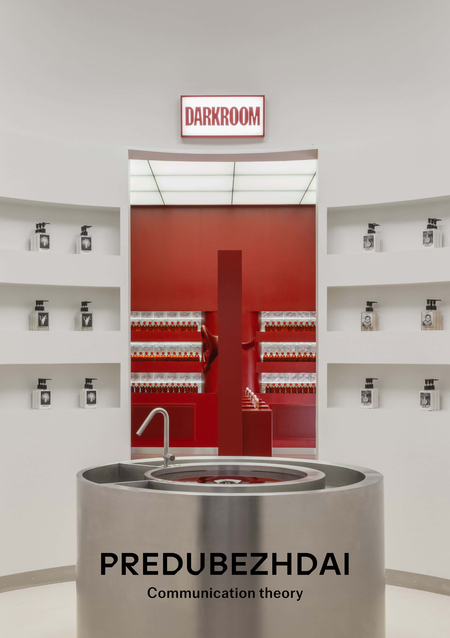
Introduction
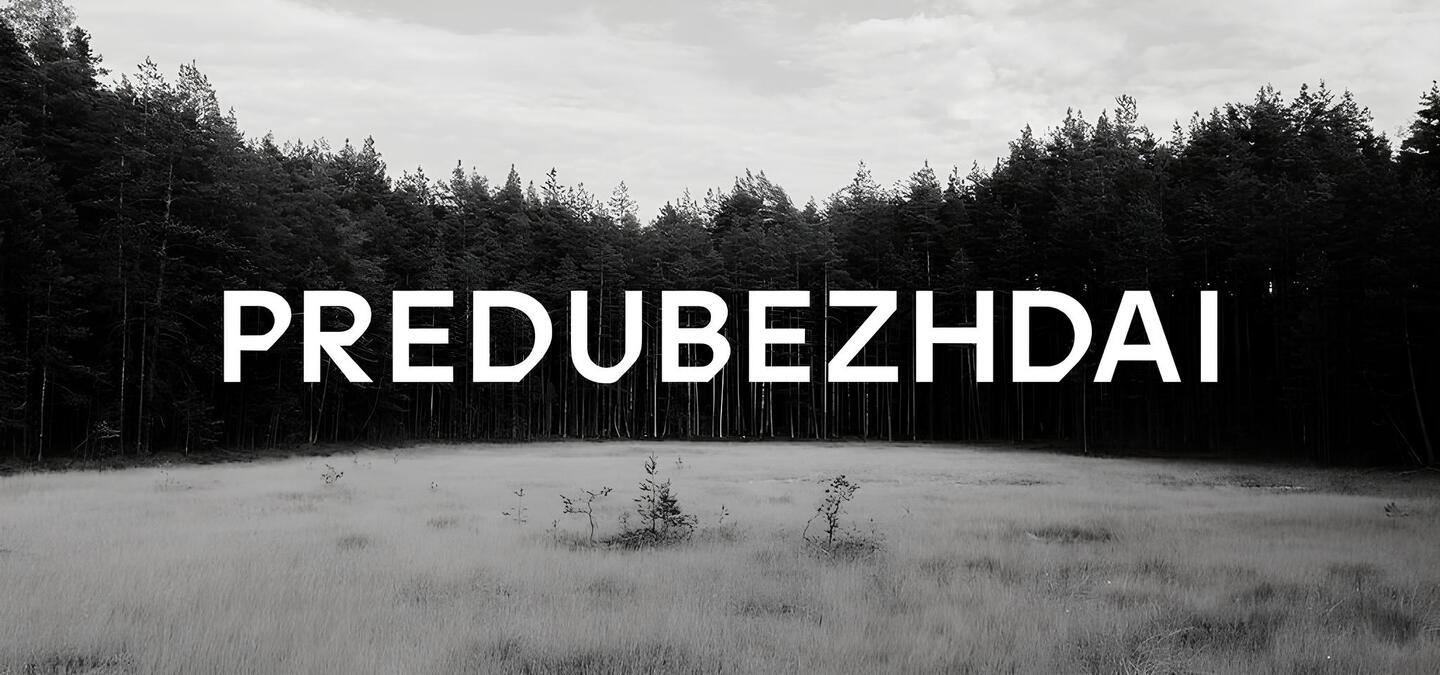
PREDUBEZHDAI, Advertising campaign, 2026
Predubezhdai (Предубеждай) — perfume & home/body fragrance brand by Anastasia Mironova
Brand
Predubezhdai is a Russian niche fragrance and lifestyle brand founded by Anastasia Mironova (also the founder of the IRNBY fitness/fashion brand). The name is a play on the Russian word предубеждение («prejudice/preconception») reworked into an imperative verb — roughly «pre-judge» / «form your own bias.» It frames the brand as something you are invited to feel about before you rationalize.
The product range is built around perfume, home fragrance, and face/body/hair care, organized not as a conventional catalog but as a set of themed collections that map onto stages of a human life: DETSTVO (childhood), PREKRASNOE DALYOKO (the beautiful far-away / first disappointments), VAM I NE SNILOS (first love), SUSPIRIA (self-awareness), and KATARSIS (release/catharsis). Individual products carry literary, folkloric, or surreal names (TRAVA, GOY ESI, SUSPIRIA).


PREDUBEZHDAI, Advertising campaign, 2026
Positioning
Predubezhdai positions itself as a memory- and emotion-driven niche brand — a «cozy cocoon of memories.» Where its sibling brand IRNBY is about drive, movement, and the future-facing body, Predubezhdai is deliberately inward and backward-looking: nostalgia, childhood, Soviet/post-Soviet cultural texture, and folklore.
Crucially, the brand sells context, not product. Fragrance is the vehicle; the actual offer is an emotional and cultural experience. It distinguishes itself from «impersonal European standards» of perfumery by leaning hard into specifically Russian language, references, and folk imagery (Cyrillic typography, archaic words like goy esi, old photographs, surreal Soviet-childhood aesthetics). This makes its positioning both niche (small, design-led, high-concept) and culturally local (it would be hard to translate or globalize without losing its meaning).
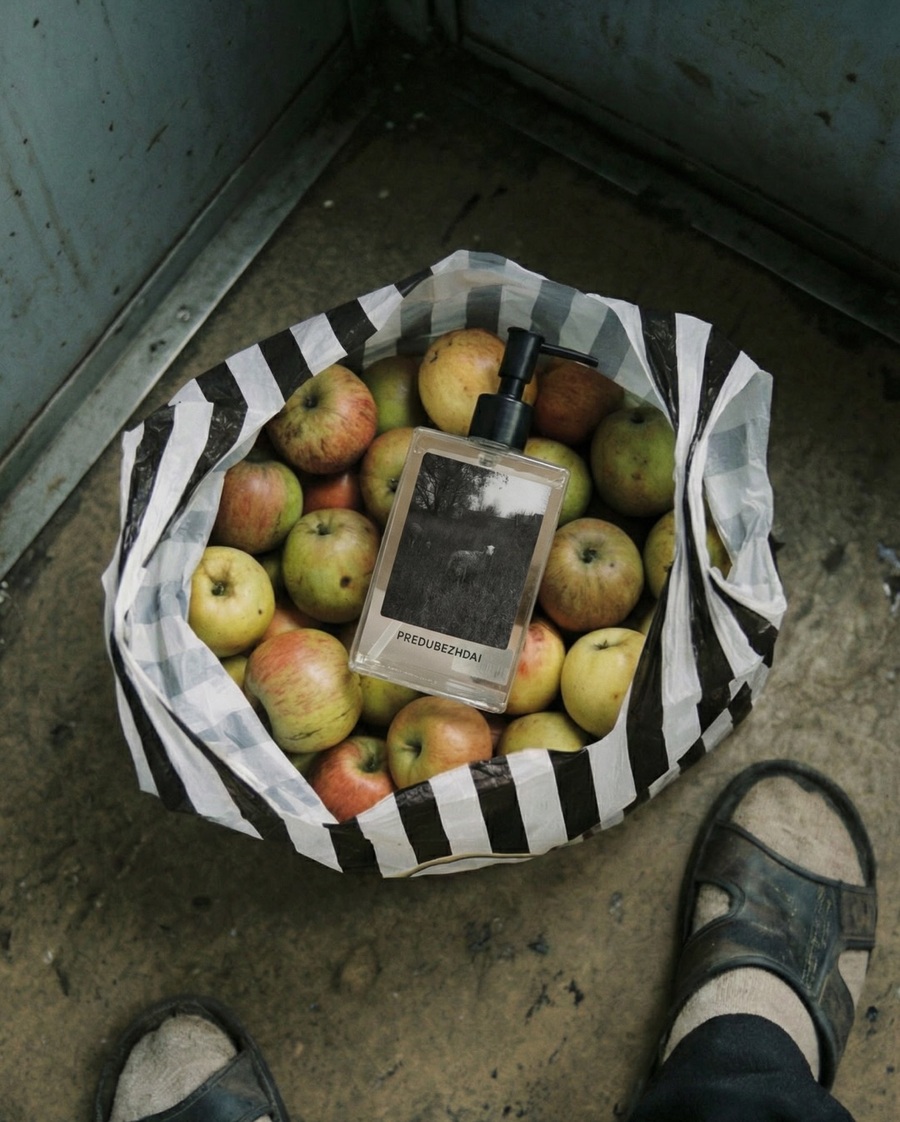

PREDUBEZHDAI, Advertising campaign, 2026
Values
The stated philosophy is captured in the brand’s own line: «To live means to preserve an unfeigned childlike interest and love for the surrounding world.» From the gathered material, the core values are:
- Emotional authenticity — feelings, memory, and sincerity over function or status.
- Nostalgia as cultural identity — childhood, the post-Soviet everyday, and shared generational memory treated as raw material.
- Russian cultural rootedness — folklore, Cyrillic, archaic vocabulary, and local references positioned against generic Western luxury codes.
- Materializing the intangible — the recurring conceit of turning emotions and memories into physical, ownable objects.
- Craft and concept — products framed as artistic/literary objects, not commodities.
Target Audience
The audience is best understood as culturally fluent, emotionally motivated Russian consumers, roughly 18–34 (Gen Y into Gen Z) — the demographic for whom nostalgia marketing reliably works and who hold enough of a shared post-Soviet/1990s–2000s childhood reference set to decode the brand’s signals.
More precisely, the brand speaks to:
- People who buy meaning and identity, not just scent — design-aware, online, niche-fragrance and «concept brand» consumers.
- An audience that responds to emotional and aesthetic cues(nostalgia, melancholy, surrealism) rather than ingredient lists or performance claims.
- Existing IRNBY / Anastasia Mironova followers — a built-in, design-literate community.
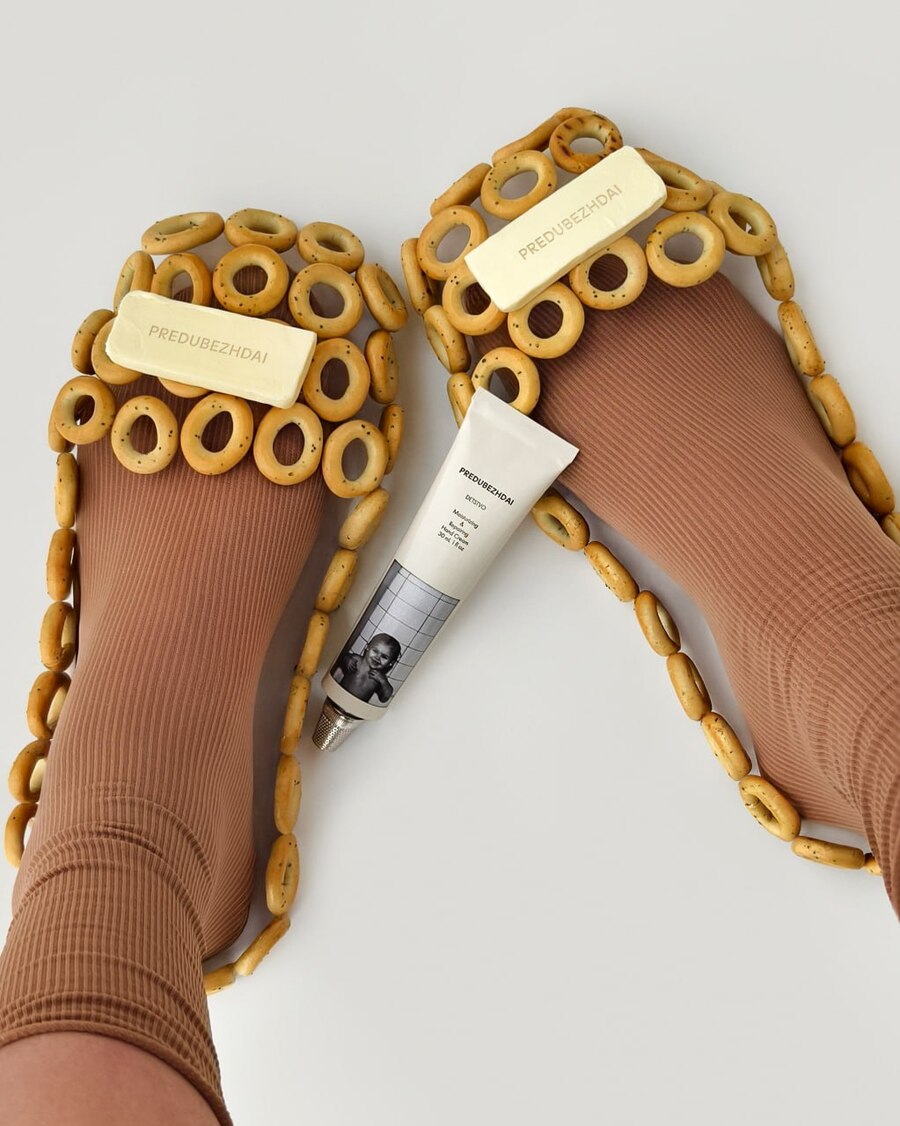
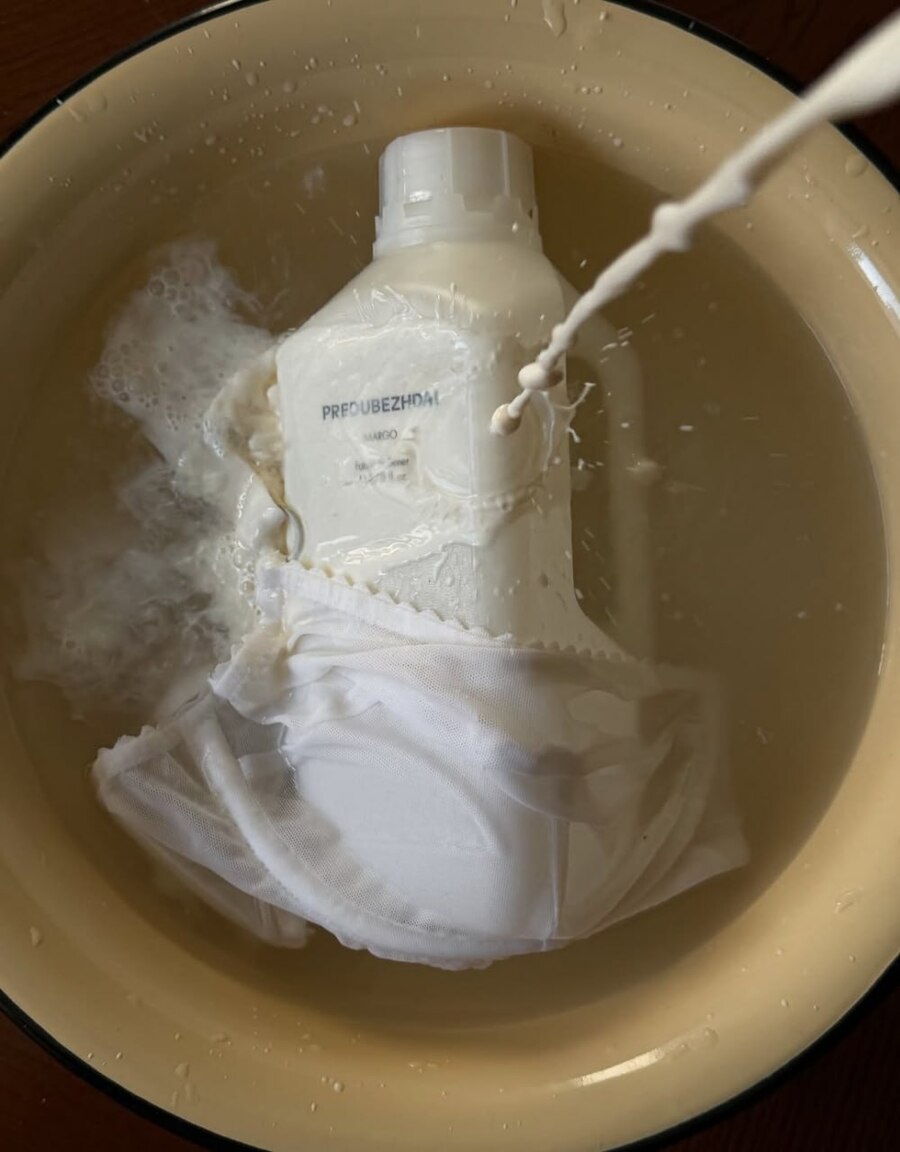
PREDUBEZHDAI, Visual code

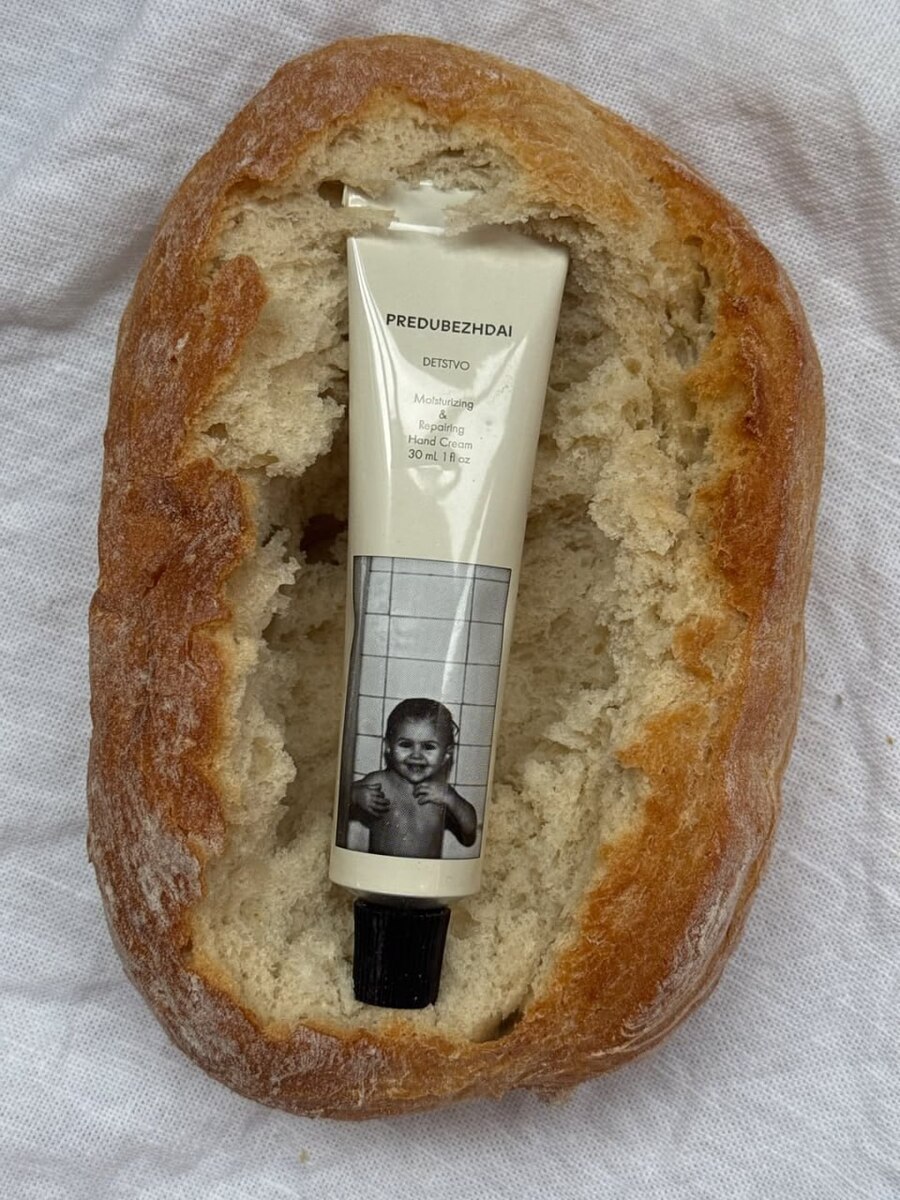
PREDUBEZHDAI, Visual code
Tone of Voice
The tone is literary, nostalgic, intimate, and playfully surreal. Copy reads like prose poetry or a diary entry rather than marketing — long, sensory, melancholic sentences («a deep source of rare knowledge, the most intimate, encoded into the cultural code»). It addresses the reader personally and tenderly (e.g. framing an offer as «a love letter for you»).
At the same time the brand is witty and self-aware, especially on Telegram: it uses wordplay-based promo codes (e.g. ВУАЛЯ — both «voilà» and «veil» — for a discount on veils), surreal «found footage"/backrooms-style nostalgic horror posts, and ironic Soviet-broadcast framings («СЕЛЬСКИЙ ЧАС» / «the rural hour»). The register slides between sincere tenderness and knowing irony, which is exactly the blend that lands with a young, online, nostalgia-literate audience.
Visual Identity
Visual identity is central to Predubezhdai and is the richest seam for later semiotic analysis. Recurring visual signs:
- Cyrillic-forward typography and archaic Russian wording — a deliberate marker of cultural locality.
- Vintage / found photography and a faded, analog, «old album» aesthetic evoking late-Soviet and 1990s childhood.
- Surreal and uncanny imagery — dreamlike, backrooms-style, nostalgic-horror compositions that make memory feel strange and immersive.
- Folkloric and literary references (e.g. goy esi, SUSPIRIA) used as both product names and visual motifs.
- Life-stage collection system as a structural visual device — the catalog itself is an emotional map rather than a product grid.
Every visual choice encodes the same message: this is memory and feeling made physical. That tight coupling of sign and meaning is what makes the brand a strong candidate for Semiotic Theory and for the peripheral-route reading of ELM.
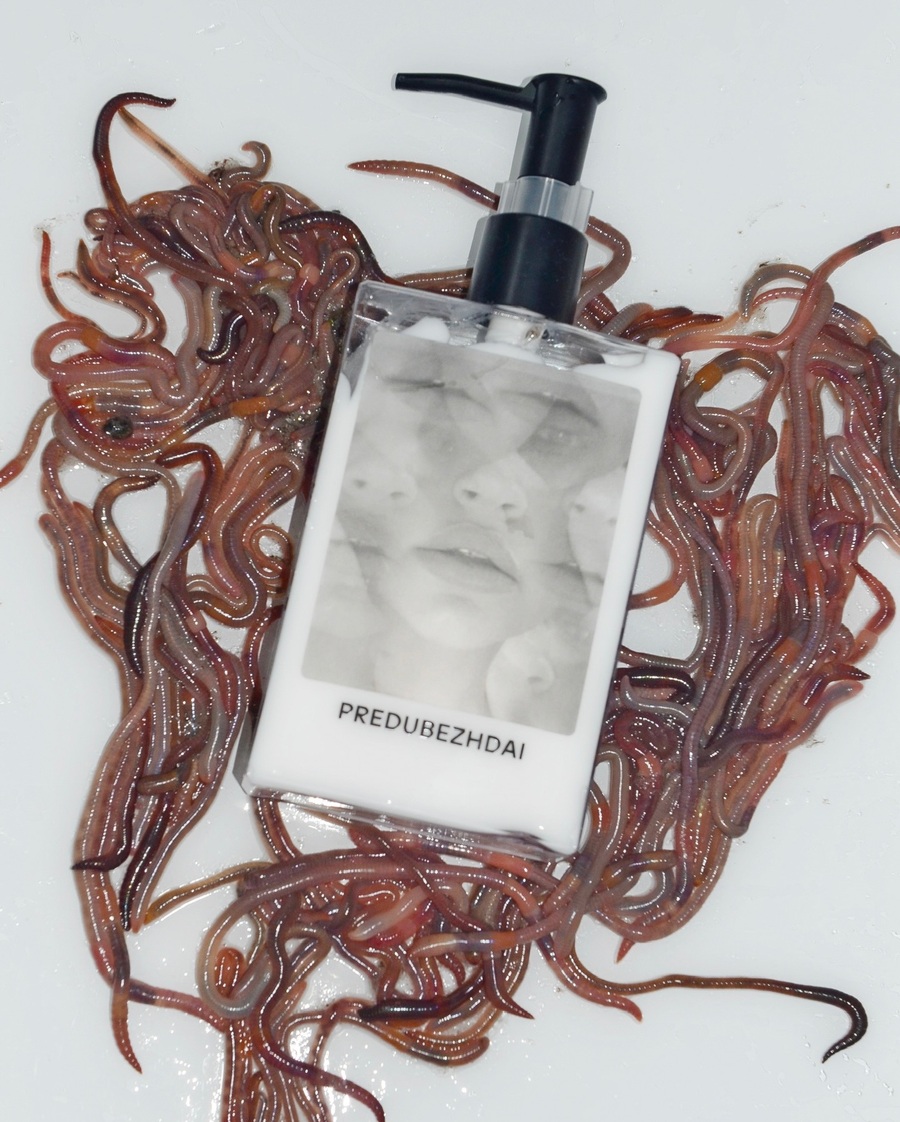
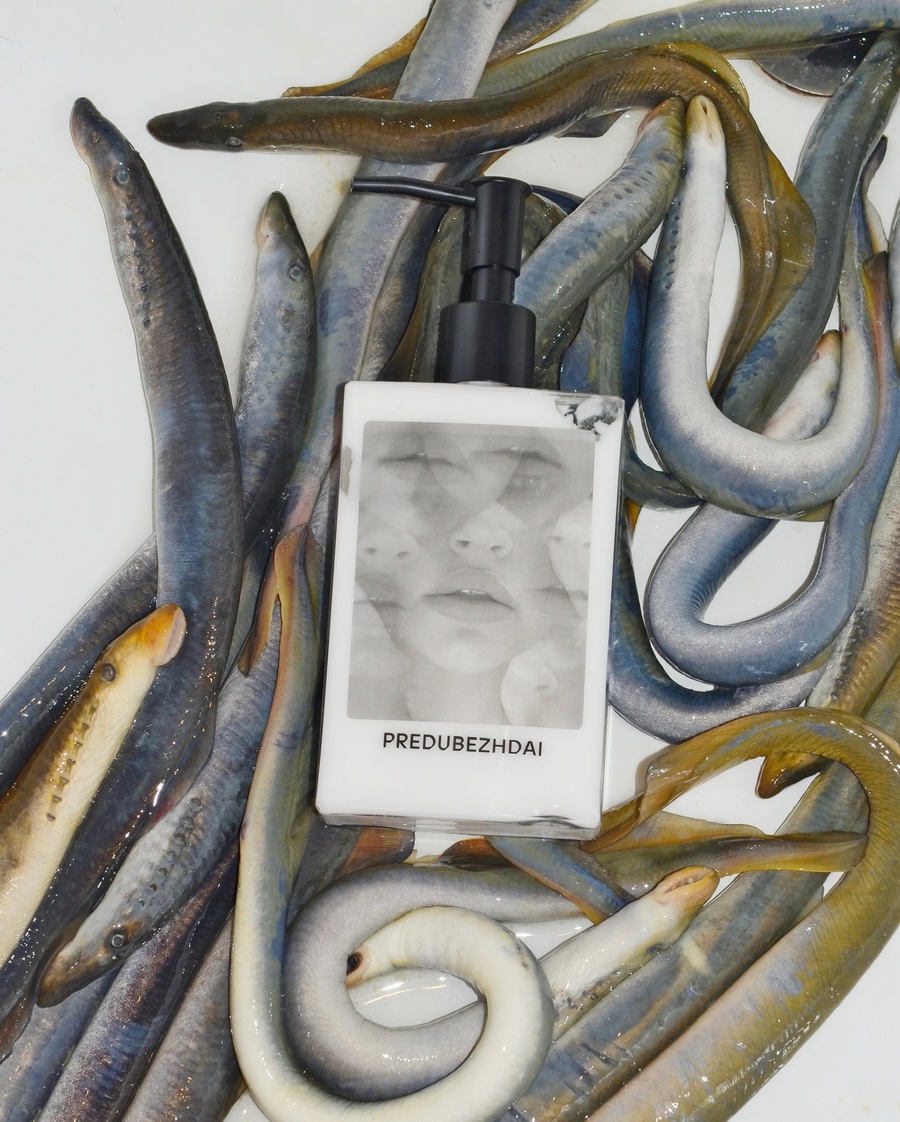
PREDUBEZHDAI, Provocative soap advertising campaign, 2026
Communication Channels
The channel mix at a glance
Predubezhdai runs a small, tightly curated set of channels rather than trying to be everywhere. Communication concentrates on three digital touchpoints — Instagram, Telegram, and the website-store — backed by a handful of physical stores and amplified by the founder’s own large following. The striking thing is the consistency: each channel is treated like a different room of the same nostalgic house, but the emotional, image-led voice never changes from room to room. What does change is the job each room does — and, crucially, how much it lets the audience answer back.
Instagram* (@predubezhdai)
Instagram* is the flagship and the brand’s main public face, with around 259K followers and a display name — «тебе не понравится» («you won’t like it») — that’s already ironic and perfectly on-tone. The content is product photography, mood reels, and nostalgic or surreal imagery, captioned in the brand’s literary voice. On paper the channel is two-way: comments and DMs are open. In practice it functions mostly as a broadcast stage for setting a mood — and whether the brand actually replies in those comments is precisely what we’ll put to the test under Dialogic Theory. For the analysis, this is also the single richest source of visual signs (Semiotics) and of peripheral cues like aesthetics and nostalgia (the peripheral route of ELM).*The activities of Meta and its affiliated social networks, Instagram and Facebook, have been deemed extremist and banned in Russia.
PREDUBEZHDAI, Brand page on Instagram
Website & online store
The website is the conversion hub — but it’s written like fiction, not a shop. This is where the collections mapped to life stages live (DETSTVO, PREKRASNOE DALYOKO, VAM I NE SNILOS, SUSPIRIA, KATARSIS), alongside poetic product descriptions, playful commerce copy («a love letter for you,» welcome bonuses), and the actual checkout. Communication is one-way, but it’s also where the brand’s useful information sits — the practical, utilitarian layer of find-it, understand-it, buy-it. In theory terms, the site is the home of the central route of ELM (real product information and a usable purchase path) and of the structural «collection map» sign for Semiotics — the one channel where the brand asks you to think and decide rather than simply feel.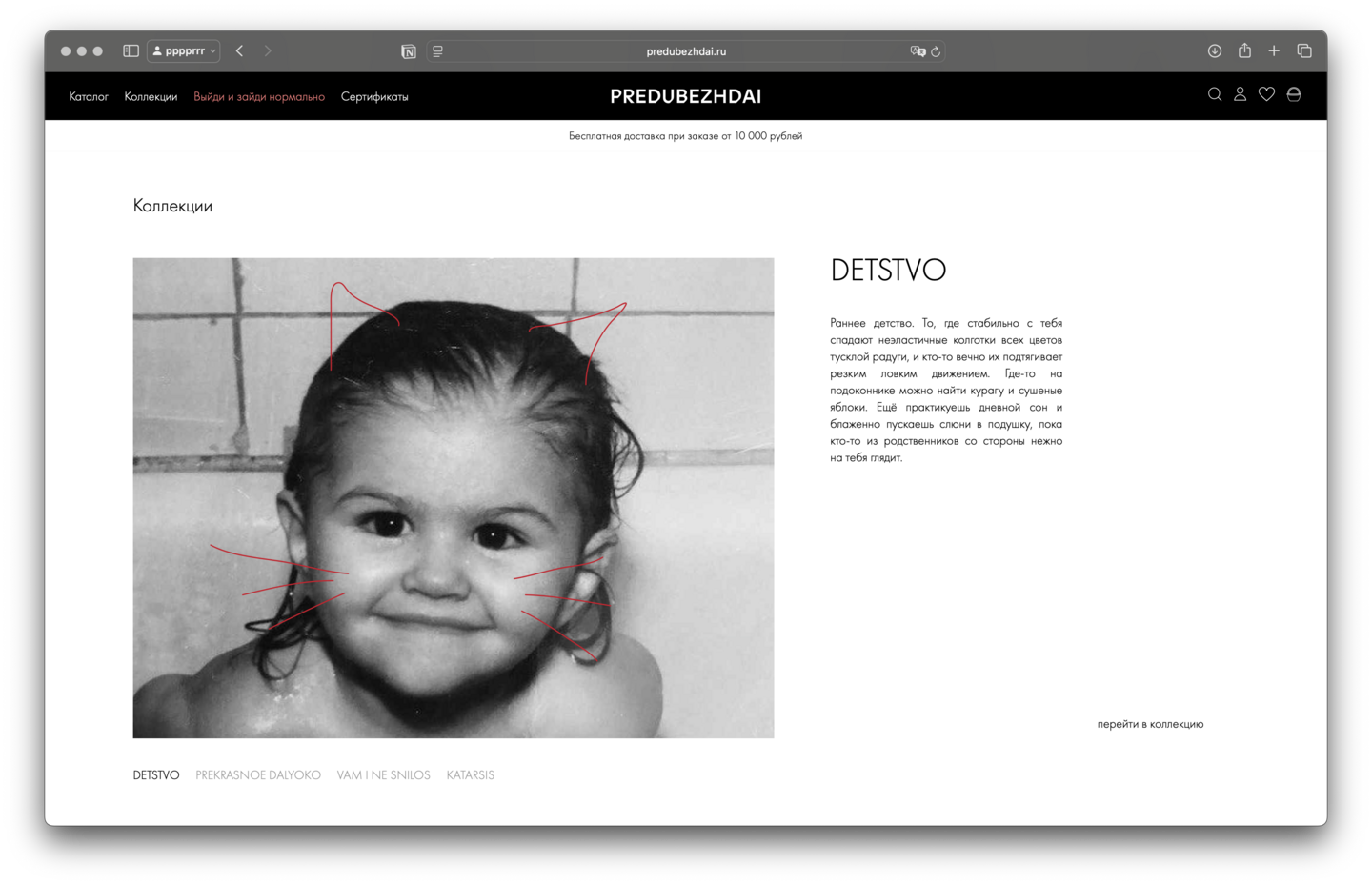
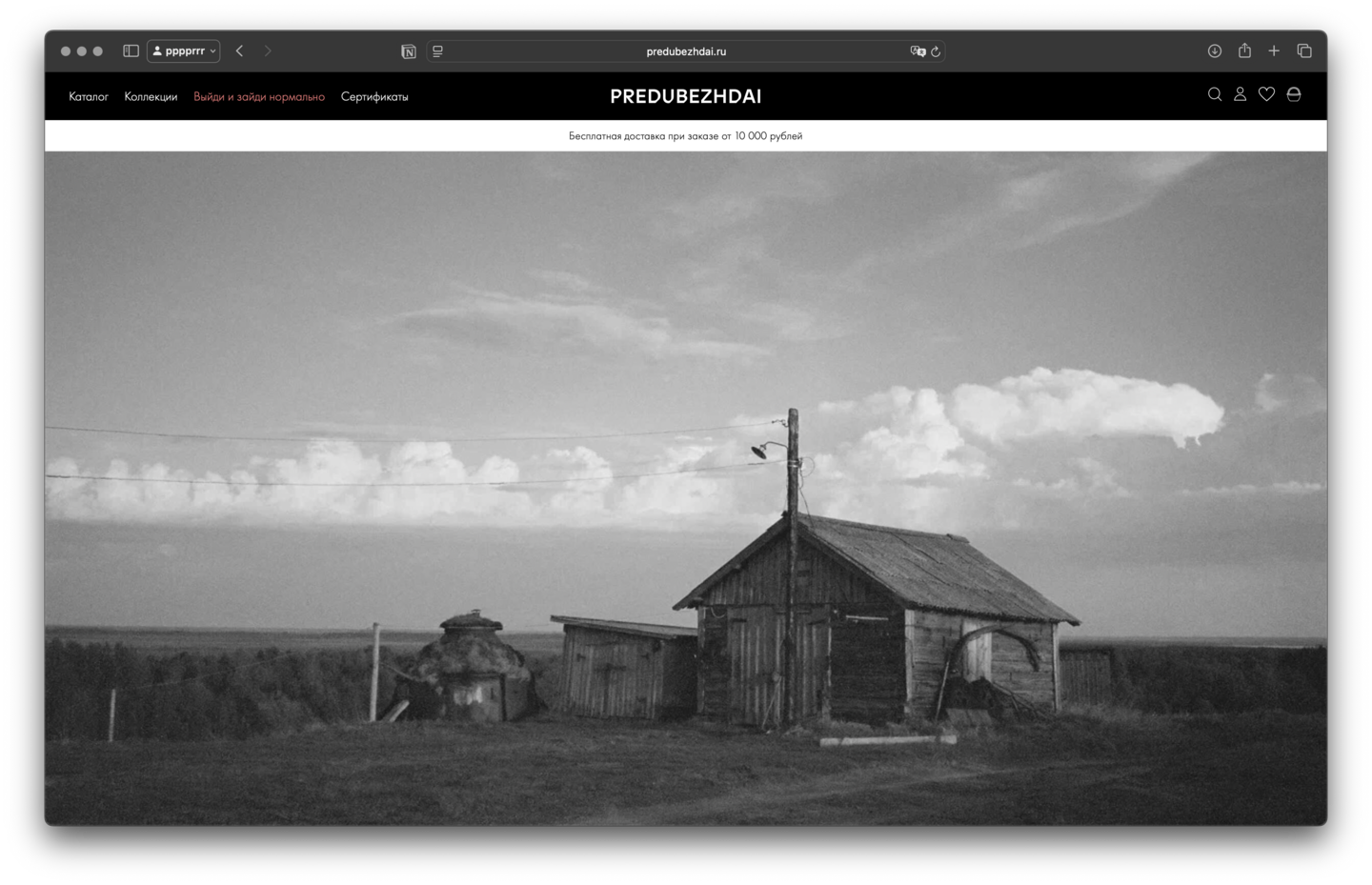
PREDUBEZDAI, Brand website
Physical retail (Moscow & St. Petersburg)
The brand also exists offline, in three stores — Bolshaya Nikitskaya 17 and Chistoprudny 21 in Moscow, and Kirochnaya 3A in St. Petersburg. Their role is a multi-sensory extension of the nostalgic world: smell, touch, and interior design doing what a screen can’t. And of all the touchpoints, this is the most genuinely two-way and embodied — a real exchange between staff and customer in real time. For the analysis it’s a useful reminder that the «memory cocoon» is built in physical space too, not just online, and it gives us a sharp contrast point for the conclusions: the brand is most truly dialogic exactly where it’s least scalable.

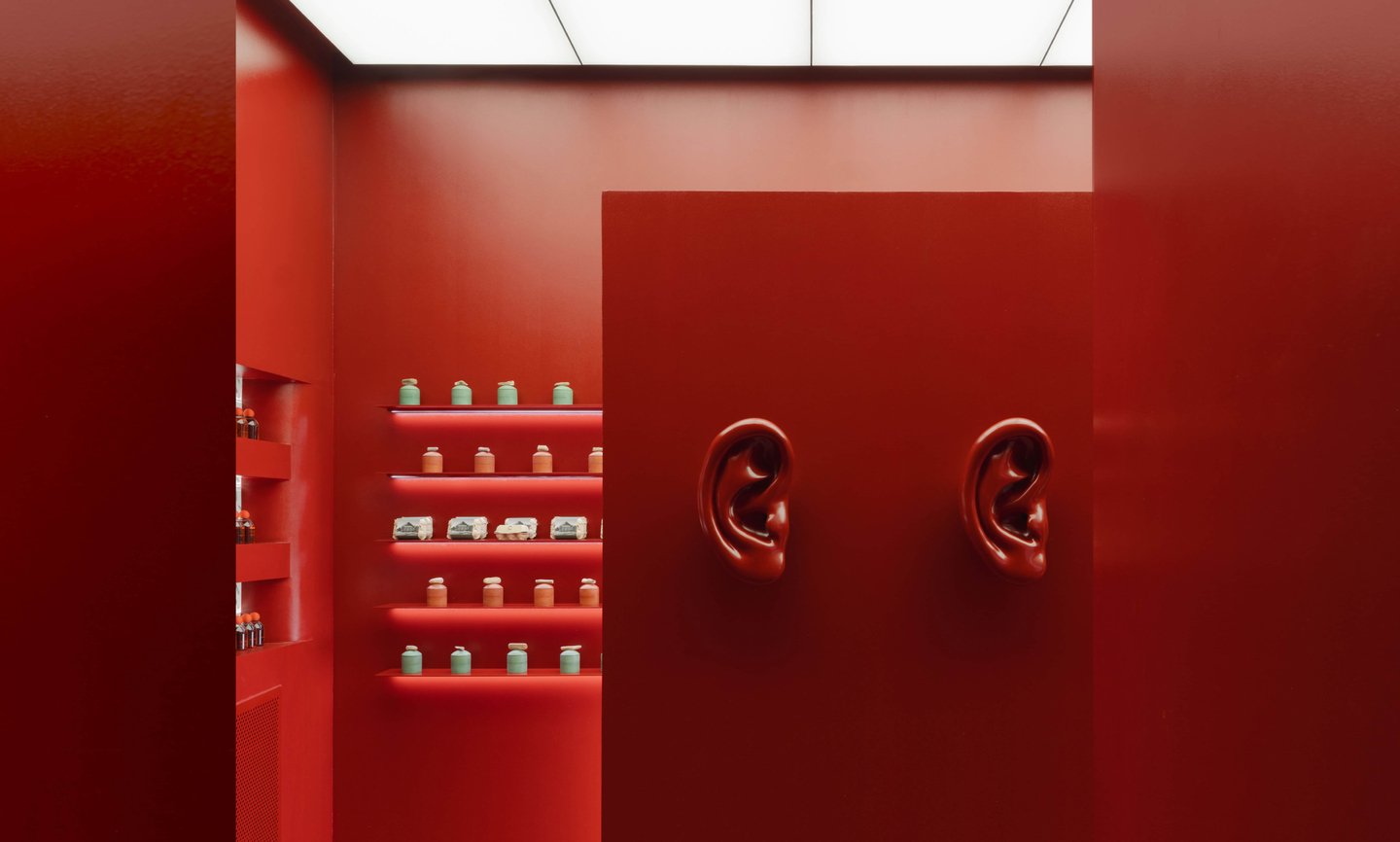

PREDUBEZHDAI, Physical retail, Moscow
The founder’s channels (Anastasia Mironova)
Finally, Mironova herself — a major blogger and IRNBY’s CEO — functions as a halo and a traffic engine for the brand. Her personal Instagram and Telegram are highly two-way and carry a large, design-literate audience that she can point toward Predubezhdai, lending it both reach and borrowed credibility. In theory terms this is a peripheral cue in ELM (source credibility and group identity) and a driver of «return visits» in dialogic terms — the brand inherits a relationship the founder has already built.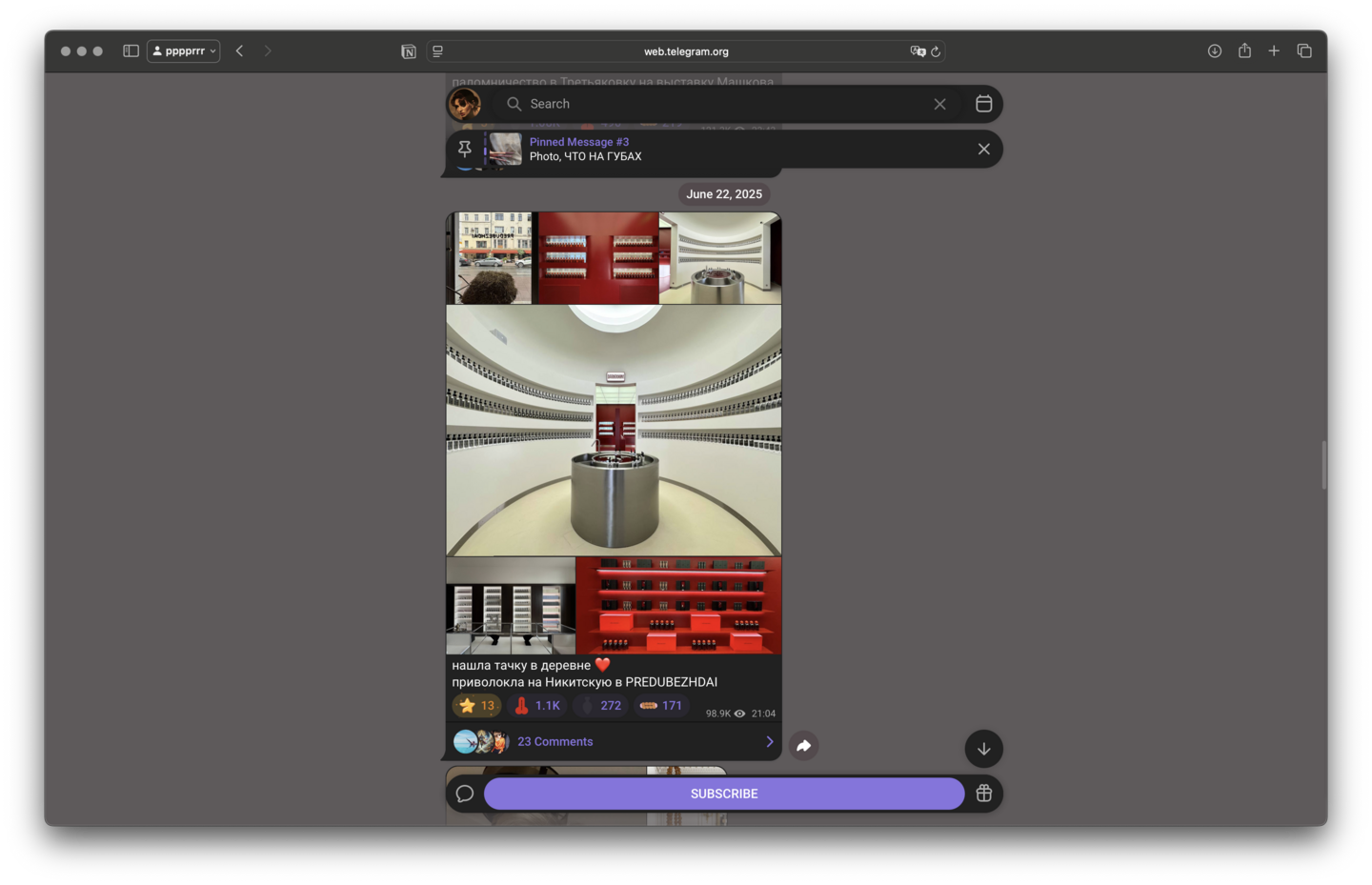
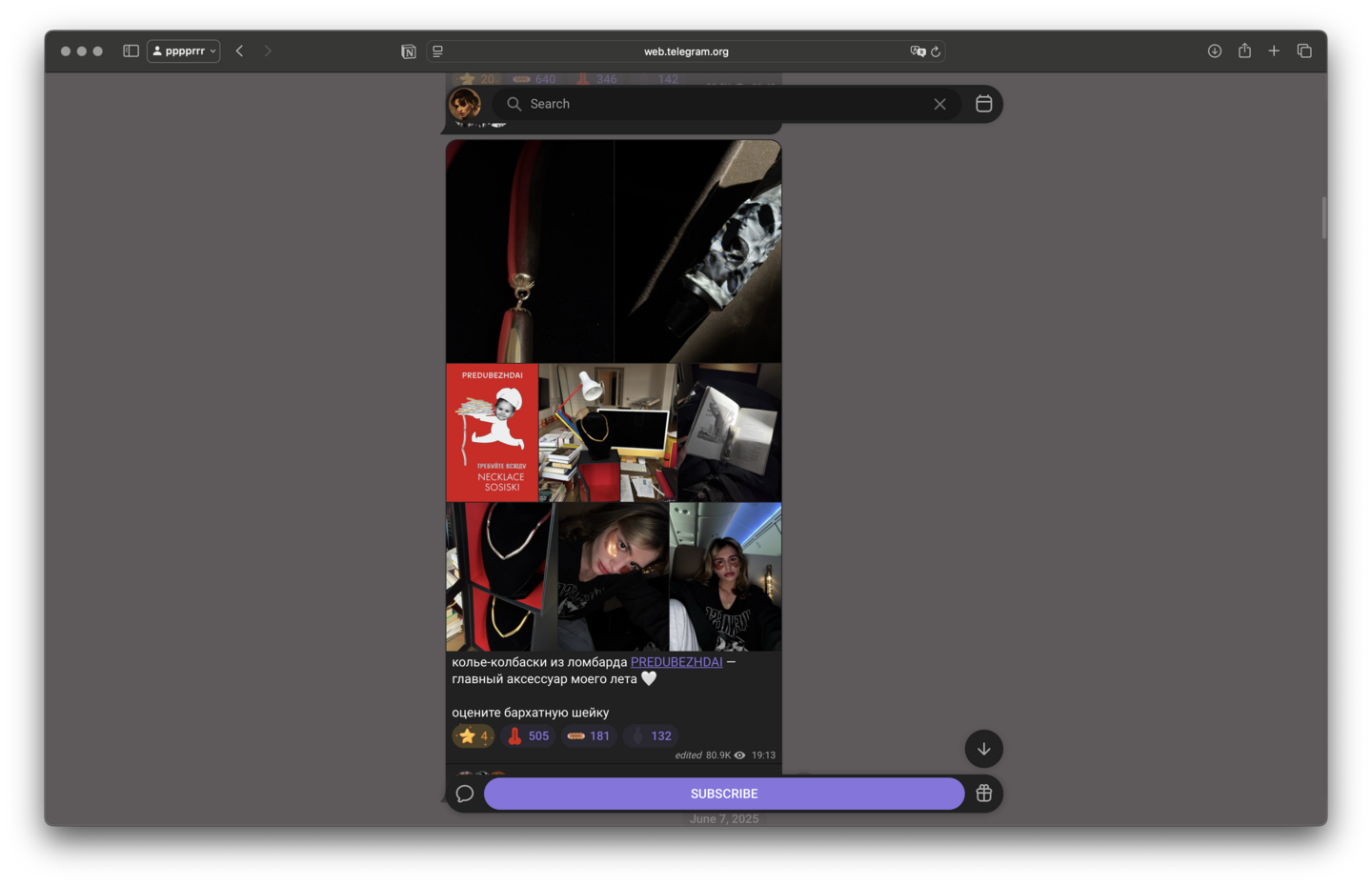
Telegram channel of the brand’s founder, Anastasia Mironova
What the channel map already tells us
Lay the channels side by side and the theory section is half-written. The brand builds spaces that look dialogic — open comments, DMs, an immersive Telegram, gamified promos — yet much of the actual flow is one-way broadcast (→ Dialogic Theory: a space for dialogue isn’t the same as dialogue). Every channel leans on encoded visual and cultural signs — Cyrillic, folklore, old photos, surreal nostalgia (→ Semiotics). The audience keeps showing up for affective and utilitarian gratifications — escapism and belonging on social, find-and-buy on the site. And persuasion runs mostly through peripheral cues on Instagram* and Telegram and through central, issue-relevant information on the website (→ ELM). In short: the architecture of conversation is everywhere; the conversation itself is the open question.*The activities of Meta and its affiliated social networks, Instagram and Facebook, have been deemed extremist and banned in Russia.
Theoretical Framework
Our lens: three theories
We read Predubezhdai through three communication theories, chosen because they don’t repeat each other — they interlock. Each one answers a different question about the same brand. Semiotic Theory asks what signs the brand uses and what they mean — it’s about the message itself. The Elaboration Likelihood Model asks how those signs actually persuade — it’s about the mechanism. And Dialogic Theory asks whether the brand is genuinely in conversation with its audience or simply broadcasting at it — it’s about the relationship. Put end to end, they take us from message to persuasion to relationship, which gives the whole analysis a single forward-moving narrative instead of three disconnected readings.
Semiotic Theory
The idea.
Communication runs on signs, and every sign carries meaning on two levels. There’s denotation — the flat, literal thing you’re looking at — and connotation — the cultural cloud of associations that thing drags behind it. When a connotation gets repeated until it feels natural and inevitable, it hardens into myth: a constructed meaning that starts passing itself off as common sense.In Predubezhdai.
The brand is unusually sign-dense. Cyrillic type, archaic words like goy esi, faded «old-album» photography, folkloric and Soviet/90s motifs, and a catalog organized as a map of life stages (DETSTVO through KATARSIS) all point the same way. Denotation: a perfume bottle. Connotation: your own childhood. Stacked together and repeated, these signs build a myth of nostalgia — the quiet suggestion that your truest self is one you’ve lost and can buy back — and it’s a myth that only fully decodes for a culturally-insider Russian audience.Dialogic Theory
The idea.
Social media hands brands all the tools for genuine two-way relationships — comments, replies, direct messages, communities. But owning the tools isn’t the same as using them. A channel can tick every technical box for dialogue and still operate as pure one-way broadcast: a beautifully built «space for dialogue» with no actual dialogue happening inside it.In Predubezhdai.
The brand constructs spaces that look deeply dialogic — open Instagram comments and DMs, an immersive serialized Telegram, gamified promo codes, return-driving drops. The open question, the one we test directly in the analysis, is whether the brand actually replies, listens, and takes relational risk — or whether it’s broadcasting a beautiful monologue that the audience is simply allowed to overhear. This is our most critical lens, and it’s the one that generates our recommendations.Analysis
A. Semiotic Theory — the brand as a system of signs
A1 — The collection map as a sign system
Look at what the catalog refuses to do. A normal shop sorts by product type — perfumes here, candles there, hair care in the back. Predubezhdai sorts by stage of life: childhood (DETSTVO), the beautiful far-away and first disappointments (PREKRASNOE DALYOKO), first love (VAM I NE SNILOS), self-awareness (SUSPIRIA), release (KATARSIS). Denotation: a navigation menu. Connotation: an autobiography you haven’t written yet but instantly recognize. This is the brand encoding meaning at the level of architecture, not decoration — before you’ve looked at a single product, the structure has already told you «this is a map of your inner life, not a shelf,» and browsing quietly becomes an act of remembering.A2 — Cyrillic & archaic language as cultural identity
Most luxury perfume hides behind French and Latin, because those languages connote a placeless, borderless elegance. Predubezhdai does the opposite on purpose. A name like ГОЙ ЕСИ is an archaic Slavic folk greeting out of a bylina; ТРАВА is just the plain, earthy word for «grass.» Denotation: two product names. Connotation: Russianness, folklore, soil, a past older than anyone alive. Per Hall, this sign is a locked door with a very specific key — an insider Russian audience opens it instantly, while an outsider hears only noise. That’s not a flaw, it’s the design: the brand trades global legibility for belonging, and the people who can read the sign feel chosen precisely because not everyone can.PREDUBEZHDAI, Soap advertising campaign, 2026


PREDUBEZHDAI, Visual code, 2026
A3 — Faded photography as the connotation of memory
Notice that the content of these images barely matters — a kitchen, a field, a doorway. What does the work is the treatment: washed-out color, grain, the slightly wrong framing no professional would compose. That treatment is a textbook Barthesian connotative device — independent of what the picture shows, the style itself signifies one word: «pastness.» One such image is just an aesthetic; a whole feed of them is an argument. Scrolling becomes a slow accumulation of «pastness» until nostalgia stops reading as a mood and starts reading as a fact about the world — which is exactly how myth works, making a constructed meaning feel natural and timeless.A4 — Materialized emotion in product copy
Here the brand stops hinting and says the quiet part out loud. The «ingredients» aren’t bergamot and cedar — they’re the extract of the warmth of a mother’s hands, a concentrate of the bitterness of a first love. In Barthes' terms this is the engine running in the open: an intangible signified (an emotion, a memory) handed a tangible signifier (a glass bottle you can own). The copy doesn’t describe the myth, it performs it — it makes the impossible claim that a feeling can be distilled, sealed, and shelved. It’s the single most quotable artifact in the whole brand, the moment the sign system admits what it’s doing.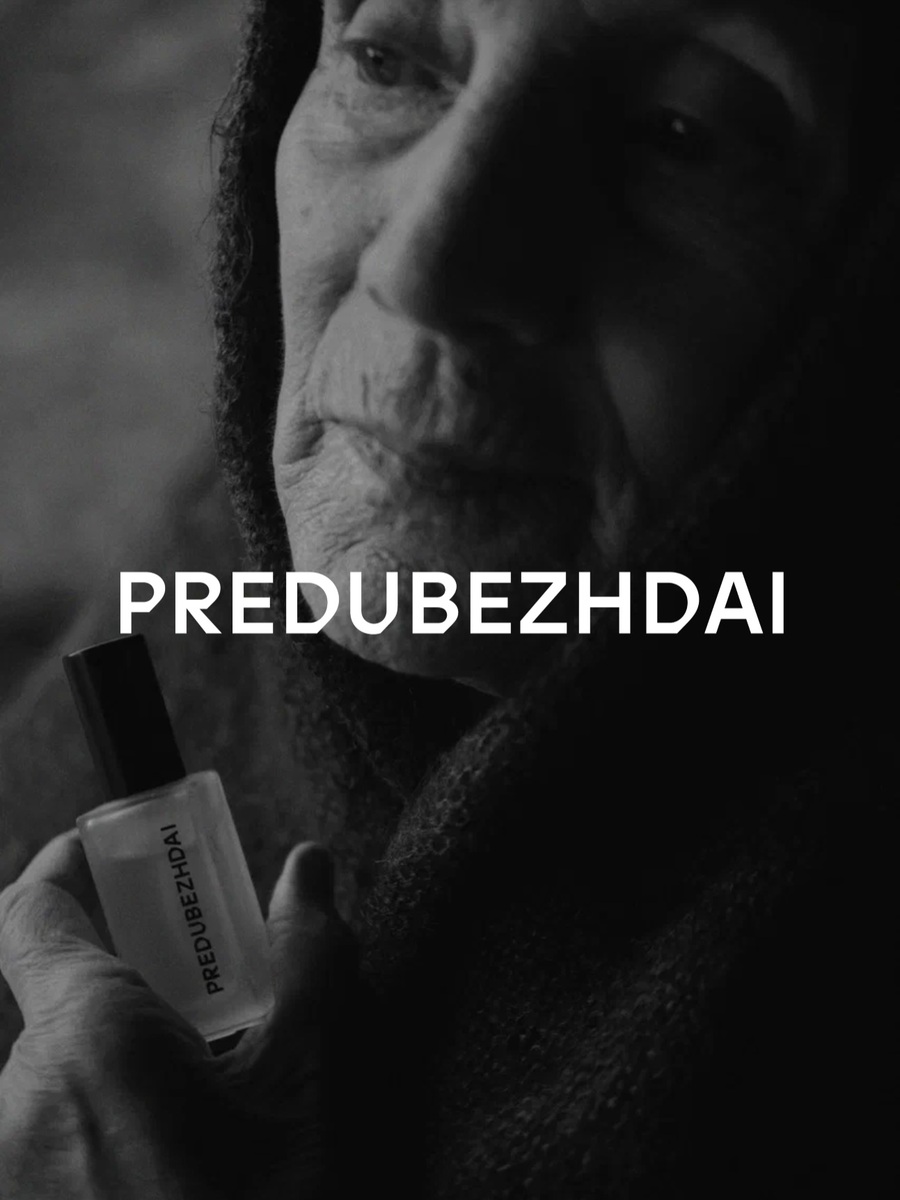

PREDUBEZHDAI, Perfume advertising campaign, 2026
PREDUBEZHDAI, Visual code
B. Elaboration Likelihood Model — how the signs persuade
B1 — Peripheral route: emotion & aesthetics
Try to find the argument in a typical post. There isn’t one — no longevity claims, no ingredient list, no «lasts 12 hours.» What persuades is pure atmosphere: beauty, melancholy, a held breath. ELM explains why that’s a fit rather than a weakness: when the buying context is low-deliberation and emotionally motivated, a spec sheet would only get in the way. People don’t reason their way into nostalgia, they fall into it — so the brand builds posts you catch rather than evaluate, and that is the peripheral route working exactly as designed.B2 — Peripheral route: source credibility
Before a single product is judged, a verdict has already been borrowed. Anastasia Mironova is a major blogger and IRNBY’s CEO, and that status is itself a peripheral cue — source credibility plus aspirational identity. Her followers don’t reason out whether the perfume is good; they transfer trust they already feel for her onto the brand. ELM calls this the classic peripheral shortcut: when you like and trust the messenger, you wave the message through without inspecting it. The founder’s reputation works as a pre-approval stamp the audience applies for free.B3 — Peripheral route: group identity
This is where Semiotics hands the baton to ELM. A post drops a reference only a certain generation of Russians will catch — a Soviet TV format, a 90s texture, an in-joke. Decoding it (Semiotics) produces a spark of recognition; ELM shows how that spark converts into a buying impulse through the cue of group identity. The logic runs fast and wordless: «I get this → this is made for people like me → I belong here → I want in.» Nobody weighed an argument — the persuasion happened in the warm flush of being on the inside.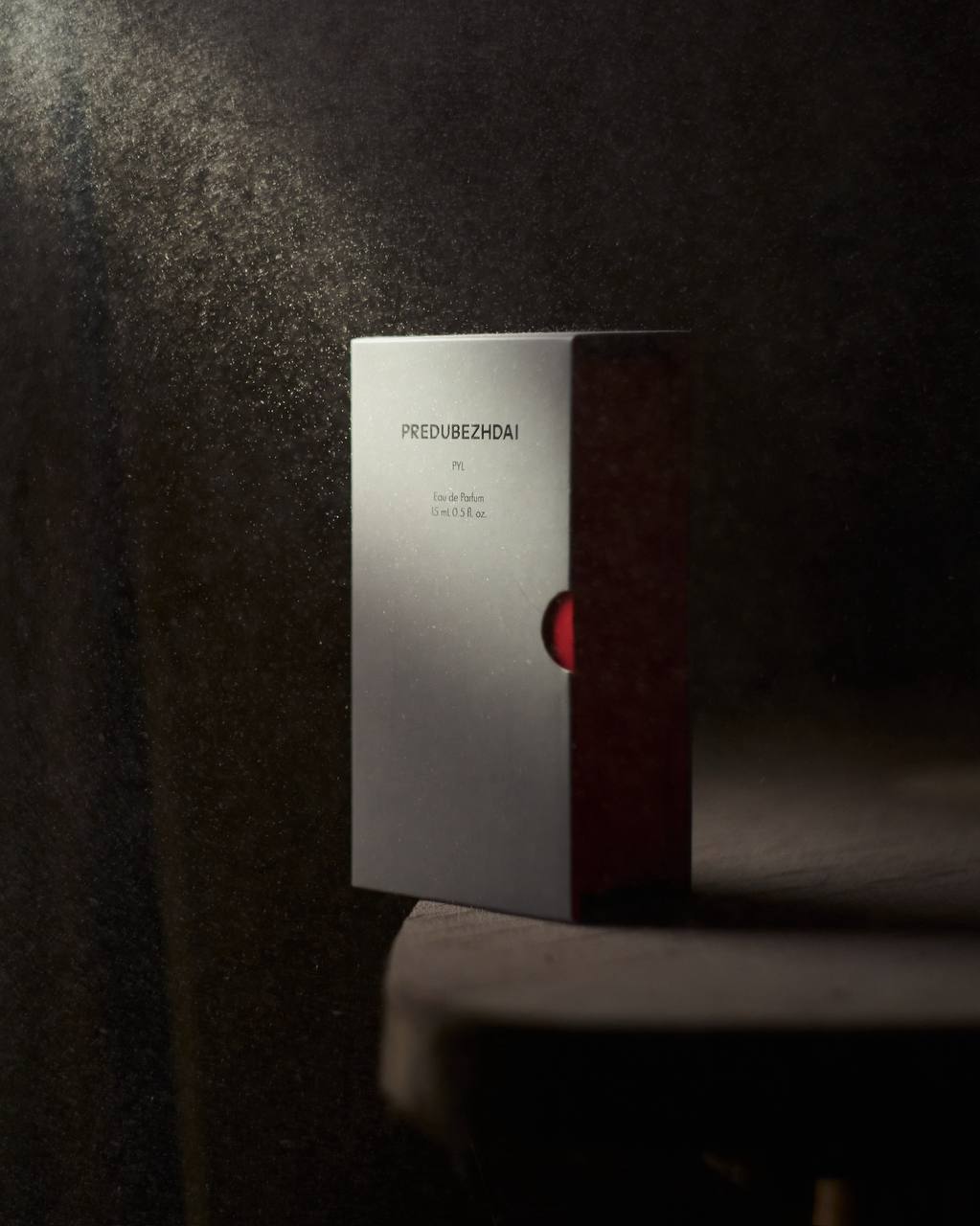


PREDUBEZHDAI, Perfume advertising, 2026


PREDUBEZHDAI, Face mask advertising, 2026
— Central route: the website
The central route isn’t missing — it’s been relocated. It lives on predubezhdai.ru, where a motivated buyer finally meets real information: what the product is, what it costs, how the collections are organized, how to check out. And this is the clever part: the brand splits the two routes by channel. Instagram and Telegram run the peripheral route to manufacture desire in a relaxed, scrolling, feeling-led state; the website switches to the central route to close the sale once the person has leaned in and is ready to think and act. Same brand, two cognitive modes, cleanly separated by where you are.PREDUBEZHDAI, Visual code
A. C. Dialogic Theory — relationship or broadcast?
C1 — The architecture of dialogue is present
On paper the brand looks like a model citizen of dialogic theory. The information is genuinely useful, the interface is intuitive, and drops, serialized Telegram posts, and wordplay promo codes like ВУАЛЯ (a pun that turns «voilà» into a discount on veils) generate return visits and conserve visitors with real craft. Every tool of dialogue is bolted on and gleaming. The strategies side of the scorecard is close to full marks — which is exactly why the next slide matters so much.C2 — The test: does the brand actually reply?
This is the hinge of the entire analysis. Lee’s whole point is that the tools are not the dialogue — a feedback loop is only real if the brand actually completes the circuit and answers. So we go to the comments and look for the brand’s own voice. If the threads are full of people speaking to a brand that never speaks back, then the dialogic feedback loop is broken, and everything that looked like conversation collapses into a beautiful monologue the audience is merely allowed to overhear.C3 — Empathy & propinquity vs risk & commitment
Score the brand against the five principles and a clear pattern falls out. On empathy and propinquity it’s excellent — the voice is warm, tender, disarmingly personal, closing the distance until the brand feels like it’s whispering to you specifically. But the harder principles, risk and commitment, ask for something else: a willingness to be changed by the public, to answer in real time, to sustain many genuine two-way relationships. That’s where the brand goes quiet. The honest reading: Predubezhdai offers intimacy as performance — a one-to-many feeling of closeness — rather than relational risk, the many-to-many work of actually being in it together. It feels personal without being interactive.
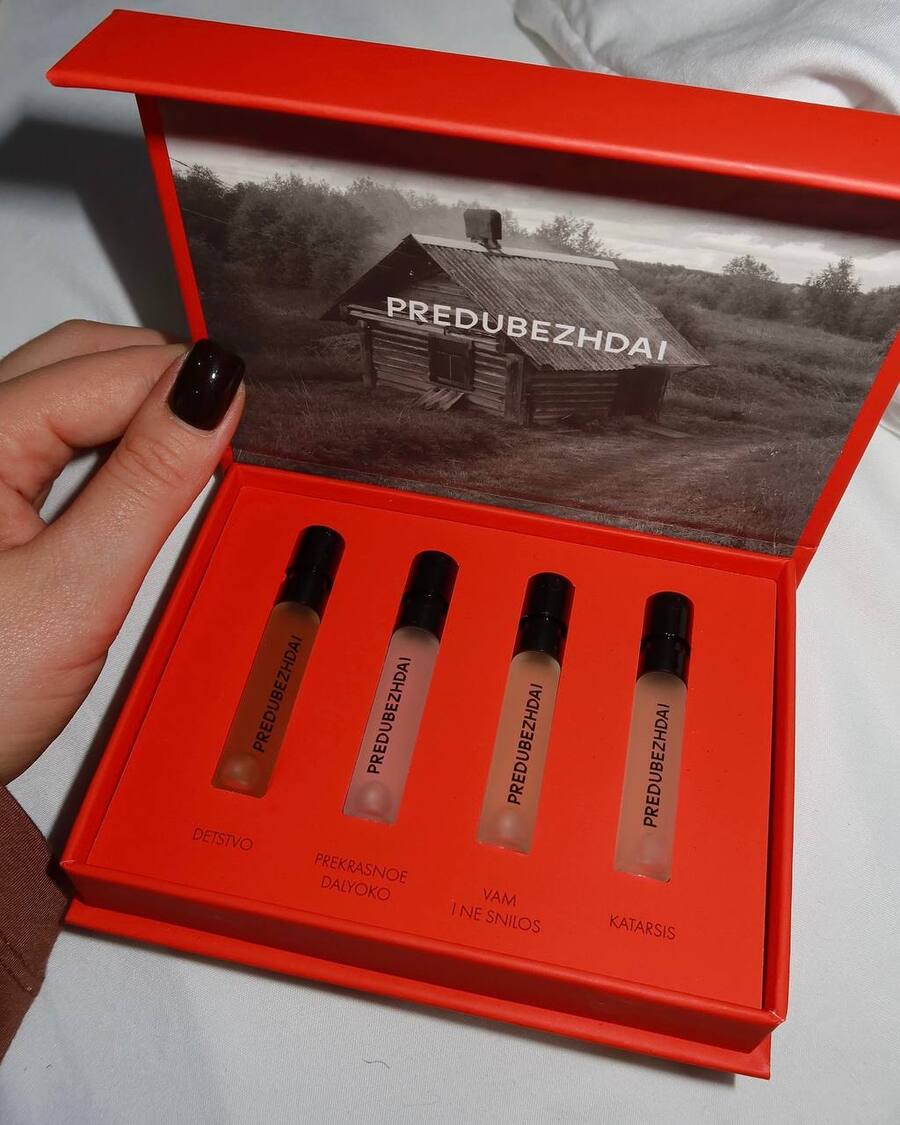
PREDUBEZHDAI, Product packaging
PREDUBEZHDAI, Brand profile on Instagram
D. Synthesis — one artifact, three lenses
Don’t keep the theories in separate boxes. Take a single nostalgic product post and run all three readings over it at once, and the project’s argument snaps into focus. Semiotics: the faded image and the Cyrillic name encode the myth of nostalgia — memory made physical, «pastness» you can purchase. ELM: the post persuades with no argument at all, riding the peripheral route on beauty, feeling, and belonging. Dialogic: the post opens a comment section — the architecture of conversation — but the moment the brand declines to reply, it reverts to broadcast. One post, three findings: message, mechanism, relationship. This is the strongest proof that the three theories aren’t a checklist but a single converging argument.Conclusions & Recommendations
PREDUBEZHDAI, Advertising campaign, 2025
Conclusions
A masterful encoder (Semiotics)
On the level of signs, Predubezhdai is close to flawless. It has built a dense, coherent system — Cyrillic and archaic language, faded «found» photography, folkloric motifs, a catalog organized as a map of life stages — that all points to one powerful myth of nostalgia: the idea that your truest self is one you’ve lost and can buy back. The brand encodes at the level of architecture, not just decoration — even the shape of the shop is a sign. This is its deepest competitive moat, and it should be protected, not diluted.A fluent persuader, with one weak spot (ELM)
The brand persuades overwhelmingly through the peripheral route — beauty, emotion, founder credibility, belonging — and does it with real skill, smartly relocating the central route (hard product information) to the website where a ready buyer can act. That split is clever. But peripheral-dominant persuasion is fragile in front of a high-involvement or skeptical buyer who wants reasons, not just a mood. Fine for an impulse purchase; for repeat or higher-price decisions, it leaves money on the table.A beautiful monologue (Dialogic)
This is the decisive finding. Predubezhdai builds every tool of dialogue — open comments, DMs, an immersive Telegram, gamified promos — and is excellent on the soft principles of empathy and propinquity. But it largely withholds the hard principles of risk and commitment: it broadcasts rather than converses, offering intimacy as performance (one-to-many) instead of relational risk (genuine two-way exchange). Tellingly, it’s most dialogic exactly where it’s least scalable — in its physical stores. Online, the room for dialogue is built, but the lights are mostly off.Recommendations
R1. Close the feedback loop (Dialogic)
The single highest-impact move: have the brand voice actually reply in comments and DMs — not copy-paste, but in the same literary register it already owns. Answering even a fraction of comments converts a broadcast into a relationship and finally activates the dialogic principles (mutuality, risk, commitment) the brand leaves on the table. The voice is already perfect for it; it just needs to point outward as well as inward.A fluent persuader, with one weak spot (ELM)
The brand persuades overwhelmingly through the peripheral route — beauty, emotion, founder credibility, belonging — and does it with real skill, smartly relocating the central route (hard product information) to the website where a ready buyer can act. That split is clever. But peripheral-dominant persuasion is fragile in front of a high-involvement or skeptical buyer who wants reasons, not just a mood. Fine for an impulse purchase; for repeat or higher-price decisions, it leaves money on the table.R2. Let the audience co-author the myth (Semiotics \+ Dialogic)
Right now the brand encodes the myth alone. Invite the audience in: memory submissions («tell us the smell of your childhood»), user photos in the faded house style, community voting on a next collection or product name. This deepens the semiotic world with real, owned memories and turns passive decoders into active co-authors — dialogue in its truest form. The nostalgia myth gets stronger the more hands help build it.R3. Add quiet central-route reinforcement (ELM)
Without breaking the mood, give the motivated, skeptical buyer something to think with: a short «how it’s made» story, a few words on craft, the founder explaining a collection. Tuck it into highlights, a site sub-page, or pinned posts — never intruding on the feeling-led feed, but there for anyone who leans in. This shores up the one structural weakness in the persuasion model and supports higher-consideration purchases.R4. Build a «decoder» doorway for near-insiders (Semiotics / Hall)
The brand’s locality is a strength, but it turns away people who are almost in on it. A light, on-brand onboarding — a pinned «start here,» a glossary-as-story explaining names like goy esi, a first-collection guide — lets near-insiders learn the cultural code instead of bouncing off it. This widens the audience without diluting the Russianness, because it teaches the key rather than changing the lock.R5. Bring the store’s warmth online (Dialogic)
The most genuinely two-way channel is physical retail — so treat it as the template. Live sessions, Q&As, founder drops, events, behind-the-counter moments can carry that embodied, reciprocal warmth onto Instagram and Telegram. The brand doesn’t need to invent a dialogic style; it needs to port the one it already has offline into its digital rooms.Predubezhdai has already built almost everything real dialogue needs — a rich and coherent world, a devoted audience that loves its voice, and channels people genuinely want to spend time in. The next step isn’t to change what works, but simply to turn the conversation on: to reply a little more, to listen a little closer, and to let the audience help tell the story it has so beautifully begun. The foundation is there; what’s ahead is an invitation.
Lee S. T. A user approach to dialogic theory in a Facebook campaign on love and marriage // Media, Culture & Society. 2014. Vol. 36, № 4. P. 437–455. DOI: 10.1177/0163443714523809.
Dias P. Motivations for multi-screening: An exploratory study on motivations and gratifications // European Journal of Communication. 2016. Vol. 31, № 6. P. 678–693. DOI: 10.1177/0267323116674111.
Allison T. H., Davis B. C., Webb J. W., Short J. C. Persuasion in crowdfunding: An elaboration likelihood model of crowdfunding performance // Journal of Business Venturing. 2017. Vol. 32, № 6. P. 707–725. DOI: 10.1016/j.jbusvent.2017.09.002.
Barthes R. Rhetoric of the Image // Barthes R. Image, Music, Text / transl. by S. Heath. New York: Hill and Wang, 1977. P. 32–51. (ключевая работа: разбор рекламного изображения, денотация/коннотация — прямо ложится на анализ визуальной айдентики бренда)
Barthes R. Mythologies / transl. by A. Lavers. New York: Hill and Wang, 1972. 159 p. (понятие мифа и коннотации — для анализа ностальгии как культурного мифа)
Hall S. Encoding/decoding // Culture, Media, Language / ed. by S. Hall, D. Hobson, A. Lowe, P. Willis. London: Hutchinson, 1980. P. 128–138. (дополнительно — связка «кодирование смыслов брендом → декодирование аудиторией»)
Predubezhdai: официальный сайт бренда [Электронный ресурс]. URL: https://predubezhdai.ru (дата обращения: 12.06.2026).
Predubezhdai: официальный канал в Telegram [Электронный ресурс]. URL: https://t.me/predubezhdaikino(дата обращения: 12.06.2026).
Predubezhdai: официальный аккаунт в Instagram [Электронный ресурс]. URL: https://www.instagram.com/predubezhdai (дата обращения: 12.06.2026).
PREDUBEZHDAI: Как превратить чувства в материальное [Электронный ресурс] // Designers from Russia. URL: https://designersfromrussia.ru/predubezhdai-kak-prevratit-chuvstva-v-materialnoe (дата обращения: 13.06.2026).
Анастасия Миронова, основательница бренда Predubezhdai [Электронный ресурс] // РБК Стиль. URL: https://style.rbc.ru/beauty_and_health/68010c909a79471d3e1fb56c (дата обращения: 13.06.2026).