Contents
- How communication theory works in design and contemporary art
- ABC. Library of meta universes and digital avatars
- ABC brand presentation for a broad audience
- ABC brand presentation for a professional audience
- How we developed the strategy with the help of the course
- Sources
1. How communication theory works in design and contemporary art
One of the most influential communication theories in the field of design and contemporary art is Marshall McLuhan’s media theory, expressed in the concept «the medium is the message.» According to this theory, the primary impact of communication lies not in the content itself, but in the form and medium through which the message is transmitted.
In the context of design, this means that visual language, interface, material, technology, and modes of interaction are not neutral carriers of meaning. Instead, they actively shape how information is perceived and interpreted. Design therefore becomes a communicative act rather than a purely aesthetic or functional solution.
In contemporary art, McLuhan’s theory is especially evident in immersive and interactive practices such as installations, virtual reality, and digital environments. These forms do not rely on linear narration; instead, they communicate through experience and presence. The viewer is no longer a passive recipient of meaning but an active participant in the communicative process, engaging emotionally, cognitively, and physically with the artwork.
The use of VR technologies in art and design fundamentally changes the structure of communication:
- the distance between the artwork and the viewer is eliminated;
- meaning is perceived as an experience rather than as text or image;
- interpretation emerges through interaction, not solely through authorial intention.
From McLuhan’s perspective, contemporary design and art function as communication systems, where the medium, technology, and form determine not only how a message is delivered, but what the message ultimately becomes. In the digital era, where visual and spatial communication dominate, meaning is increasingly constructed through interaction and immersion rather than through verbal explanation.
Thus, communication theory helps explain why modern design and art prioritize experience, environment, and participation: it is not only what is communicated that matters, but how, through which medium, and with what level of engagement the message reaches the audience.
2. ABC. Library of Meta Universes and Digital Avatars
The universe of a literary work is often much larger than what exists within the book itself. At the ABC Library, visitors can explore the world described in a book through VR headsets, where the surrounding visual environment expands and complements the written text. In addition, the library offers the opportunity to interact with a digital avatar of each book’s author, allowing visitors to discuss the work, the details of its creation, or the author’s creative journey.
ABC is a library of multiple literary universes and digital avatars of writers. Through VR technology, a person can fully immerse themselves in the world of a literary work and even become part of it. The library has an English name formed from the first three letters of the alphabet, reflecting the idea that everyone first learns the alphabet before they begin to read.
3. ABC brand presentation for a broad audience
ABC. Library of meta universe and digital avatars
ABC is a brand about returning to the essence of a story and a new type of presence.
In a world saturated with fast content and superficial scrolling, we offer a moment to stop and immerse. Our project is not about reading speed, but about depth of experience. ABC transforms engaging with literature from an act of information consumption into a simple yet powerful ritual that returns you to a sense of wonder and personal connection with the world of the narrative. We believe that reading is not just about the plot, but about personal experience and sensation. Using ABC is a way to pause, tune out the external noise, and feel like an explorer again. The spaces, sounds, and dialogues are designed to remind you of the spirit of discovery, the silence of libraries, the scale of universes, and the authenticity of human thought—things that feel real and timeless. We do not promise you simply to «read a book faster.» Instead, we offer presence, personal discovery, and a sense of belonging.ABC’s target audience consists of people who value depth, curiosity, and conscious leisure.
They are interested in culture, storytelling, and rich inner experience, not quick entertainment or aggressive gamified content. This audience seeks formats that feel authentic, intellectually honest, and emotionally resonant. They are drawn to brands that support slow immersion, dialogue with cultural heritage, and a sense of intellectual and emotional resonance. ABC speaks to those who see reading not only as a function of text assimilation but as a personal, transformative journey.ABC sells an experience of connection with a story’s universe.
Even in the familiar act of reading, the brand brings a feeling of being inside the narrative, of touching something vast and true. There is no pressure, rush, or loud claims. Everything is designed to feel natural, captivating, and inspiring.Promt: A person wearing VR glasses in a dark space, surrounded by glowing fragments of text or abstract worlds Ai: Recraft.



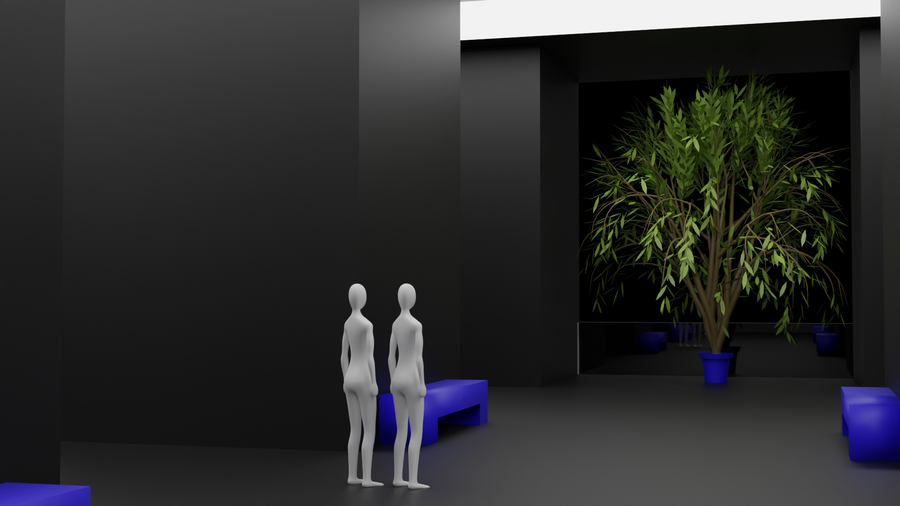

Library space of the future (conceptual)
The brand is built around the idea that communication is not about telling the story, but about creating a space that can be felt and lived.
Promt: A man wearing VR glasses «inside» a magical world. Ai: Recraft
This is why ABC focuses on atmosphere, immersion, and discovery, rather than loud slogans or plot summaries. By staying consistent in how it looks and feels, ABC becomes a space of trust over time. It is not about convincing you of the importance of the classics, but about being a portal—quiet, steadfast, and natural. ABC is a reminder that encountering a story can be profound, and that the feeling of personal discovery is a goal in itself. The way the brand communicates is based on the understanding that people create meaning themselves through experience. The visual imagery, sound design, architecture of virtual spaces, and overall atmosphere are designed to help you feel connected to the world of the work and your own perception, not to convince you with textual arguments. You are free to interpret this experience in your own way. The brand’s virtual spaces—libraries, story worlds—are addressed primarily to the general audience, as they operate on an experiential, not analytical, level. These spaces translate the brand’s values into a tangible experience through immersive design, narrative architecture, poetics of form, and minimal instructional interference. Materials (even digital ones), spatial rhythm, and atmosphere are used to create a sense of awe, focus, and «here and now» presence within the story.
ABC is not only about access to books, but about a shared way of feeling and knowing.
We create a brand that brings people together around depth, curiosity, and connection to the worlds of human imagination. Through ABC, we envision a community where engagement with literature extends beyond individual reading and becomes a shared experience. This can take the form of VR book clubs, collaborative research sessions into an author’s universe, literary quests, or moments of collective contemplation of digital installations based on works.
• For readers • For students • For creators • For curious minds
Image posters in the environment
By participating in this, people don’t just «use the technology"—they become part of a community that values depth, shared discovery, and care for the intellectual and emotional landscape. ABC offers a space where you can reconnect with culture, with others, and with your own inner world—at your own pace.
Image posters in the environment
4. ABC brand presentation for a professional audience
Target audience:
designers, curators, publishers, VR/XR specialists, cultural institutions, investorsGoal:
demonstrate conceptual depth, communication logic, and systemic design thinkingPrinciple:
clarity, structure, rationaleAdvertising posters in the environment
Communication Approach and Epistemological Position
ABC is constructed within a phenomenological and experiential paradigm of communication. The brand does not aim to transmit information about literature in a linear, didactic manner. Instead, its goal is to facilitate the emergence of a unique, personal experience for each user. The meaning of «reading» is not predefined by the brand but is co-created through the user’s immersive interaction with the literary universe. ABC shifts the focus from the passive consumption of a text to the active participation in a constructed reality.We prioritize: · experience over explanation · immersion over information · personal meaning-making over a fixed interpretation
ABC adopts this logic by designing communication not as a one-way transmission, but as an immersive dialogue between the user and the literary space. The user is not a receiver but a co-author of their own narrative experience.
Shopper with a signature style
Semiotic Tradition (Primary)
From a semiotic perspective, ABC operates as a complex, multi-layered system of signs rather than a simple storytelling platform. · The VR environment functions as a signifier of a new ontological status for literature—from a text to a navigable space. · The AI avatar of the author acts as a sign that blurs the boundaries between the historical creator, the textual narrator, and the interactive interlocutor. It is a sign of accessibility and dialogue with cultural heritage. · Visual and auditory cues within the experience (light, sound, spatial design) are not merely decorative; they are iconic signs that build the atmosphere and indexical signs that guide emotional response. · Deliberate ambiguity in environmental storytelling (unexplored corners of a virtual library, subtle references) prevents a single denotation and encourages personal connotation and exploration.
Meaning is not embedded in the code of the application; it emerges during the user’s semiotic interaction with this constructed system of signs. This aligns with the core semiotic assumption that communication is the process of generating meaning through interaction with sign systems.
Branded business card
Socio-Cultural Tradition (Structural)
ABC intervenes in the social practice of reading and cultural consumption.
By transferring the act of reading from a private, individual interaction with a physical book to a shareable, immersive digital experience, the brand participates in the reproduction and transformation of cultural norms. It reframes literature from a solitary, introspective practice to a potential social and sensory phenomenon.
Here, communication is understood as: · A producer of new cultural rituals (e.g., «visiting» a book in VR, «conversing» with an author). · A tool for the re-legitimization of classical literature in the digital age. · A mechanism for cultural reframing, shifting the perception of reading from an educational duty to an engaging, cutting-edge leisure activity.
The brand thus functions as a cultural interface and mediator, facilitating a new form of engagement with canonical texts rather than merely repackaging them.
A tag that can also be used as a bookmark.