Concept
«Everything Everywhere All at Once» is an American science fiction comedy-action drama about the struggles of a Chinese immigrant family. Evelyn Wang, the mother and wife, runs her business—a laundry—and visits the tax office to deal with financial problems. Suddenly, her husband arrives, but he is from a PARALLEL UNIVERSE, an «Alphaverse,» bringing news that the multiverse is in danger and only Evelyn can save it. She must fight Jobu Tupaki—the being who lives all dimensions at the same time, having lost all sense of meaning in life. Jobu Tupaki is also Evelyn’s daughter from another universe, and now she is searching for the Evelyn who could understand her. Despite the absurd plot, «Everything Everywhere All at Once» delivers a fascinating, poignant story about expectations, the meaning of life, nihilism, and kindness.

Comparing the screenplay to the film, I noticed numerous parallels running through the entire narrative. The plot is so saturated with absurdity that the writers manage to weave together such disparate concepts in their chaos—like bagels and washing machines—which keeps me engrossed in studying the screen with every rewatch. In essence, where else would one be able to endlessly examine and compare minor details in the plot of everything, everywhere, and always?
Essentially, the script establishes the main parallels and hints at future events in the plot, and the film—with its actors, production design, and sound engineering—adds even more details that perfectly complement and unify the narrative.
In this study, I will examine how the two central ideologies of the narrative—nihilism and optimism—are presented through «insignificant» details—the foundations upon which these worldviews rest. Some details were added by the production designers, some remained in the script, some connect entirely different plotlines, and some only become fully clear when viewing the film alongside reading the script.
Washing Machines and Doughnuts
One of the core elements of the iconography are circles—cookies, washing machines, bagels, and googly eyes. These listed round elements hold opposing meanings: some represent the burdens on our souls, while others embody inspiring joys, thereby reflecting the duality of life.
The most prominent circular element is undoubtedly the bagel, the «everything bagel» created by Joob Tapaki, as a sole means of finding solace and ceasing to feel the pain of life’s meaninglessness—it becomes the primary symbol of nihilism. We are alluded to this at the very beginning of the film through another similar element—a washing machine drum.
Joy «hypnotizes» herself with the washing machine drum, sinking into its black hole. This scene repeats in flashbacks of Evelyn’s journey, connecting mother and daughter, showing how they go through the same experience, foreshadowing Evelyn’s role in the «main» universe as the one who will understand Alpha Joy.
Overall, Evelyn’s workplace—the laundry—is her trap. Thus, the circle reinforces itself as a symbol of apathy, loss, and the desire for something «better, ” another life.
This parallel is underscored by a small, amusing detail involving a bagel that isn’t in the script (though bagels are specifically mentioned when describing the scene, so this isn’t coincidental). After her first jump to another universe (where she was a major superstar), Evelyn asks Alpha Waymond about the possibility of staying in another universe permanently. He vehemently rejects her idea in response, stating that remaining in other dimensions is dangerous and generally goes against the laws of the universe, and she, looking glum, tosses the bagel.
Karaoke
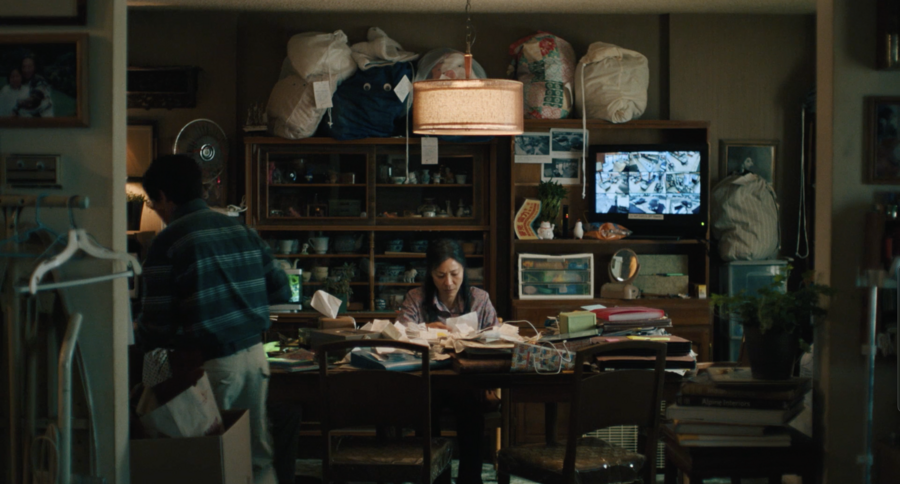
Another recurring detail throughout the plot is the karaoke machine. The opening scene—the very first thing we see—shows the main characters—Evelyn, her husband Raymond, and their daughter Joy—singing together karaoke. Suddenly, the scene shifts—the happy family gives way to a table covered with the taxes Evelyn is dealing with. The script clearly features the song they are singing along to: «Barbie Girl» by Aqua. It is a simple children’s song, created purely for entertainment.
The family moment abruptly ends, and we see a table littered with receipts and papers—Evelyn is preparing for a visit to the tax office. This marks the first intersection of karaoke and taxes—one of the many strange semantic combinations in this film.