Early Christian Catacombs (3rd–4th Centuries)
An Image Against Prohibition?
Problematic Question: How did early Christians, strictly adhering to the commandment «You shall not make for yourself an idol or any likeness,» justify the act of creation? Are these frescoes «images» in the conventional sense, or something else?
The hypothesis I will test is this: Frescoes in the catacombs are not «images, ” but „symbols“ in a specific, symbolic sense. The prohibition against the second commandment applied to „idols“ (objects of worship), not to symbolic representations as such. Furthermore, the catacomb painting itself developed under the conditions of this prohibition, transforming it into a distinct visual language where the image does not claim to be a deity, but merely points to one.
Rationale for the selected topic:
First, the catacomb paintings from the 3rd–4th centuries represent a fascinating transitional period—a time when old classical traditions were fading, and new Christian art was just beginning to emerge. I am interested in studying this very turning point: how familiar classical imagery gradually shifted and transformed into medieval symbols. Second, this topic sits at the intersection of several disciplines—art history, theology, philosophy, and cultural studies. This means one can do more than just describe the drawings; one can investigate the meaning the people of that time imbued in them and how that relates to their faith. This kind of holistic perspective is not often found in contemporary work, which is why I want to try integrating these approaches. Third, this topic is both convenient and engaging to work with because many of the frescoes have been preserved. I won’t have to rely solely on dry texts; there are real images here that I can examine, compare, and analyze for myself.
Principle for selecting material for the chosen topic:
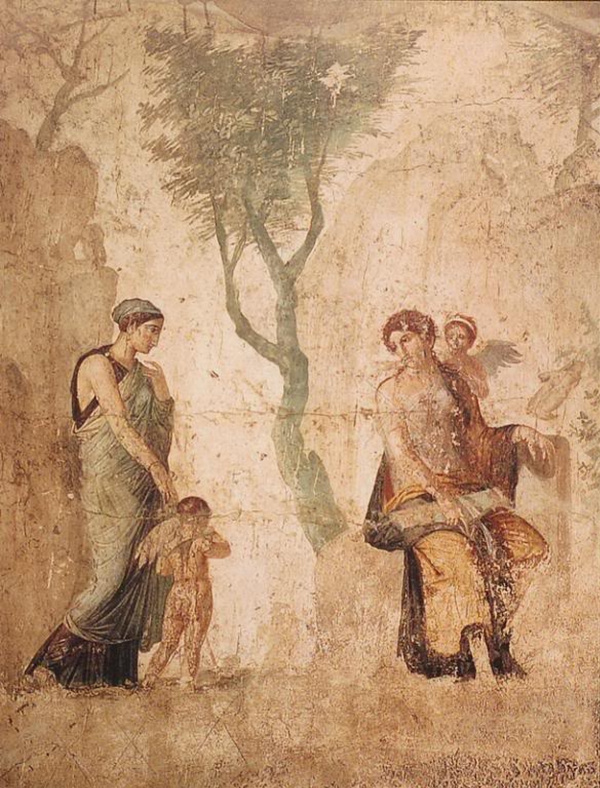
It is simply impossible to cover all of Rome’s catacombs in a single term paper, so I decided to limit the scope of my sources. I selected monuments based on two main criteria: they must date to the 3rd–4th centuries (a period when Christianity was already spreading but had not yet become the official state religion) and they must contain the themes and imagery most relevant to my topic. As a result, the paper will thoroughly analyze three complexes: — Priscilla Catacombs—here, the «Greek Chapel» (roughly mid-3rd century) with biblical scenes is of interest. It clearly illustrates how familiar classical images, such as the seasons or the phoenix, were infused with new Christian meaning. — Callixtus Catacombs—here, I will examine the crypt of Luke and the adjacent chambers, where early depictions of the Good Shepherd, praying figures (orants), scenes of Baptism, and symbols of the Eucharist, such as fish and bread, have been preserved. — Domitilla Catacombs—these will be useful for comparing how the same subjects could be depicted differently. Additionally, for contrast, I want to incorporate the frescoes of Pompeii (1st century). It is clear they have no connection to Christianity, but they excellently display classical ancient painting, which aimed to realistically copy reality. Against their backdrop, it will be much clearer to see how significantly the artists' approach to representing the world changed in the early Christian era.
The structure of the term paper is designed to move sequentially: from a general historical context to the frescoes themselves, and finally, to a deep interpretation of them. Therefore, the paper consists of three chapters, each with a specific objective.
Chapter 1—Historical and Theological Context. First, we must examine how early Christians felt about imagery in general. I will review the Old Testament prohibition against creating images, explore how early Christian authors (Tertullian, Clement of Alexandria, Origen) interpreted it, and determine how the doctrine of the Incarnation helped justify the emergence of painting. Without this background, it is impossible to understand why the artists of the catacombs painted in the manner they did. Chapter 2—Analysis of the Frescoes The practical part of this study moves directly to the monuments: I will describe their style, subject matter, and hidden symbols. To make the changes more apparent, I will compare the catacomb paintings with the ancient frescoes of Pompeii—this will clearly illustrate how the very approach to representation changed. Chapter 3—Theoretical Reflection In the final chapter, I aim to explain why this art is structured in this particular way, drawing upon the work of contemporary scholars. For instance, the ideas of Jonas Elsner will help us understand how these paintings served to unify the Christian community. Susan Buck-Morse’s approach will demonstrate that catacomb painting is not merely «clumsy» drawing, but a conscious reinterpretation of antique traditions. Furthermore, distinguishing between the concepts of «image» and «icon» will help draw conclusions and answer the central question of this work.
This division into chapters is very helpful: it prevents everything from becoming a jumble and clearly separates historical background, artwork descriptions, and theoretical conclusions.
All the materials I work with can be divided into two main groups: visual and textual. Visual sources are the catacomb frescoes themselves. I try to view them not merely as ancient drawings, but as a kind of «text» that needs to be deciphered. To do this, I pay attention to composition, the gestures of the figures, proportions, color, and how the forms are arranged in space. The main question I pose to every image is: is the artist attempting to realistically replicate the real world (as was done in Pompeii), or does the drawing function as a conventional sign pointing to some hidden spiritual meaning?
I divided the textual sources into two parts:
- Primary (Ancient Texts): This includes the Old Testament prohibition against making images from the Book of Exodus (20:4-5), as well as the works of early Christian thinkers like Tertullian, Clement of Alexandria, and Origen. I study them not as dry rules, but as living arguments within a debate—it is important for me to understand exactly how early Christians reasoned about whether it was permissible to create sacred images at all.
- Secondary (contemporary research): these are studies from our time—for example, S. N. Tyurina’s article «Between Image and Icon, ” the research by Jonas Elsner and Susan Buck-Moss, and the specialized reference guide from Routledge. I rely on them not for ready-made answers, but as useful tools. For instance, Tyurina’s article helps clarify existing methods of study; Elsner’s ideas allow one to understand how the believing viewer perceived frescoes; and Buck-Moss’s approach explains how ancient narratives were „translated“ into the language of Christianity.
My core principle when working with this entire collection isn’t simply to retell others' thoughts, but to apply the ideas of contemporary scholars to specific frescoes from the catacombs of Priscilla and Callixtus. My own, albeit modest, research contribution lies in trying to illustrate with living examples how the image of the phoenix or the seasons was reinterpreted in the «Greek Cappella.»
wikipedia